

Background
FREY, Bruno S. was born in 1941 in Basel, Switzerland.
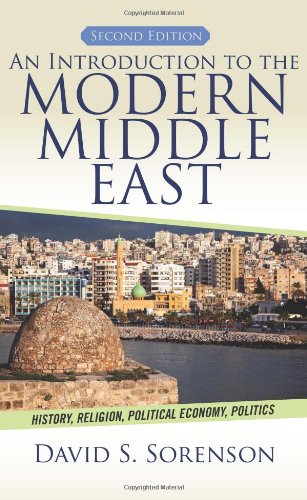
( Combining elements of comparative politics with a count...)
Combining elements of comparative politics with a country-by-country analysis, author David S. Sorenson provides a complete and accessible introduction to the modern Middle East. With an emphasis on the politics of the region, the text also dedicates chapters specifically to the history, religions, and economies of countries in the Persian (Arabian) Gulf, the Eastern Mediterranean, and North Africa. In each country chapter, a brief political history is followed by discussions of democratization, religious politics, women's issues, civil society, economic development, privatization, and foreign relations. In this updated and revised second edition, An Introduction to the Modern Middle East includes new material on the Arab Spring, the changes in Turkish politics, the Iranian nuclear issues, and the latest efforts to resolve the Israeli-Palestinian dilemma. Introductory chapters provide an important thematic overview for each of the book's individual country chapters and short vignettes throughout the book offer readers a chance for personal reflection.
http://www.amazon.com/gp/product/0813349222/?tag=2022091-20

( Combining essential themes in the discipline of compara...)
Combining essential themes in the discipline of comparative politics with a country-by-country analysis, author David S. Sorenson provides a complete and accessible introduction to the modern Middle East. While emphasizing politics, the text dedicates separate chapters specifically to the history, religions, and political economy of the region. These introductory chapters together constitute an important thematic overview and orientation for each of the book’s individual country chapters, including countries of the Persian (Arabian) Gulf, the Eastern Mediterranean, and North Africa. In each country chapter, a brief political history is followed by discussions of democratization, religious politics, women’s issues, civil society, economic development, privatization, and foreign relations. Throughout the book, Images”-short vignettes based on the author’s personal observations during his extensive travels in the Middle East-offer readers a chance for personal reflection on the topics discussed in each chapter.
http://www.amazon.com/gp/product/0813343992/?tag=2022091-20

(In Search of Stability: Explorations in Historical Politi...)
In Search of Stability: Explorations in Historical Political Economy ponders the issue of how Western industrial societies overcame major challenges to political and economic stability in the twentieth century. Successive essays ask: what ideological messages did American influence transmit to Europe after World War I, then again after World War II? Did Nazis and Italian fascists share an economic ideology or impose a unique economic system in the interwar period and during World War II? How do their accomplishments stack up comparatively against those of the liberal democracies? After 1945, what was the relationship between concepts of productivity and class division? How have the major experiences of twentieth-century inflation arisen out of class and interest-group rivalry? Most generally, what has been the representation of interests in capitalist political economies?
http://www.amazon.com/gp/product/0521346983/?tag=2022091-20
FREY, Bruno S. was born in 1941 in Basel, Switzerland.
Ricentiatus Rer. Policy Dr Rer. Policy, Habilitation University Basel, 1964, 1965,1969.
Visiting Lector, Wharton School, University Pennsylvania, 1967-1968. Association Professor, University Basel, 1969-1970. Professor, University Konstanz, W. Germany, 1970-1977.
Visiting Professor, University Stockholm, 1982. Visiting Fellow, Institute, Institution International Economics Studies, Stockholm 1982. Guest Professor, Institute, Institution Advanced Studies, Vienna, 1983.
Visiting Fellow, All Souls College Oxford, 1983. Professor of Economics, University Zürich, Zürich, Switzerland, since 1977. Managing Editor, Kyklos,
1979-.
(In Search of Stability: Explorations in Historical Politi...)
( Combining essential themes in the discipline of compara...)
( Combining elements of comparative politics with a count...)
Early work was in the then fashionable fields of economic growth and income distribution. Since the late 1960s I have increasingly become interested in the application of the economic approach to new fields, among them environmental economics. My main research area has been modern political economy (public choice).
I have constructed theoretical models of the interactions of the economy and politics (politico-economic models, sometimes called political business-cycle models), and have econometrically tested them for various representative (United States, United Kingdom, Germany) and direct (Switzerland) democracies. In addition to voters, government and public bureaucracy, the Central Bank’s behaviour has also been taken into account. The research has now shifted to integrating and measuring the shadow (or hidden) economy.
To the study of the (far-reaching) consequences of public choice for the theory of economic policy. And to the
application of public choice to international problems (international political economics). Among the other ‘non-market’ areas, I have contributed to the economics of the arts.
While I am convinced that the economic model of behaviour is superior to most others, I endeavour to improve its performance (in collaboration with psychologists and sociologists) by taking new aspects of human behaviour into account.
