

Background
Degler, Carl Neumann was born on February 6, 1921 in Orange, New Jersey, United States. Son of Casper and Jewell (Neumann) Degler.
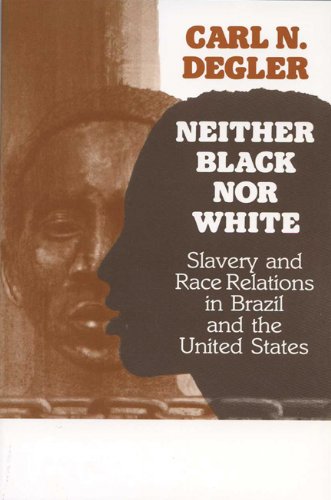
( Carl Degler’s 1971 Pulitzer-Prize-winning study of comp...)
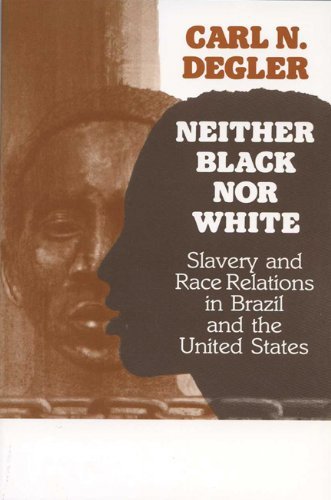
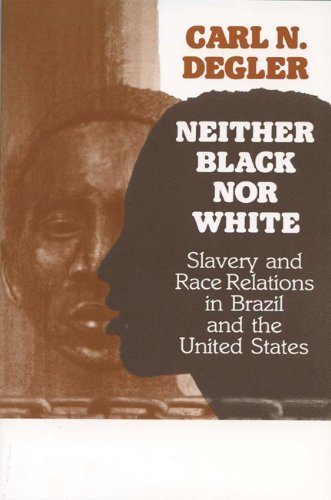
Carl Degler’s 1971 Pulitzer-Prize-winning study of comparative slavery in Brazil and the United States is reissued in the Wisconsin paperback edition, making it accessible for all students of American and Latin American history and sociology. Until Degler’s groundbreaking work, scholars were puzzled by the differing courses of slavery and race relations in the two countries. Brazil never developed a system of rigid segregation, such as appeared in the United States, and blacks in Brazil were able to gain economically and retain far more of their African culture. Rejecting the theory of Giberto Freyre and Frank Tannenbaum—that Brazilian slavery was more humane—Degler instead points to a combination of demographic, economic, and cultural factors as the real reason for the differences. “In the early 1970s when studies in social history were beginning to blossom on the North American scene, Carl Degler’s prize-winning contribution was a thoughtful provocative essay in comparative history. Its thoughtfulness has not diminished with the years. Indeed, it is as topical today as when it was first published. The Brazilian experience with rapid industrialization and its attempt to restore democratic government indicates that the issues which Degler treated in the early 1970s are more pertinent than ever today.”—Franklin W. Knight, Department of History, Johns Hopkins University.
http://www.amazon.com/gp/product/0299109143/?tag=2022091-20
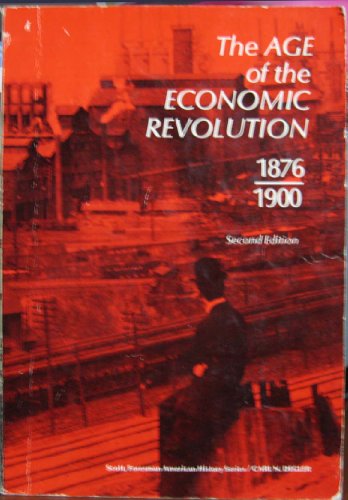
(The age of the economic revolution.)
The age of the economic revolution.
http://www.amazon.com/gp/product/0673079678/?tag=2022091-20

http://www.amazon.com/gp/product/B001MT9MXY/?tag=2022091-20

(This book deals with the closing decades of the nineteent...)
This book deals with the closing decades of the nineteenth century 1876 - 1900. Emphasis throughout is on explanation of the past. The why not just the what.
http://www.amazon.com/gp/product/B000L38076/?tag=2022091-20

http://www.amazon.com/gp/product/B002GFG3BW/?tag=2022091-20

http://www.amazon.com/gp/product/B0098XR6ZW/?tag=2022091-20
http://www.amazon.com/gp/product/B010WEXJLU/?tag=2022091-20
http://www.amazon.com/gp/product/B00Y2QUVUM/?tag=2022091-20
http://www.amazon.com/gp/product/B010EUBYC8/?tag=2022091-20
http://www.amazon.com/gp/product/B011SIVUBA/?tag=2022091-20
http://www.amazon.com/gp/product/B010EUEVG4/?tag=2022091-20
( "This product of meticulous attention to historical det...)
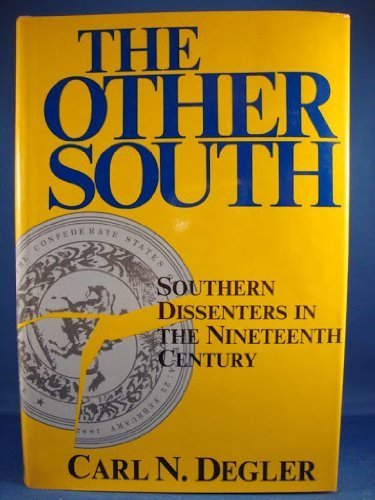
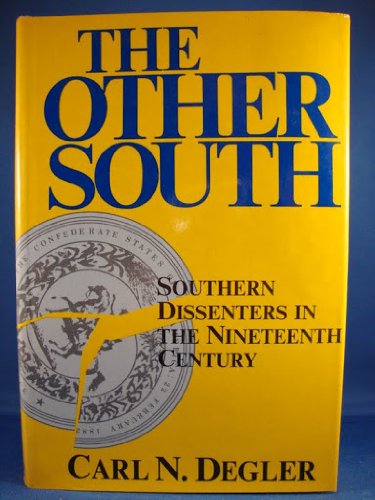
"This product of meticulous attention to historical detail plus a grasp of American history that enables the author to discern patterns from a mass of information . . . should permanently destroy the notion of the South as a 19th-century monolith."--Journal of American History "An important and insightful book on a neglected subject in American political and social history. It adds not only to our understanding of ‘the other South,’ but also contributes to our awareness of the other America which the 19th-century South represented."--Political Science Quarterly Carl Degler argues that if one is to understand who southerners were and are today, southern dissent of the 19th century must be understood and appreciated, since those years shaped southern ideas, customs, and values. The Other South highlights white men and women of the 19th century who challenged the domination of slavery in the region, objected to the disruption of the American Union, strove to change the politics and economy of the South during Reconstruction, and worked to displace the dominant Democratic party with the Populist party. While earlier studies suggest the presence of individual southern dissenters, Degler’s work broadens the story to include a large number of hitherto unknown individuals and to illustrate not only the variety and complexity of southern dissent but also the broad patterns of dissent across the whole century. By linking and comparing these dissenting groups, Degler reveals underlying and important convictions among southern dissenters as well as the conflicts that beset white southerners who felt compelled to resist or deny the views of the majority. Drawing on extensive historical literature and a wealth of manuscript material, Degler shows the diversity of southern experience in the 19th century and explores who the dissenters were. He examines the grounds for their opposition and points to patterns of opinion far different from the long-held image of a monolithic Old South. Carl N. Degler is Margaret Byrne Professor of American History, emeritus, at Stanford University and past president of the Southern Historical Association and the American Historical Association. His publications include Place Over Time: The Continuity of Southern Distinctiveness and Neither Black Nor White: Slavery and Race Relations in Brazil and the United States.
http://www.amazon.com/gp/product/0060110228/?tag=2022091-20
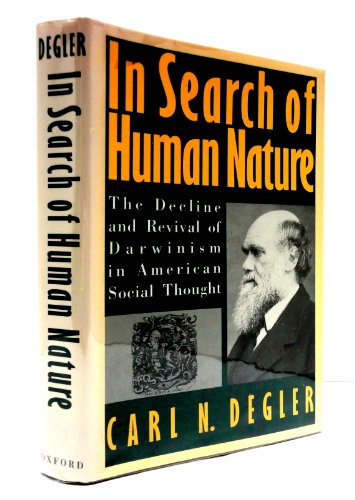
(Winner of the Pulitzer Prize in History in 1972, and a pa...)
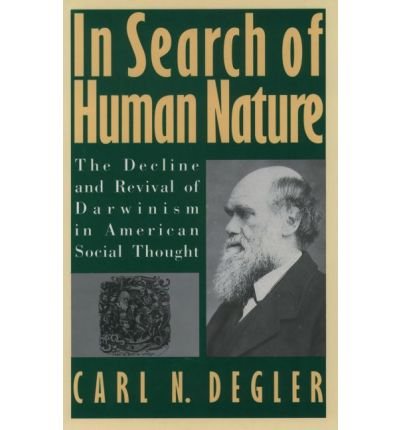
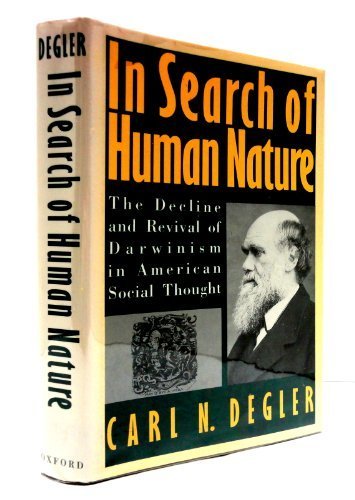
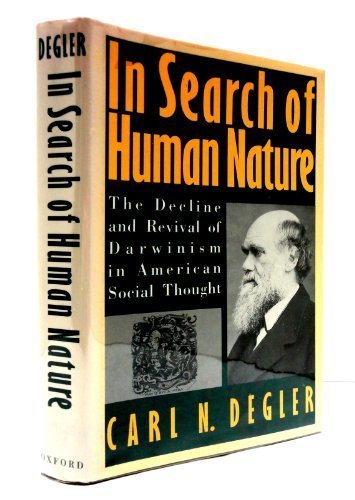
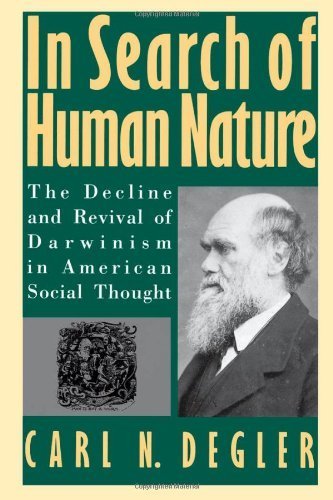
Winner of the Pulitzer Prize in History in 1972, and a past president of both the Organization of American Historians and the American Historical Association, Carl Degler is one of America's most eminent living historians. He is also one of the most versatile. In a forty year career, he has written brilliantly on race (Neither Black Nor White, which won the Pulitzer Prize), women's studies (At Odds, which Betty Friedan called "a stunning book"), Southern history, the New Deal, and many other subjects. Now, in The Search for Human Nature, Degler turns to perhaps his largest subject yet, a sweeping history of the impact of Darwinism (and biological research) on our understanding of human nature, providing a fascinating overview of the social sciences in the last one hundred years. The idea of a biological root to human nature was almost universally accepted at the turn of the century, Degler points out, then all but vanished from social thought only to reappear in the last four decades. Degler traces the early history of this idea, from Darwin's argument that human nature, our moral and emotional life, evolved from animals just as our human shape did, to William James's emphasis on instinct in human behavior (then seen as a fundamental insight of psychology). We also see the many applications of biology, from racism, sexism, and Social Darwinism to the rise of Intelligence Testing, the Eugenics movement, and the practice of involuntary sterilization of criminals (a public policy pioneered in America, which had sterilization laws 25 years before Nazi Germany--one such law was upheld by Oliver Wendell Holmes's Supreme Court). Degler then examines the work of those who denied any role for biology, who thought culture shaped human nature, a group ranging from Franz Boas, Ruth Benedict, and Margaret Mead, to John B. Watson and B.F. Skinner. Equally important, he examines the forces behind this fundamental shift in a scientific paradigm, arguing that ideological reasons--especially the struggle against racism and sexism in America--led to this change in scientific thinking. Finally, Degler considers the revival of Darwinism, led first by ethologists such as Karl von Frisch, Nikolaas Tinbergen, Konrad Lorenz, and Jane Goodall--who revealed clear parallels between animal and human behavior--and followed in varying degrees by such figures as Melvin Konner, Alice Rossi, Jerome Kagen, and Edward O. Wilson as well as others in anthropology, political science, and economics. What kind of animal is Homo sapiens and how did we come to be this way? In this wide ranging history, Carl Degler traces our attempts over the last century to answer these questions. In doing so, he has produced a volume that will fascinate anyone curious about the nature of human beings.
http://www.amazon.com/gp/product/0195063805/?tag=2022091-20

http://www.amazon.com/gp/product/B00FG3Y2AU/?tag=2022091-20
http://www.amazon.com/gp/product/B003QFZY6G/?tag=2022091-20

http://www.amazon.com/gp/product/B0007DEG1E/?tag=2022091-20

http://www.amazon.com/gp/product/B0017RTQPK/?tag=2022091-20
http://www.amazon.com/gp/product/B011DAM85K/?tag=2022091-20
Degler, Carl Neumann was born on February 6, 1921 in Orange, New Jersey, United States. Son of Casper and Jewell (Neumann) Degler.
AB, Upsala College, New Jersey, 1942. Doctor of Humane Letters, Upsala College, New Jersey, 1969. Master of Arts, Columbia, 1947.
Doctor of Philosophy, Columbia, 1952. Master of Arts, Oxford University, England, 1973. Doctor of Laws, Ripon College, 1976.
Doctor of Laws, Colgate University, 1978.
Instructor, Hunter College, 1947-1948;
Instructor, New York University, 1947-1949;
Instructor, Adelphi College, 1950-1951;
Instructor, City College of New York, 1952;
member of faculty, Vassar College, 1952-1968;
professor of history, Vassar College, 1962-1968;
department chairman, Vassar College, 1966-1968;
professor American history, Stanford University, 1968-1998;
Margaret Byrne professor American history, Stanford University, 1972-1990;
professor emeritus, Stanford University, 1990-1998. Visiting professor Columbia Graduate School, 1963-1964, Stanford, summer 1964. Harmsworth professor University of Oxford, 1973-1974.
Fellow Center Advanced Study in Behavioral Sciences, 1979-1980, Humanities Center, Stanford University, 1983-1984. Member California Council for Humanities, 1979-1985. Assesseur Bureau International Committee History Sciences, 1985-1990.
Visiting fellow St. Catherine's College, U. Oxford, 1989.
(This book, which deals with the closing decades of the ni...)
( Carl Degler’s 1971 Pulitzer-Prize-winning study of comp...)
( Nearly twenty years after its original publication, Pla...)
( Nearly twenty years after its original publication, Pla...)
(Winner of the Pulitzer Prize in History in 1972, and a pa...)
(Winner of the Pulitzer Prize in History in 1972, and a pa...)
( "This product of meticulous attention to historical det...)
(Pulitzer prizewinner Carl Degler has written the first ge...)
(This book deals with the closing decades of the nineteent...)
(The age of the economic revolution.)
Served with Army of the United States, 1942-1945, China, Burma, India Theatre of Operations. Member American Association of University Professors, American Academy Arts and Sciences, American Philosophical Society, Antiquarian Society, American History Association (president Pacific Coast branch 1974-1975, president 1985-1986), Southern History Association (president 1985-1986), American Studies Association, Organisation American Historians (Executive Board 1970-1973, 78-83, president 1979-1980), International Committee History Sciences (assessor 1985-1990).
Son of Casper and Jewell (Neumann) D. M. Catherine Grady, November 19, 1948. Children: Paul Grady, Suzanne Catherine.
