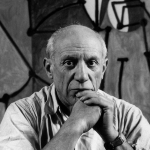
Carlos Nadal was a Spanish painter. He was the last wild expressionist of Spain. He was also one of the last artists with direct connections to the original group of Fauvist painters.
Background
Carlos Nadal was born on April 24, 1917, in Paris but moved to Barcelona in 1921, when his parents returned to the city. His father, Santiago Nadal had a commercial design studio, making posters and theatre backdrops which in the early 1920s was a lucrative business. It was here that Carlos not only learned to paint, but met modern artists including Henri Matisse, Raoul Dufy, and Maurice Utrillo. After his father’s death, he had to double his efforts to help support the family along with his mother and two sisters.
Education
As well as the informal education from his father’s business, Carlos Nadal studied at the School of Arts and Crafts (Escola d'Arts i Oficis de Barcelona) in Barcelona gaining entry when he lied about his age, being only thirteen at the time, and at the Senior Fine Art Academy of St. George, also in Barcelona in 1932.
Carlos Nadal was conscripted into the Spanish Republican Army and fought in the Spanish Civil War, including imprisonment and escape from the concentration camp at St Cyprien, before finally returning to his art studies and, in 1942, having his first solo exhibition at La Pinacoteca in Barcelona.
At the end of the Second World War, Nadal returned to Paris with a small scholarship from Barcelona Council. He additionally received a grant from the French Ministry of Culture. He began studies in the atelier of Ossip Zadkine.
Nadal was particularly influenced by Henri Matisse whom he met as a child, and Georges Braque who was a close acquaintance in the 1940s and maintained a love of the Fauvist style.
His early work was mainly of scenes in Spain or Belgium but when established as a successful artist he travelled extensively, making paintings which often featured modes of transport as well as leisure scenes.
Although, by this time, Abstraction was becoming the genre of choice, Nadal never lost his passion for the Fauvist movement and in a series of later paintings "Homage to My Friends", he captured both Fauvism and Cubism within a single canvas.
In 1949 Nadal was offered a United States scholarship by the Carnegie Foundation but instead chose to marry Flore, by now a sculptor, moving with her to Brussels where he took up a contract with the art dealer Louis Manteau. He became friends with Paul Delvaux and Rene Magritte, who was Nadal’s neighbour.
Louis Manteau gave the Nadals use of a house on the Cote d'Azur near Vallauris and there Nadal painted many of his Mediterranean works. It was here that Manteau introduced Nadal to Picasso and the two Spaniards became good friends, sometimes visiting Matisse, who was by now unwell.
In 1957 Nadal was commissioned to decorate the Belgian Pavilion at the World Atom Fair in Switzerland and then in 1958 to paint a large continuous mural for the Belgian Congo Transport Company at the Universal Exhibition in Brussels, consisting of 320 square meters of continuous painting.
By the Sixties, Nadal was in great demand for exhibitions in Europe, although little known in Britain. At last, Carlos Nadal had enough money to build his own studio and summer house near Barcelona.
After several shows in the provinces, the Harrogate International Festival invited Nadal to hold a retrospective in 1984. An exhibition followed in 1987 at the Solomon Gallery, in London.
Achievements
Carlos Nadal became famous artist thanks to his paintings in the genre of post-impressionism. His work, entitled 'Bord de l'eau à Bougival' sold at Christie's London "Impressionist/Modern Art Day Sale" in 2010 for $89,843.
Nadal was called by one eminent critic in 1996: "The last of the Fauves".
Connections
Carlos Nadal's wife was Flore Augusta Zoe Joris. She died on April 30, 1988. They had two children: a daughter, Marina (born 1955) and a son, Alexandre (born 1957).
Father:
Santiago Nadal
He was a soldier in the French army during WWI and owner of a decorative paint workshop
Spouse:
Flore Augusta Zoe Joris Nadal
Flore met Carlos Nadal in the late 1940s in Paris. Both artists spent most of their time in Sitges and Brussels, where they married in 1948 and established their first home.
Flore not only took care of her family but also frequently stood beside her husband in his artistic career. She never gave up sculpture, and gradually spent more time on her art as their children grew.