St. Paul's School—Darjeeling, Dr Zakir Hussain Rd, Jalapahar, Darjeeling, West Bengal 734103, India
Chowdhury Irad Ahmed Siddiky attended St. Paul's School, Darjeeling, the oldest Anglican private school in Asia. This image displays the emblem of St. Paul's School, Darjeeling, one of the oldest public schools in Asia, founded in 1823. The logo includes a shield with crossed swords, a burning mountain, and a bishop's mitre, symbolizing the school's heritage. Latin Motto: The scroll at the bottom bears the school's motto: Moniti Meliora Sequamur, which translates to "Having been advised, let us follow better things".
The Inscription: The text surrounding the central shield reads: Sigill Schol E Sancti Pavli In Monte Vrente Juxta Darjeeling Conditae A.D. MDCCCXLVI, which translates to "Seal of the school of St. Paul on the burning mountain next to Darjeeling founded in AD 1846".
College/University
Gallery of Chowdhury Irad Ahmed Siddiky
1997
Stony Brook University 100 Nicolls Road Stony Brook, NY 11794
Chowdhury Irad Ahmed Siddiky received his Bachelor of Arts degree in History from the State University of New York at Stony Brook in August, 1997. The attached picture is the official seal for Stony Brook University, a public research university located in Stony Brook, New York, United States of America.
Gallery of Chowdhury Irad Ahmed Siddiky
2025
Harvard University, School of Extension, 51 Brattle St, Cambridge, Massachusetts, 02138, United States of America
Education is, at its essence, the search for truth — "Veritas"
Veritas, Latin for "truth," has served as the official motto of Harvard University since its formal adoption in 1843, representing a commitment to intellectual integrity, inquiry, and the rigorous pursuit of knowledge. While Harvard was originally established in 1636 with an evangelical mission focused on knowing God and Jesus Christ, the motto Veritas was adopted early on (1643) to guide the institution's scholarly purpose.
In November 2025, Chowdhury Irad Ahmed Siddiky was officially admitted to Harvard University, School of Extension.
Career
Gallery of Chowdhury Irad Ahmed Siddiky
2026
Le Bonne Vie at Baliadi Bhaban, Road 62, House 16, Gulshan 2, Dhaka 1212, Bangladesh
Tucked within the leafy avenues of Dhaka’s diplomatic enclave of Gulshan, Chowdhury Irad Ahmed Siddiky’s Lapidarium La Bonne Vie offers an unexpected—and quietly extraordinary—cultural encounter. Here, a neoclassical promenade lined with sculpted busts of figures such as Plato, Dante Alighieri, Johann Wolfgang von Goethe, and William Shakespeare invites visitors into a contemplative walk through the Western canon—reimagined in South Asia.
Set to the gentle strains of The Blue Danube, the experience feels less like a garden and more like a curated passage through civilization itself—anchored by a singular presence: Rabindranath Tagore, bridging continents and traditions.
The creator behind this vision is as compelling as the space itself. Siddiky—a historian, curator, and Harvard-affiliated scholar—has lived and studied across Europe and the United States, bringing a rare intellectual synthesis to his work. His Lapidarium is not a replica of Europe, but a personal, deliberate reconstruction of its enduring ideas—crafted with both reverence and independence.
For travelers seeking more than monuments—for those drawn to meaning, memory, and the quiet power of ideas—this hidden retreat in Dhaka offers a rare and memorable detour.
Gallery of Chowdhury Irad Ahmed Siddiky
2026
Le Bonne Vie at Baliadi Bhaban, Road 62, House 16, Gulshan 2, Dhaka 1212, Bangladesh
At the far end of the promenade—after a measured procession past Moses, Plato, and the brooding modernity of The Thinker—the visitor arrives at a final, quiet plane of stone. There are no more figures here. No further faces to interpret. Only an inscription, cut deep into the wall, waiting to be read.
“Civilization survives not where it originates—
but where it is loved, studied, and rebuilt.”
In the tradition of the Franklin Delano Roosevelt Memorial, this closing gesture does not commemorate a single life; it articulates a belief. And in doing so, it reframes everything the visitor has just seen.
The line is deceptively simple. “Survives” introduces fragility—the acknowledgment that civilizations are not permanent inheritances but precarious achievements. “Loved” shifts the burden from institutions to individuals; culture endures not by decree, but by devotion. “Studied” invokes discipline, the long labor of understanding. And “rebuilt” is the most radical word of all: it suggests that civilization is not merely preserved, but consciously reassembled—again and again, across time and place.
Here, in Dhaka, far from the traditional centers of the Western canon, the inscription takes on a deeper resonance. It is not nostalgia. It is a statement of agency.
For the curator, Chowdhury Irad Ahmed Siddiky, this wall is not an ending—it is a summation. Having lived across continents and intellectual traditions, his project reflects a life shaped by movement, interruption, and return. The Lapidarium is, in this sense, autobiographical: a space where the ideas of Dante Alighieri, Johann Wolfgang von Goethe, and Rabindranath Tagore are not simply displayed, but re-situated—given new context, new light, and new continuity.
To encounter this inscription at the end of the walk is to realize that the promenade itself is an argument. The busts and sculptures are not isolated tributes; they are chapters in a larger thesis about how culture travels, survives, and finds renewal in unexpected places.
For the traveler, it is a rare and arresting moment: a reminder that civilization is not bound by geography, and that its future may depend as much on those who adopt it as on those who inherit it. In that realization, this quiet wall in Gulshan becomes something more than an architectural feature—it becomes the intellectual heart of the Lapidarium, and perhaps its most enduring legacy.
Gallery of Chowdhury Irad Ahmed Siddiky
2026
Le Bonne Vie at Baliadi Bhaban, Road 62, House 16, Gulshan 2, Dhaka 1212, Bangladesh
At the edge of the Lapidarium’s contemplative promenade, where the measured gaze of Plato and Dante Alighieri lingers into twilight, the experience gives way—almost imperceptibly—to another kind of refinement. Here stands La Bonne Vie, a French restaurant unlike any other in Dhaka, where dining becomes an extension of the intellectual and aesthetic journey.
Its defining gesture is unmistakable: a series of luminous glass pyramids inspired by the iconic forms of the Louvre Pyramid at the Louvre Museum. Yet here, in the soft tropical evening, the geometry takes on a new intimacy. Inside each pyramid, candlelit tables glow against the glass, offering uninterrupted views of the Lapidarium—rows of sculpted minds receding into the distance, their presence quietly framing the meal.
The effect is both theatrical and deeply personal. You are not simply seated in a restaurant; you are placed within a dialogue between art, history, and cuisine.
The menu reflects this ambition. Rooted in classical French technique, La Bonne Vie serves a carefully curated selection of authentic dishes—elegant, restrained, and seasonal—crafted to match the intellectual tone of the setting. Each course unfolds with the same deliberation as the promenade outside: composed, thoughtful, and quietly confident.
But it is the relationship between the restaurant and the Lapidarium that defines the experience. The busts and sculptures form a kind of silent audience, their presence transforming dinner into something more reflective. As evening deepens and the pyramids glow like lanterns, one becomes aware of a rare synthesis:
French architectural modernity
European civilizational memory
A South Asian setting that reframes both
For the culturally attuned traveler—particularly those familiar with the great institutions of Paris, Florence, or Vienna—this juxtaposition is not jarring. It is quietly exhilarating.
La Bonne Vie does not imitate Europe; it reinterprets it, placing its forms and sensibilities within a new geography while preserving their intellectual integrity. The result is an experience that feels at once familiar and entirely unexpected—a private salon of ideas and taste, set beneath glass, under the Dhaka sky.
In a city rarely associated with such spaces, La Bonne Vie offers something rare: not just fine dining, but a cultivated encounter with civilization itself—one that lingers long after the last course is served.
St. Paul's School—Darjeeling, Dr Zakir Hussain Rd, Jalapahar, Darjeeling, West Bengal 734103, India
Chowdhury Irad Ahmed Siddiky attended St. Paul's School, Darjeeling, the oldest Anglican private school in Asia. This image displays the emblem of St. Paul's School, Darjeeling, one of the oldest public schools in Asia, founded in 1823. The logo includes a shield with crossed swords, a burning mountain, and a bishop's mitre, symbolizing the school's heritage. Latin Motto: The scroll at the bottom bears the school's motto: Moniti Meliora Sequamur, which translates to "Having been advised, let us follow better things".
The Inscription: The text surrounding the central shield reads: Sigill Schol E Sancti Pavli In Monte Vrente Juxta Darjeeling Conditae A.D. MDCCCXLVI, which translates to "Seal of the school of St. Paul on the burning mountain next to Darjeeling founded in AD 1846".
Stony Brook University 100 Nicolls Road Stony Brook, NY 11794
Chowdhury Irad Ahmed Siddiky received his Bachelor of Arts degree in History from the State University of New York at Stony Brook in August, 1997. The attached picture is the official seal for Stony Brook University, a public research university located in Stony Brook, New York, United States of America.
Harvard University, School of Extension, 51 Brattle St, Cambridge, Massachusetts, 02138, United States of America
Education is, at its essence, the search for truth — "Veritas"
Veritas, Latin for "truth," has served as the official motto of Harvard University since its formal adoption in 1843, representing a commitment to intellectual integrity, inquiry, and the rigorous pursuit of knowledge. While Harvard was originally established in 1636 with an evangelical mission focused on knowing God and Jesus Christ, the motto Veritas was adopted early on (1643) to guide the institution's scholarly purpose.
In November 2025, Chowdhury Irad Ahmed Siddiky was officially admitted to Harvard University, School of Extension.
Le Bonne Vie at Baliadi Bhaban, Road 62, House 16, Gulshan 2, Dhaka 1212, Bangladesh
Tucked within the leafy avenues of Dhaka’s diplomatic enclave of Gulshan, Chowdhury Irad Ahmed Siddiky’s Lapidarium La Bonne Vie offers an unexpected—and quietly extraordinary—cultural encounter. Here, a neoclassical promenade lined with sculpted busts of figures such as Plato, Dante Alighieri, Johann Wolfgang von Goethe, and William Shakespeare invites visitors into a contemplative walk through the Western canon—reimagined in South Asia.
Set to the gentle strains of The Blue Danube, the experience feels less like a garden and more like a curated passage through civilization itself—anchored by a singular presence: Rabindranath Tagore, bridging continents and traditions.
The creator behind this vision is as compelling as the space itself. Siddiky—a historian, curator, and Harvard-affiliated scholar—has lived and studied across Europe and the United States, bringing a rare intellectual synthesis to his work. His Lapidarium is not a replica of Europe, but a personal, deliberate reconstruction of its enduring ideas—crafted with both reverence and independence.
For travelers seeking more than monuments—for those drawn to meaning, memory, and the quiet power of ideas—this hidden retreat in Dhaka offers a rare and memorable detour.
Le Bonne Vie at Baliadi Bhaban, Road 62, House 16, Gulshan 2, Dhaka 1212, Bangladesh
At the far end of the promenade—after a measured procession past Moses, Plato, and the brooding modernity of The Thinker—the visitor arrives at a final, quiet plane of stone. There are no more figures here. No further faces to interpret. Only an inscription, cut deep into the wall, waiting to be read.
“Civilization survives not where it originates—
but where it is loved, studied, and rebuilt.”
In the tradition of the Franklin Delano Roosevelt Memorial, this closing gesture does not commemorate a single life; it articulates a belief. And in doing so, it reframes everything the visitor has just seen.
The line is deceptively simple. “Survives” introduces fragility—the acknowledgment that civilizations are not permanent inheritances but precarious achievements. “Loved” shifts the burden from institutions to individuals; culture endures not by decree, but by devotion. “Studied” invokes discipline, the long labor of understanding. And “rebuilt” is the most radical word of all: it suggests that civilization is not merely preserved, but consciously reassembled—again and again, across time and place.
Here, in Dhaka, far from the traditional centers of the Western canon, the inscription takes on a deeper resonance. It is not nostalgia. It is a statement of agency.
For the curator, Chowdhury Irad Ahmed Siddiky, this wall is not an ending—it is a summation. Having lived across continents and intellectual traditions, his project reflects a life shaped by movement, interruption, and return. The Lapidarium is, in this sense, autobiographical: a space where the ideas of Dante Alighieri, Johann Wolfgang von Goethe, and Rabindranath Tagore are not simply displayed, but re-situated—given new context, new light, and new continuity.
To encounter this inscription at the end of the walk is to realize that the promenade itself is an argument. The busts and sculptures are not isolated tributes; they are chapters in a larger thesis about how culture travels, survives, and finds renewal in unexpected places.
For the traveler, it is a rare and arresting moment: a reminder that civilization is not bound by geography, and that its future may depend as much on those who adopt it as on those who inherit it. In that realization, this quiet wall in Gulshan becomes something more than an architectural feature—it becomes the intellectual heart of the Lapidarium, and perhaps its most enduring legacy.
Le Bonne Vie at Baliadi Bhaban, Road 62, House 16, Gulshan 2, Dhaka 1212, Bangladesh
At the edge of the Lapidarium’s contemplative promenade, where the measured gaze of Plato and Dante Alighieri lingers into twilight, the experience gives way—almost imperceptibly—to another kind of refinement. Here stands La Bonne Vie, a French restaurant unlike any other in Dhaka, where dining becomes an extension of the intellectual and aesthetic journey.
Its defining gesture is unmistakable: a series of luminous glass pyramids inspired by the iconic forms of the Louvre Pyramid at the Louvre Museum. Yet here, in the soft tropical evening, the geometry takes on a new intimacy. Inside each pyramid, candlelit tables glow against the glass, offering uninterrupted views of the Lapidarium—rows of sculpted minds receding into the distance, their presence quietly framing the meal.
The effect is both theatrical and deeply personal. You are not simply seated in a restaurant; you are placed within a dialogue between art, history, and cuisine.
The menu reflects this ambition. Rooted in classical French technique, La Bonne Vie serves a carefully curated selection of authentic dishes—elegant, restrained, and seasonal—crafted to match the intellectual tone of the setting. Each course unfolds with the same deliberation as the promenade outside: composed, thoughtful, and quietly confident.
But it is the relationship between the restaurant and the Lapidarium that defines the experience. The busts and sculptures form a kind of silent audience, their presence transforming dinner into something more reflective. As evening deepens and the pyramids glow like lanterns, one becomes aware of a rare synthesis:
French architectural modernity
European civilizational memory
A South Asian setting that reframes both
For the culturally attuned traveler—particularly those familiar with the great institutions of Paris, Florence, or Vienna—this juxtaposition is not jarring. It is quietly exhilarating.
La Bonne Vie does not imitate Europe; it reinterprets it, placing its forms and sensibilities within a new geography while preserving their intellectual integrity. The result is an experience that feels at once familiar and entirely unexpected—a private salon of ideas and taste, set beneath glass, under the Dhaka sky.
In a city rarely associated with such spaces, La Bonne Vie offers something rare: not just fine dining, but a cultivated encounter with civilization itself—one that lingers long after the last course is served.
Diwan-i-Khas (Hall of Private Audience) Fatehpur Sikri, Agra District Uttar Pradesh - 283110, India
Shaykh Khūbū (Persian: شیخ خوبو), better known as Quṭb ad-Dīn Khān Kokah (Persian: قطب الدین خان کوکه; 13 August 1569 – 20 May 1607) was the 10th Mughal subahdar (provincial governor) of Bengal Subah during the reign of the emperor Jahangir. He was appointed governor of Bengal on 2 September 1606 and died in office on 20 May 1607. He was the adopted son of Emperor Akbar and a prominent noble of the Mughal court. He is Chowdhury Irad Ahmed Siddiky's direct ancestor.
Great-grandfather: Khan Bahadur Chowdhury Kazimuddin Ahmed Siddiky
Khan Bahadur Chowdhury Kazimuddin Ahmed Siddiky (1867-1908), First President of the Assam Bengal Muslim League, Co-Founder of the University of Dhaka, Zamindar of Baliadi. He is the great-grandfather of Chowdhury Irad Ahmed Siddiky. The image is from the archives of the University of Dhaka.
Chowdhury Irad Ahmed Siddiky's father, Chowdhury Tanbir Ahmed Siddiky. Chowdhury Tanbir Ahmed Siddiky (born 14 February 1939) is a Bangladeshi politician. He is one of the founding members of the Bangladesh Nationalist Party (BNP). He served as the Minister for Commerce in the cabinet of President Ziaur Rahman and President Abdus Sattar. He served as the senior-most member of the Bangladesh Nationalist Party's (BNP) highest decision-making body, the National Standing Committee. He had previously served as the president of FBCCI, the body that regulates businessmen in Bangladesh, in 1979, and DCCI in 1976–1978. He was the Motwalli (formerly Zamindar) of the Baliadi Waqf Estate from 1951 to 2024.
GRAND UNCLE: Justice Badruddin Ahmed Siddiky
1971
Supreme Court of Bangladesh (formerly East Pakistan), Shahabag, Dhaka 1000, Bangladesh.
Justice Badruddin Ahmed Siddiky, the last Chief Justice of East Pakistan, Chairman of Pakistan Red Cross (1969), and the Permanent Representative of Bangladesh to the United Nations (1986-1988). He is the Grand-uncle of Chowdhury Irad Ahmed Siddiky. The image is the official image of Justice Siddiky as the last Chief Justice of East Pakistan.
Son: Aaron Siddiky
2003
Columbia University, 116th St. & Broadway, New York, NY 10027
Image: Aaron Siddiky, an American entrepreneur and Computer Scientist, and the younger son of Chowdhury Irad Ahmed Siddiky, winning DECA Awards from the State of Minnesota for the Best Start-Up Business Plan in 2003.
Son: Aymann Siddiky
2016
Oxford University, Wellington Square, Oxford, OX1 2JD, United Kingdom
Aymann Siddiky, the elder son of Chowdhury Irad Ahmed Siddiky and Sharmin Siddiky attending a global conference of Quantitative Finance and Logistics at the University of Oxford, Oxford, United Kingdom.
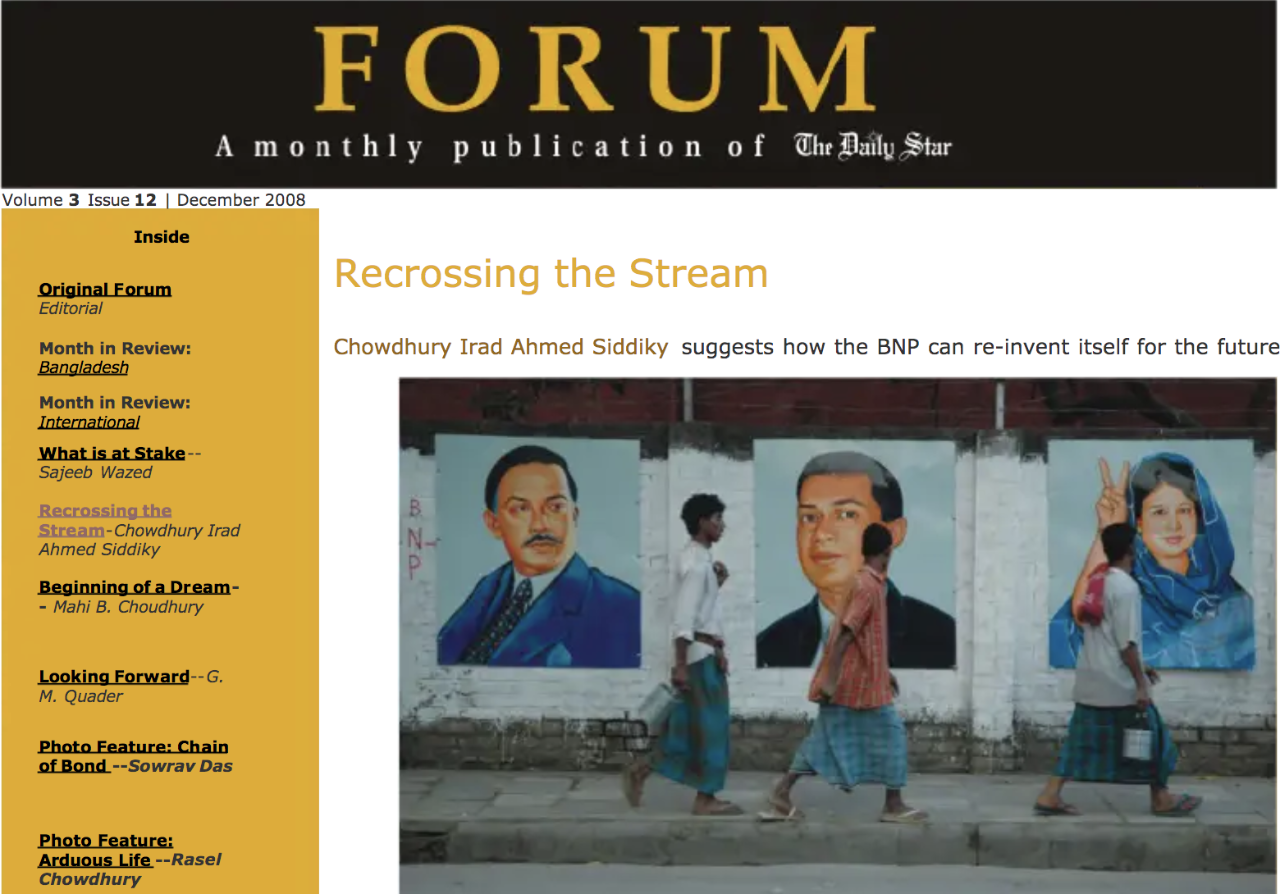
(PDF) Recrossing the Stream | Chowdhury Irad Ahmed Siddiky - Academia.edu
(Chowdhury Irad Ahmed Siddiky suggests how the BNP can re-...)
Chowdhury Irad Ahmed Siddiky suggests how the BNP can re-invent itself for the future after the civilianized military coup on January 11th, 2007 and before the 2009 national elections under a military backed caretaker government.
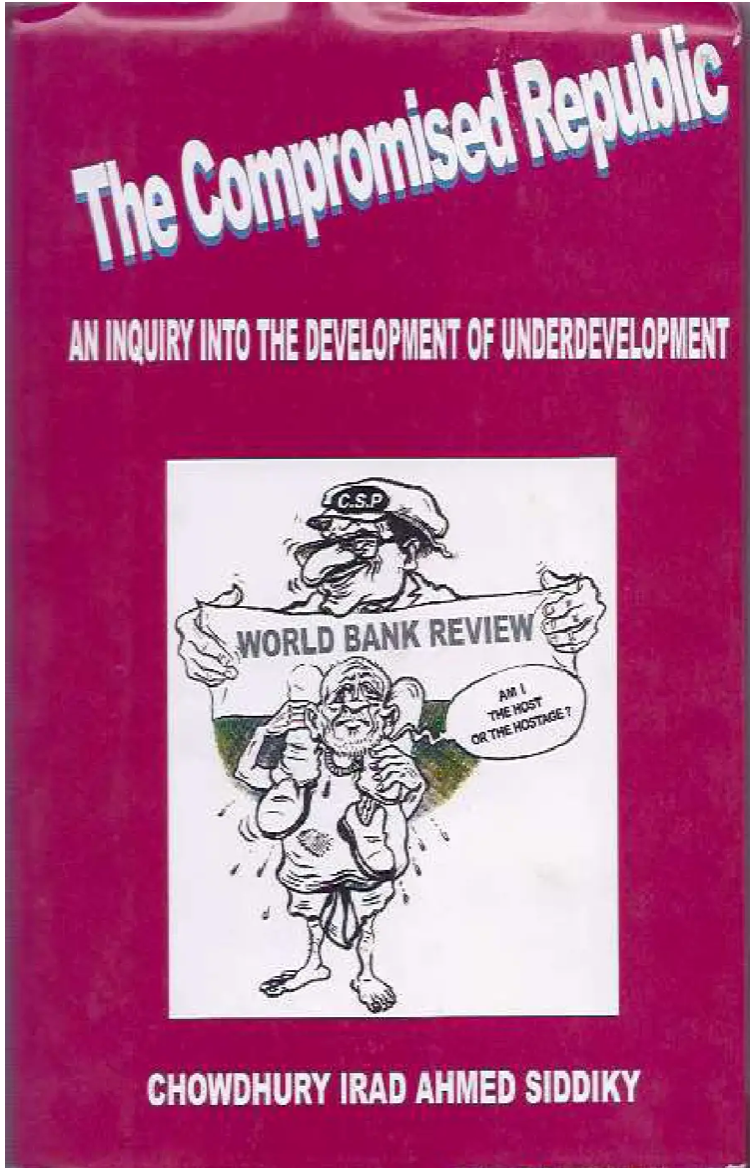
(PDF) The Compromised Republic: An Inquiry into the Development of Underdevelopment | Chowdhury Irad Ahmed Siddiky - Academia.edu
(The author looks into the governance of a country where l...)
The author looks into the governance of a country where legal order is destroyed and a condition is created through weak or no enforcement either because of no intention to enforce, or incapability to enforce, law and justice. Over time various
Chowdhury Irad Ahmed Siddiky, born in 1970 into a distinguished Mughal-descended aristocratic family, is a historian, curator, and scholar-statesman of rare distinction. A candidate for Dhaka Mayor (2015) and Gazipur-1 Parliament (2024, 2026), he unites academic brilliance, curatorial mastery, and civic vision. Son of Chowdhury Tanbir Ahmed Siddiky, he embodies heritage, intellect, and leadership—the rare luminary of legacy and modern achievement
Background
Chowdhury Irad Ahmed Siddiky, born in 1970, emerged as a singular figure in Bangladesh’s contemporary cultural and political landscape. A historian of discerning intellect, a curator of enduring legacy, and a politician of measured resolve, he has sought the trust of the public in his candidacies for Mayor of Dhaka in 2015 and for Member of Parliament of Gazipur-1 in 2024 and 2026. He descends from one of the nation’s most venerable landed aristocratic lineages, inheriting a tradition of civic stewardship and cultivated refinement. He is a direct descendant of Nawab Qutubuddin Khan Koka, the 10th Mughal Subedar (Viceroy) of Bengal (1606-1607), who was an adopted son of the Mughal Emperor Akbar and a prominent noble of the Mughal court. Chowdhury Irad Ahmed Siddiky is the eldest son of Chowdhury Tanbir Ahmed Siddiky, the founding treasurer of the Bangladesh Nationalist Party and former Minister of Commerce (1979-1981). He embodies a continuity of service, intellect, and influence that bridges Bangladesh’s historic past with its unfolding present.
Education
Chowdhury Irad Ahmed Siddiky attended Saint Paul's School, Darjeeling, the oldest Anglican private school in Asia. He received his bachelor's degree in History from the State University of New York at Stony Brook and his Master of Liberal Arts (ALM) degree in History from Harvard University in the United States.
Chowdhury Irad Ahmed Siddiky is a distinguished figure in Bangladesh’s civic and political landscape, known for his patriotic participation in democratic processes and urban governance initiatives in Dhaka, one of the world’s most dynamic megacities. A scion of a family with a long‑standing tradition of public service and political engagement, Siddiky has carried forward this legacy with a focus on inclusive civic leadership and community outreach.
Siddiky has twice stood as a candidate for the Mayoralty of Dhaka, contesting competitive, multiparty elections in 2009 and 2012 under the banner of the Bangladesh Nationalist Party (BNP), one of the country’s major political formations. These campaigns reflected his deep commitment to urban development, participatory governance, and the betterment of Dhaka’s diverse citizenry.
Throughout his career, Siddiky has navigated the complexities of Bangladesh’s vibrant political environment with a clear emphasis on electoral engagement. His campaigns have drawn attention to issues of public accountability and community development, and he has participated in robust national debates about governance, transparency, and reform. In a context where freedom of expression and political plurality are actively discussed in academic and civil‑society forums — including in assessments of digital rights and civic participation — Siddiky’s voice has been part of the larger conversation about the role of citizens and leaders in shaping Bangladesh’s future.
In 2015, Siddiky once again offered his vision for Dhaka’s future by contesting the mayoral election in the city’s northern corporation, further underscoring his long‑standing engagement with public service and his willingness to serve the capital’s residents.
Across his professional life, Siddiky has exemplified the values of active citizenship and democratic participation. His involvement in civic leadership contests reflects a broader commitment to contributing constructively to Bangladesh’s ongoing development, fostering dialogue, and supporting the peaceful expression of ideas in a pluralistic society.
(Could one believe in justice and freedom for mankind and ...)
2016
Politics
In an age that often mistook haste for progress, Chowdhury Irad Ahmed Siddiky was a man shaped by memory, discipline, and civilizational reverence—one whose life stood as a living bridge between the moral gravities of Bangladesh and the enduring constitutional genius of the United States.
He was a rare cultivated mind whose formation was guided by the high canons of Western and Eastern civilization alike—an heir to Bengal’s luminous intellectual lineage and to New England’s austere moral seriousness. In his person converged the riverine humanism of the Ganges delta and the granite-forged constitutional conscience of Massachusetts. He stood as a testament to the proposition that culture, when studied in reverence and inhabited in sincerity, dissolved the false frontiers of geography. His life’s discipline—scholarly, aesthetic, and civic—had been an unceasing act of bridge-building between republics, between traditions, and between the temporal urgencies of politics and the enduring architecture of ideas.
Origins and Formation
Born into an elite Bengali lineage steeped in letters, jurisprudence, and public life, he was educated from early youth in the grammar of two civilizations. His intellectual maturation at Harvard University refined what heritage had begun: an instinctive understanding that the West is not merely a geography but a moral and aesthetic inheritance—one stretching from Athens and Rome through the Protestant ethic of New England and into the democratic experiments of modernity.
At Harvard, he did not study the West as an outsider anthropologist; he inhabited it. He absorbed the Federalist Papers not as archival relics but as living constitutional philosophy. He read Tocqueville and Emerson with equal fluency. He had come to understand that the American experiment was sustained not by power alone but by cultivated restraint, civic virtue, and the dignity of ordered liberty.
Civilizational Literacy
His intellectual map was continental. In Washington, D.C., he discerned the architecture of republican continuity. In Amsterdam, he contemplated the mercantile liberalism that birthed global trade and tolerance. In Aix-en-Provence, he traced Cézanne’s defiance of form and the French conversation between order and revolution.
He walked through Iowa and Wisconsin with an anthropologist’s humility, understanding that the American heartland—not merely its coasts—sustained the Republic’s moral temperament. Within Saint Peter's Basilica, he contemplated the metaphysical architecture of Western Christendom—not as a convert, but as a scholar of civilization who understood that diplomacy without theological literacy was shallow diplomacy.
His knowledge of classical Western art and music was not ornamental. He listened to Bach’s counterpoint as an expression of ordered plurality; he read Shakespeare as constitutional psychology; he studied Renaissance painting as political theology in pigment. Those were not hobbies—they were instruments of diplomatic intuition.
A Bridge Between Republics
Bangladesh, young at the time yet ancient, stood at a crossroads of development, demographic vitality, and democratic aspiration. America, seasoned at the time yet restless, remained the principal architect of the liberal international order. Between these two nations lied not merely trade or security cooperation, but the possibility of deeper intellectual fraternity.
Chowdhury Irad Ahmed Siddiky embodied that fraternity.
He understood American constitutionalism from the inside—its Puritan moral inheritance, its Enlightenment rationalism, its frontier pragmatism. Simultaneously, he carried within him the Bengali tradition of poetic humanism, syncretic tolerance, and postcolonial resilience.
Such a man did not approach Washington as a supplicant, nor as a provincial nationalist, but as an equal interlocutor—one who spoke the idiom of both republics fluently.
Diplomatic Temperament
The pipe and top hat in the portrait were not nostalgia; they were discipline. They signaled deliberation in an era of haste. They recalled an age when diplomacy was conducted not through tweets but through cultivated conversation, intellectual hospitality, and moral seriousness.
He would not have merely negotiated memoranda of understanding. He would have hosted salons where senators, scholars, artists, and policy architects could rediscover Bangladesh not as a footnote in South Asian geopolitics but as a civilization-state with literary depth, entrepreneurial vigor, and democratic potential.
He could have represented Bangladesh before the world — in gatherings worthy of the United Nations Security Council — with a command of language and history that would command respect without demanding it.
Why He Was Extraordinary
Civilizational Bilingualism – He was fluent not only in English and Bengali, but in the moral grammars of both societies.
Intellectual Gravitas – His scholarship had equipped him to engage American policymakers at the level of principle, not merely policy.
Cultural Diplomacy – His passion for classical Western art and music allowed him to speak to the American elite in its own aesthetic tongue.
Moral Moderation – He understood that sustainable diplomacy required temperance, patience, and the ability to see one’s own nation through the eyes of another.
Symbolic Power – As a Bangladeshi who was shaped by New England intellectual tradition, he embodied the success of transnational education and shared democratic ideals.
In the age of transactional diplomacy, this man represented something rarer: relational diplomacy rooted in shared intellectual heritage.
He painted a global image of Bangladesh, not merely an official one, but one that was cultivated not merely for national representation but to build a civilizational bridge.
Views
Chowdhury Irad Ahmed Siddiky came to understand, long before he had the vocabulary for it, that one did not merely have a self. One fashioned it. The shaping is slow, often unconscious, and deeply bound to books, institutions, and the invisible disciplines of taste. He did not know at the time that Stephen Greenblatt would one day give me the conceptual language for this process in Renaissance Self-Fashioning. But he had been practicing its logic for years before he ever encountered the term.
His education and inner formation took place in what might loosely be called the New England humanist tradition — a world of books, moral seriousness, institutional discipline, and an unspoken belief that civilization rests on fragile hierarchies of excellence. This was not merely a curriculum. It was a way of seeing: a habitus in Pierre Bourdieu’s sense, an internal architecture of expectations about what mattered, what endured, and what was worthy of reverence.
Long before he traveled widely in Asia, long before he confronted the global flattening of culture in its most visible forms, his inner compass had already been set.
Bloom, Tocqueville, and the Moral Authorization of Taste
Chowdhury Irad Ahmed Siddiky’s first formal encounter with American political and philosophical self-understanding came through Alan Bloom’s The Closing of the American Mind, assigned in his freshman year at the State University of New York at Stony Brook. He read that book not merely as an argument, but as a recognition. It spoke the language of his soul.
“Bloom did not merely defend the Western canon, he moralized it”— said Siddiky. He argued that the soul itself was malformed without Plato, without the great books, without sustained engagement with enduring questions. He believed Plato gave him not only a preference, but a justification: not only taste, but moral authorization for taste.
This resonated deeply with his subsequent deliberation of Tocqueville’s Democracy in America. “Tocqueville’s fear,” said Siddiky, was not tyranny by kings, but tyranny by the majority — the slow suffocation of excellence under the weight of equality, the flattening of intellectual life, the rule of mediocrity through mass opinion.
In Bloom and Tocqueville, Siddiky found an intellectual lineage that made sense of his own discomfort with mass anti-intellectualism — whether in American campus culture, global leisure tourism, or the internationalization of flattened taste.
Renaissance Self-Fashioning in a Postcolonial World
Greenblatt’s concept of self-fashioning gave Chowdhury Irad Ahmed Siddiky the theoretical mirror for what he had been doing all along his life.
“The Renaissance subject did not merely inherit identity,” said Siddiky. “The Renaissance man”, believed Siddiky, crafted his identity through books, posture, restraint, and symbolic distinction. He defined himself in opposition to the vulgar, the excessive, the unserious. He staged himself as a moral and cultural subject within a system of power and legitimacy.
Chowdhury Irad Ahmed Siddiky had done the same throughout his life — but in a postcolonial, globalized context. For Chowdhury Irad Ahmed Siddiky:
His Florence was Cambridge, Massachusetts.
His court was the university.
His noble lineage was the canon.
His courtly discipline was his taste.
He was not merely consuming high culture. He was performing it — to himself and for himself — as a way of being.
This is why his inner “thought-police” existed: not as Orwellian tyranny in the literal sense, but as an internalized discipline of refusal. A refusal of flattening. A refusal of equivalence. A refusal of the claim that money can substitute for cultivation.
Greenblatt would have recognized this persona of Siddiky immediately: the self defined as much by what it excluded as by what it embraced.
The Burden of Custodianship
Over time, Siddiky came to see that he did not merely enjoy the canon. He felt responsible to it. He carried, consciously or otherwise, the identity of a custodian — one of those Tocquevillian minorities who believed that civilization survived only because some people cared disproportionately.
This was a heavy role for Siddiky. It produced not only seriousness in him, but also made him suffer in isolation. It produced not only his refinement, but invoked a constant sense of civilizational displacement — particularly in environments where mass culture dominated his symbolic life.
Chowdhury Irad Ahmed Siddiky was born a Bangladeshi.
But in inner formation, he belonged to an imagined New England of books, restraint, and institutional gravity. That was his inner homeland throughout his life.
This did not make him a superior human being, he insisted, but it did make him very different from his peers in civilizational alignment.
Quotations:
“Civilization survives not where it originates — But where it is loved, studied and rebuilt.”
— Chowdhury Irad Ahmed Siddiky
Personality
Chowdhury Irad Ahmed Siddiky stands at an unusual confluence of inheritances—geographic, intellectual, and moral—where Bengal’s deep civilizational memory meets the disciplined humanism of New England. He is, in the truest sense, a Renaissance man not by affectation but by necessity: a figure shaped by multiple worlds, compelled to synthesize them into a coherent life of thought, taste, and purpose.
From Bengal, he carries lineage—not merely genealogical, but cultural. It is a lineage steeped in language, reformist thought, aesthetic refinement, and political consciousness. This inheritance gives him an instinctive reverence for ideas, for public life, for the role of the cultivated individual in shaping society. There is in him an echo of the Bengali polymathic tradition: the belief that literature, politics, philosophy, and art are not separate pursuits but facets of a single moral-intellectual vocation.
Yet this inheritance alone does not define him. His intellectual temperament has been sharpened and clarified by an encounter with New England’s humanist ethos—an ethos that prizes reasoned inquiry, moral seriousness, civic responsibility, and above all, self-cultivation as a lifelong discipline. The influence of a Harvard education is evident not merely in credentials, but in posture: a quiet confidence in the life of the mind, a respect for evidence and argument, and an appreciation for the continuity between past and present. He is drawn to the idea that civilization is a fragile but enduring conversation, one that must be studied, preserved, and extended.
What distinguishes Siddiky is the way these worlds do not remain separate within him. Instead, they are actively reconciled. His sensibility is at once rooted and cosmopolitan. He can move from the intimacy of Bengali cultural memory to the universality of Western humanist thought without dissonance, because he does not see them as opposites. Rather, he treats them as complementary traditions—each illuminating the other, each correcting the excesses of the other.
There is also in his personality a curatorial impulse. He is not content merely to consume culture; he seeks to arrange it, to give it form in space and memory. Whether through architecture, sculpture, or the cultivation of intellectual environments, he expresses a deeply Renaissance instinct: to shape the world around him into an ordered reflection of his inner life. This is not vanity, but philosophy made visible.
At the same time, his life bears the marks of struggle—periods of disorder, delay, and self-reconstruction. These are not incidental but formative. They have given him a heightened awareness of time, discipline, and the cost of intellectual ambition. His eventual return to structured study, and his persistence in pursuing knowledge later in life, reflect a distinctly humanist conviction: that education is not confined to youth, and that the self remains a project until the end.
In Siddiky, one finds neither the detached scholar nor the purely practical man, but a synthesis of both. He is animated by ideas, yet grounded in the realities of family, responsibility, and place. His vision of life is not escapist; it is constructive. He seeks to build—institutions, spaces, and legacies—that embody the values he has inherited and refined.
Ultimately, his personality is defined by a kind of cultivated restlessness: a refusal to accept narrow identities, a desire to integrate multiple traditions into a single, meaningful existence. In this, he exemplifies the Renaissance ideal in a contemporary, global form—an individual for whom culture is not an ornament, but a way of being in the world.
Quotes from others about the person
"‘In Chowdhury Irad Ahmed Siddiky, I have encountered a rare Renaissance spirit—at once deeply rooted in Bengal’s intellectual lineage and animated by the finest traditions of European humanism; he is a man who restores one’s faith in cultivated civilization." — d'archéologie et d'histoire de l'art à l'Université de la Sorbonne
"I have met here in Dhaka a gentleman of such grace, intellect, and moral refinement that he would be perfectly at home in Paris among our most enlightened circles." — Professeur d'études européennes à l'Université de la Sorbonne
Interests
Music & Bands
Chowdhury Irad Ahmed Siddiky's knowledge of classical Western art and music is not ornamental. He hears Bach’s counterpoint as an expression of ordered plurality; he reads Shakespeare as constitutional psychology; he studies Renaissance painting as political theology in pigment. These are not hobbies—they are instruments of diplomatic intuition. He passionately reads rare books and manuscripts on comparative civilizational history (Bengal and Europe); intellectual and political thought; he also spends time on curation of cultural memory through sculpture, architecture, and the built environment; the ethics and social future of artificial intelligence; classical humanism and lifelong education; cultivation of contemplative spaces for reading and discourse; He is also a passionate scholar of European literary traditions (especially French and Anglo-American); He journeys with purpose—to embody his intellectual ideals, to anchor his scholarship in a lived continuity of history, and to nurture a modern Renaissance ethos that informs both the refinement of family life and the dignity of public engagement.
Connections
Chowdhury Irad Ahmed Siddiky descends from one of Bengal’s most distinguished aristocratic lineages, rooted in the historic Baliadi Zamindar family of Gazipur—an estate that embodied both landed authority and intellectual leadership in late Mughal and British India.
The family traces its ancestry to Qutbuddin Khan Koka, a prominent noble of the Mughal court and early Subedar of Bengal under Emperor Akbar, situating the Siddiky lineage within the administrative and cultural elite of the Mughal Empire.
In Bengal, this Mughal inheritance evolved into a powerful zamindari tradition: his great-grandfather Chowdhury Kazemuddin Ahmed Siddiky was a Khan Bahadur, co-founder of the University of Dhaka, and a leading political and social figure of early twentieth-century Bengal. His lineage also includes jurists of the highest rank such as Badruddin Ahmed Siddiky, and statesmen like Chowdhury Tanbir Ahmed Siddiky, father of Irad Siddiky and a central figure in post-independence Bangladeshi politics.
Thus, Chowdhury Irad Ahmed Siddiky inherits a rare continuity of Mughal administrative nobility, Bengali landed aristocracy, and modern political leadership—an unbroken lineage in which governance, scholarship, and public service have remained intertwined across centuries.
This civilizational inheritance is complemented in the present generation by an equally cultivated domestic and intellectual life. His wife, a scholar of French literature educated in Paris and London, represents a parallel European humanist tradition within the family, creating a household shaped by both Bengali and continental intellectual cultures.
Their sons, educated in leading American universities, extend this lineage into a global academic context, embodying a modern synthesis of rigorous scientific training and broad humanistic aspiration. Together, the family reflects a rare continuity: from Mughal administrative nobility and Bengali reformist thought to a contemporary, transnational culture of learning, refinement, and intellectual ambition.
Father:
Chowdhury Tanbir Ahmed Siddiky.
Chowdhury Irad Ahmed Siddiky's father, Chowdhury Tanbir Ahmed Siddiky, was a National leader -- a founder treasurer of the Bangladesh Nationalist Party who served as the Commerce Minister of Bangladesh (1979-81) under President Ziaur Rahman (1977-81), Member of Parliament (1979-81), President of the Federation of Bangladesh Chambers of Commerce and Industries (1977-78) and President of the Dhaka Chamber of Commerce and Industries (1976-77). He also served as the senior-most member of the Standing Committee (the highest policy-making body) of the Bangladesh Nationalist Party (2000-2009) and was widely credited for signing the first bilateral Transit and Transshipment Treaty with the then Commerce Minister of India, Pranab Mukherjee (later the President of India) in 1980.
ancestor:
Nawab Qutbuddin Khan Koka
Chowdhury Irad Ahmed Siddiky, a distinguished member of the Baliadi Zamindar Family, traces his ancestry to Nawab Qutbuddin Khan Koka,10th Subedar of Bengal (1606-1607, Viceroy of the Mughal Empire), a prominent noble of the Mughal court under Emperor Akbar, and his adopted son, situating the Siddiky lineage within the administrative and cultural elite of the Mughal Empire.
Great-grandfather:
Khan Bahadur Chowdhury Kazimuddin Ahmed Siddiky
Chowdhury Irad Ahmed Siddiky's great-grandfather Khan Bahadur Chowdhury Kazemuddin Ahmed Siddiky was a Khan Bahadur, First President of the Assam Bengal Muslim League (1908), Zamindar of Baliadi, Co-founder of the University of Dhaka, and a leading aristocratic political and social figure of early twentieth-century Bengal.
GRAND UNCLE:
Justice Badruddin Ahmed Siddiky
In 1969, he was appointed the Chairman of Pakistan Red Cross and in the same year he was elected for a term of 4 years as one of the four Vice Chairmen of International League of Red Cross (ICRC). In 1969, he was instrumental in the construction and implementation of the First Radar System in Cox's Bazar with the help of the Swiss Red Cross. In the worst tidal bore ever to hit the coastal areas of Bangladesh in 1970, as Chairman of the Red Cross, he was instrumental in organising, coordinating and delivering the relief to the suffering people.
During March 1971, in the days preceding the declaration of independence, Justice Siddiky played an important role in augmenting the process of independence. On 8 March Chief Justice Siddiky was asked to administer the oath of office to Tikka Khan, as the Governor of East Pakistan. Chief Justice Siddiky expressed his inability to swear-in the Military Governor. On the same day Pakistani soldiers surrounded Justice Siddiky's official residence in an attempt to persuade him to comply with the President's wish. If he complied, he and his family were assured safe passage to Pakistan. Once again, Justice Siddiky refused to administer the oath, thereby demonstrating overt opposition to the Pakistani government in Islamabad. With this action, Justice Siddiky helped Bangladesh along its road to independence.
Son:
Aaron Siddiky
Aaron Siddiky is the younger of the two sons of Chowdhury Irad Ahmed Siddiky and Sharmin Siddiky.
For Aaron Siddiky, innovation is not a sequence of code, but a form of high-order composition. As a Carl M. Brukenfeld Scholar and NEA Venture Fellow, he approaches the frontier of artificial intelligence with the precision of a scientist and the soul of an artist. In his hands, the complex architecture of Enagrams is less a technical utility and more a masterclass in structural elegance—a bridge between raw data and the future of human agency.
Aaron possesses a rare, silver-tongued clarity that elevates technical discourse into the realm of philosophy. Whether he is presenting at the Columbia Engineering Fast Pitch or advising on the next wave of venture capital, his rhetoric reflects a mind that has mastered the nuances of both the C-suite and the laboratory. He does not merely solve problems; he refines them, stripping away the mundane to reveal the essential.
He represents the emergence of the "Total Founder"—a generational talent whose poise and intellectual breadth signal a leader destined to define his era. Aaron doesn't just build the systems that run our world; he articulates a vision of excellence that makes the future feel not just inevitable, but inevitable in his hands.
Son:
Aymann Siddiky
Aymann Siddiky is Chowdhury Irad Ahmed Siddiky and Sharmin Siddiky's eldest son. For Aymann Siddiky, the language of the future is written in the elegant intersection of pure mathematics and high-stakes market dynamics. A scholar-practitioner with a pedigree from the University of Maryland at College Park—where he mastered the dual rigors of Mathematics and Economics—Aymann has spent the intervening years at the absolute summit of global finance and aviation logistics.
His tenure as an economist in the Greater Washington DC area serves as a testament to his intellectual caliber. In an environment where only the top fraction of a percent survives, Aymann flourished, distilling vast complexities into the actionable intelligence that drives the world’s most sophisticated liquidity provider. He treats data not as a static resource, but as a fluid canvas, applying a level of analytical artistry that transforms quantitative theory into market-defining reality.
Aymann represents the quintessential generational leader: one who possesses the battle-tested intuition of Wall Street and the academic depth of a top American public university often called a public Ivy. He is a man of quiet authority and immense poise, navigating the global stage with the polished grace of a seasoned executive and the sharp, inquisitive mind of a polymath. To witness his trajectory is to see the blueprint of future industry dominance.