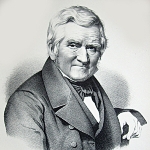
Christen Kobke was a Danish painter, considered among the integral figures of the Golden Age of Danish painting.
Background
Christen Kobke was born on May 26, 1810 in Copenhagen, Denmark. The son of Peter Berendt Kobke, a baker, and his wife Cecilie Margrete (Petersen) Kobke. Christen was one of 11 children.
In 1815 the family moved from a bakery near Hillerod to Kastellet, a military fortification area in Copenhagen, where his father was head baker. At the age of 11 he suffered from a bout of rheumatic fever. He made many drawings during his convalescence and decided that he would become an artist.
Education
In 1822 at 12 years of age Kobke started his studies at the Royal Danish Academy of Art in Copenhagen, Denmark. He studied first in the drawing class, then under Christian August Lorentzen’s painting studio, and finally 4 years under Christoffer Wilhelm Eckersberg after Lorentzen’s death in 1828. Eckersberg stressed observance of nature, and Kobke’s talent grew under Eckersberg’s disciplined training.
Career
Kobke painted his first mature work "View of Arhus Cathedral" in 1829. He lived in Kastellet, Denmark until 1833 and made many paintings of the area.
In 1832 Kobke shared a studio with his friend, landscape painter Frederik Hansen Sodring. He painted a portrait of Sodring which now hangs in the Hirschsprung Collection.
In 1834 he moved, along with his parents, outside of Copenhagen’s fortifications near Sortedamssoen, a lake area. He painted many views overlooking the lake towards the city and the embankments surrounding the city. His work became larger, more monumental.
Like many of his contemporary artists he came under the influence of Niels Lauritz Hoyen, art historian, who promoted a nationalistic art. Hoyen called for artists to search for subject matter in the folk life of their country instead of searching for themes in other lands, such as Italy (which was at that time considered a requirement for an artist’s training). On a visit to Hillerod in 1835 Kobke painted a romantic picture of Frederiksborg Palace, "Frederiksborg Slot ved Aftenbelysning" ("Frederiksborg Palace in the Evening Light").
In 1838 he traveled via Dresden and Munich to Italy accompanied by decorative painter Georg Hilker. They arrived in Rome by year’s end where he met his brother-in-law Frederik Christopher Krohn, sculptor and medallionist, and many other Danish artists. He traveled, along with Constantin Hansen the following summer to Naples, Sorrento, Pompeii and Capri where he painted out in the open air.
He returned home in 1840 with a large collection of sketches for later use and inspiration. Unfortunately, most of his later work with these Italian themes was uninspired, and they found little favor. Kobke even considered at the time becoming a decorator, having participated in 1844-1845 in the decoration of the Thorvaldsens Museum, a museum dedicated to the artistic works of Bertel Thorvaldsen.
Two years after his father died in 1843 the family sold the property outside Copenhagen, and Kobke moved back into the city. His application for admission to the Academy, which was accompanied by one of his failed Italian landscapes, was rejected in 1846.
Christen Kobke died of pneumonia on February 7, 1848 in Copenhagen, Denmark, and is buried in Assistens Cemetery in Copenhagen, Denmark.
Achievements
Christen Kobke is recognized today as one of the most talented among Denmark’s Golden Age painters and the most internationally renowned Danish painter of his generation.
His works are in the collections of not only Danish museums, but also such international museums as the J. Paul Getty Museum in Los Angeles, the Louvre Museum in Paris, and the Scottish National Gallery in Edinburgh.