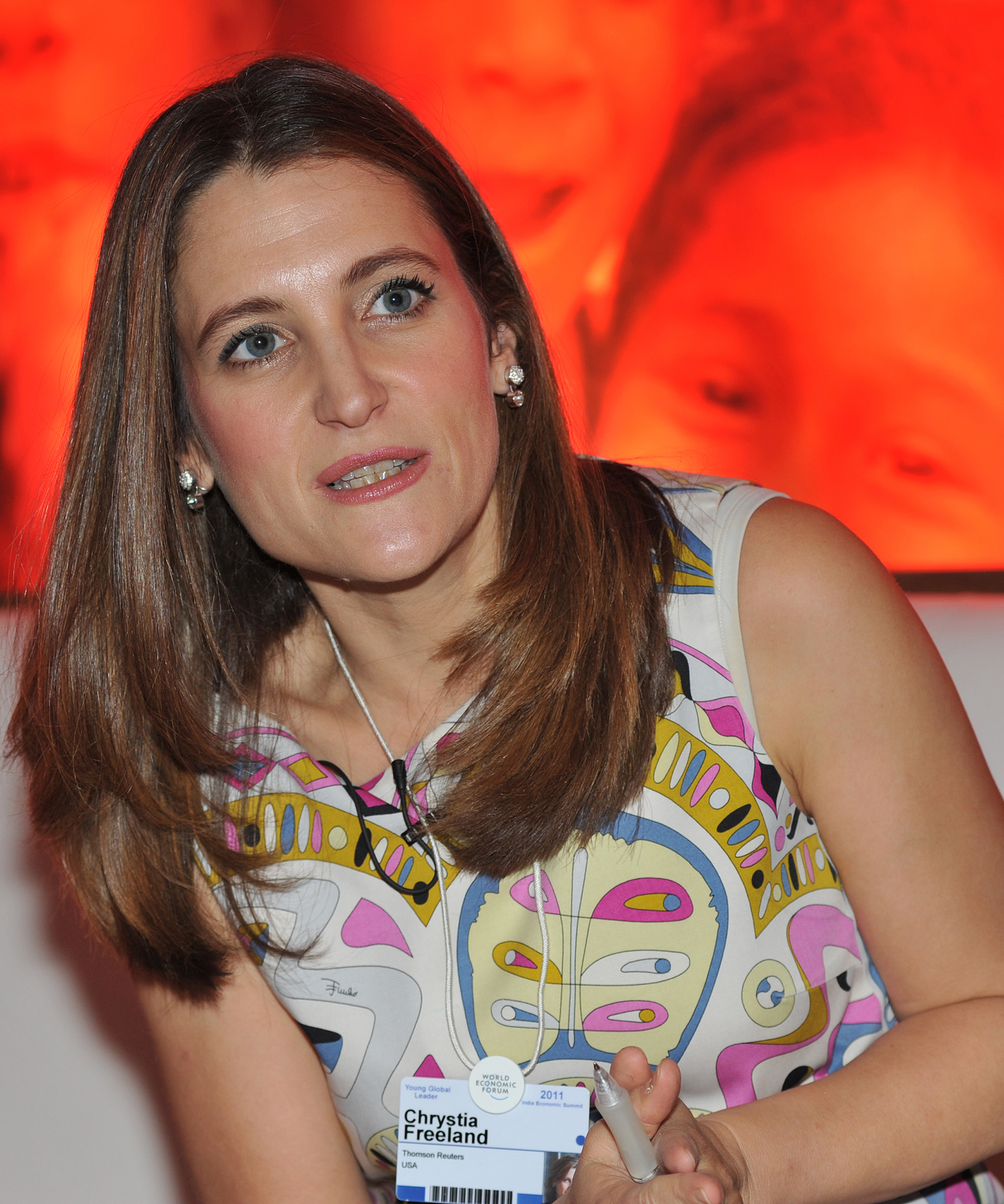
Chrystia Freeland is a Canadian journalist, author, and Liberal politician who became Deputy Prime Minister and Canada’s first woman Minister of Finance. Her career has included senior editorships at the Financial Times and The Globe and Mail, books on post-Soviet Russia and global inequality, trade negotiations, and leadership of the Rhodes Trust.
Background
Ethnicity:
Freeland has documented Ukrainian heritage through her maternal family.
Freeland was born on August 2, 1968, in Peace River, Alberta, a regional centre in northern Alberta. Her mother, Halyna Chomiak, came from a Ukrainian-Canadian family, and Freeland has maintained a public connection with Ukrainian history and political affairs.
Her early adulthood coincided with the final years of the Soviet Union and the political and economic transformations that followed its collapse. That setting informed her later journalistic specialization in Russia, Ukraine, and Eastern Europe, as well as her first book on the struggle between reformers and oligarchs in post-Soviet Russia.
Education
Freeland earned a Bachelor of Arts in History and Literature from Harvard University in 1991. Harvard, founded in 1636 in Cambridge, Massachusetts, is the oldest institution of higher education in the United States and has long combined liberal-arts education with advanced scholarship.
She then studied at St Antony’s College, University of Oxford, as a Rhodes Scholar, completing postgraduate work in Slavonic Studies. St Antony’s, founded in 1950, is Oxford’s specialist college for modern history, international relations, economics, and area studies; its academic environment was closely suited to Freeland’s later work on Russia, Ukraine, and international political economy.
Freeland began her journalism career as a Ukraine-based stringer for the Financial Times, The Washington Post, and The Economist in the early 1990s. She subsequently held a succession of editorial and correspondent positions at the Financial Times, including Eastern Europe correspondent, Moscow bureau chief, United Kingdom national news editor, FT.com editor, deputy editor, editor of electronic services, and United States managing editor. These assignments placed her within international financial journalism during the dissolution of the Soviet Union, the emergence of post-Soviet states, and the expansion of digital news publishing.
From 1999 to 2001, Freeland was deputy editor of The Globe and Mail, a major Canadian national newspaper founded in 1844 through the merger of The Globe and The Mail and Empire. She returned to the Financial Times in senior editorial roles before joining Thomson Reuters in 2010 as managing director and editor of Consumer News. Thomson Reuters was a global news and information organization serving financial, professional, and media markets.
Freeland entered federal politics in 2013, winning a by-election as the Liberal Member of Parliament for Toronto Centre. She later represented University—Rosedale and held cabinet responsibilities as Minister of International Trade, Minister of Foreign Affairs, Deputy Prime Minister, Minister of Finance, and, briefly, Minister of Transport and Internal Trade. As international trade minister, she worked on CETA and the renegotiation of NAFTA, which produced the CUSMA agreement. As foreign minister, she emphasized human rights, democratic institutions, transatlantic relations, and support for Ukraine. As finance minister from 2020 to 2024, she became the first woman to hold Canada’s finance portfolio.
After leaving federal parliamentary politics in 2026, Freeland continued work in public policy and international affairs. She became a Senior Research Fellow at Harvard Kennedy School and an economic adviser to the President of Ukraine. In July 2026, she became Warden of Rhodes House and Chief Executive Officer of the Rhodes Trust, the educational charity that administers the Rhodes Scholarship and related programs.
Freeland played a central role in negotiating the Canada–United States–Mexico Agreement, which replaced the North American Free Trade Agreement and preserved a continental framework for trade among Canada, the United States, and Mexico.
As Minister of Foreign Affairs, Freeland led Canada’s diplomatic response to major international disputes and promoted human rights, democratic institutions, support for Ukraine, and a rules-based international order.
Freeland became Canada’s first woman Minister of Finance in 2020 and directed the finance portfolio during the COVID-19 pandemic and the subsequent economic recovery.
(A political memoir and international analysis based on Fr...)
2026
Politics
Freeland is affiliated with the Liberal Party of Canada, a centrist-to-centre-left political party that traditionally combines liberal individual rights, social programs, economic openness, and a federal role in national development. Her political positions have emphasized parliamentary democracy, gender equality, multilateral cooperation, support for Ukraine, a rules-based international order, and the use of trade policy to protect Canadian interests.
As Minister of International Trade, she helped negotiate the Comprehensive Economic and Trade Agreement with the European Union and later played a central role in replacing NAFTA with the Canada–United States–Mexico Agreement. As Minister of Foreign Affairs, Deputy Prime Minister, and Minister of Finance, she represented a liberal internationalist approach that linked economic policy, democratic resilience, human rights, and national sovereignty.
Views
Freeland’s public writings and political work emphasize democratic accountability, international cooperation, social mobility, and the relationship between economic power and political legitimacy. In Plutocrats, she examined the concentration of wealth and influence among a global super-rich whose economic networks increasingly transcend national communities.
Her public-policy arguments have also connected trade, security, and democracy. She has presented liberal democracy as requiring both open international partnerships and institutions capable of responding to inequality, authoritarianism, and the political effects of economic dislocation.
Connections
Freeland is married to journalist Graham Bowley, and they have three children. Her maternal family background includes Ukrainian-Canadian journalist and political activist Michael Chomiak, whose life and wartime experiences have been discussed in historical research on Ukrainians in Canada and Europe.
husband:
Graham Bowley
Journalist and author.
References
Harvard Kennedy School biography of Chrystia Freeland
Documents Freeland’s journalism, political offices, education, awards, current fellowship, economic advisory work, and appointment as incoming Chief Executive Officer of the Rhodes Trust.
Rhodes Trust appointment announcement
Documents Freeland’s Rhodes Scholarship, journalistic and political career, and appointment as Warden of Rhodes House and Chief Executive Officer of the Rhodes Trust beginning in July 2026.
2013 Lionel Gelber Prize
Documents Freeland’s receipt of the Lionel Gelber Prize for Plutocrats and describes the book’s examination of global economic power and inequality.