

Background
Ryn, Claes Gösta was born on June 12, 1943 in Norrköping, Sweden. Permanent resident of the United States, 1979, naturalized, 2002. Son of Gösta Karl and Cecilia Edit (Blom) Ryn.
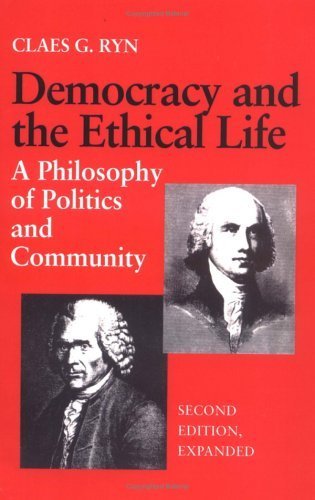
http://www.amazon.com/gp/product/B008F1U2VI/?tag=2022091-20
( This study goes to the heart of ethics and politics. St...)
This study goes to the heart of ethics and politics. Strongly argued and lucidly written, the book makes a crucial distinction between two forms of democracy. The author defends constitutional democracy as potentially supportive of the ethical life, while he criticizes the plebiscitary form of democracyas undermiining man's moral nature. The book includes an extensive interpretation and refutation of the ideas of Jean-Jacques Rousseau and offers a new perspective on the American Constitution and the relationship between moral community and self-interest. This edition includes an important new section on the common good and the state of Western democracy. PRAISE FOR THE BOOK: "One of the best books on the terrain where politics and morality precariously overlap, recommended vigorously to all who are concerned with the loss of political morality."―Peter Viereck "An excellent and much needed analysis, and synthesis, of the relation of man's moral life to democratic, constitutional self rule."―Vera Lex
http://www.amazon.com/gp/product/0813207118/?tag=2022091-20
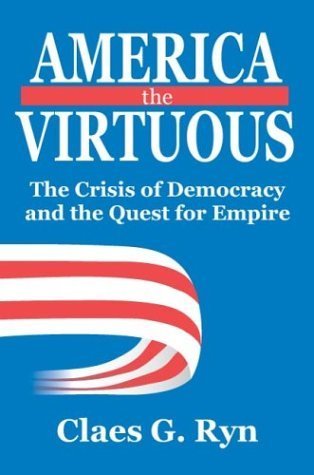
http://www.amazon.com/gp/product/B01181QWFQ/?tag=2022091-20
( Urged on by a powerful ideological and political moveme...)
Urged on by a powerful ideological and political movement, George W. Bush committed the United States to a quest for empire. American values and principles were universal, he asserted, and should guide the transformation of the world. Claes Ryn sees this drive for virtuous empire as the triumph of forces that in the last several decades acquired decisive influence in both the American parties, the foreign policy establishment, and the media. Public intellectuals like William Bennett, Charles Krauthammer, William Kristol, Michael Novak, Richard Perle, and Norman Podhoretz argued that the United States was an exceptional nation and should bring "democracy," "freedom," and "capitalism" to countries not yet enjoying them. Ryn finds the ideology of American empire strongly reminiscent of the French Jacobinism of the eighteenth century. He describes the drive for armed world hegemony as part of a larger ideological whole that both expresses and aggravates a crisis of democracy and, more generally, of American and Western civilization. America the Virtuous sees the new Jacobinism as symptomatic of America shedding an older sense of the need for restraints on power. Checks provided by the US Constitution have been greatly weakened with the erosion of traditional moral and other culture.
http://www.amazon.com/gp/product/141281331X/?tag=2022091-20
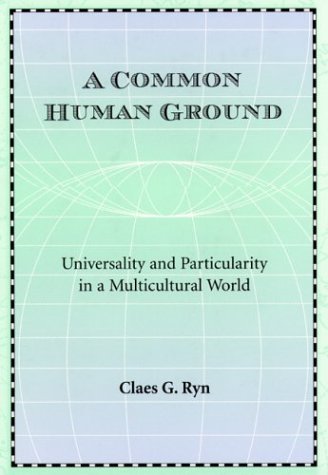
( A great challenge of the twenty-first century is the da...)
A great challenge of the twenty-first century is the danger of conflict between persons, peoples, and cultures, among and within societies. In A Common Human Ground, Claes Ryn explores the nature of this problem and sets forth a theory about what is necessary for peaceful relations to be possible. Many in the Western world trust in “democracy,” “capitalism,” “liberal tolerance,” “scientific progress,” or “general enlightenment” to handle this problem. Although each of these, properly defined, may contribute toward alleviating disputes, Ryn argues that the problem is much more complex and demanding than is usually recognized. He reasons that, most fundamentally, good relations among individuals and nations have moral and cultural preconditions. What can predispose them to mutual respect and peace? One Western philosophical tradition, for which Plato set the pattern, maintains that the only way to genuine unity is for historical diversity to yield to universality. The implication of this view for a multicultural world would be a peace that requires that cultural distinctiveness be effaced as far as possible and replaced with a universal culture. A very different Western philosophical tradition denies the existence of universality altogether. It is represented today by postmodernist multiculturalism—a view that leaves unanswered the question as to how conflict between diverse groups might be averted. Ryn questions both of these traditions, arguing for the potential union of universality and particularity. He contends that the two need not be enemies, but in fact need each other. Cultivating individual and national particularities is potentially compatible with strengthening and enriching our common humanity. This volume embraces the notion of universality, while at the same time historicizing it. Using wide-ranging examples, Ryn presents a firmly sustained and systematic argument centering on this central issue. His approach is interdisciplinary, discussing not only political ideas, but also fiction, drama, and other arts. Scholarly and philosophical, but not specialized, this book will appeal to general readers as well as intellectuals.
http://www.amazon.com/gp/product/0826214940/?tag=2022091-20
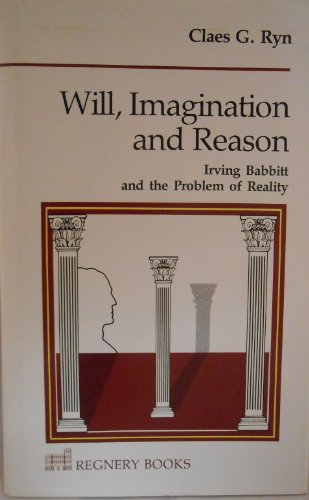
(Ryn provides a thorough examination of the ideas of Irvin...)
Ryn provides a thorough examination of the ideas of Irving Babbitt, leader of the New Humanism movement in the 1920s and 1930s.
http://www.amazon.com/gp/product/0895265796/?tag=2022091-20
( This strongly and lucidly argued book gave early warnin...)
This strongly and lucidly argued book gave early warning of a political-intellectual movement that was spreading in the universities, media, think-tanks, and foreign-policy and national security establishment of the United States. That movement claims that America represents universal principles and should establish armed global hegemony. Claes G. Ryn demonstrates that, although this ideology is often called “conservative” or “neoconservative,” it has more in common with the radical Jacobin ideology of the French Revolution of 1789. The French Jacobins selected France as savior of the world. The new Jacobins have anointed the United States. The author explains that the new Jacobinism manifests a precipitous decline of American civilization and that it poses a serious threat to traditional American constitutionalism and liberty. The book’s analyses and predictions have proved almost eerily prophetic. President George W. Bush made neo-Jacobin ideology the basis of U.S. foreign policy, and it continues to exercise great influence in both parties. This new edition of a modern classic contains a thought-provoking afterword by the author that brings the book up to date.
http://www.amazon.com/gp/product/093278304X/?tag=2022091-20
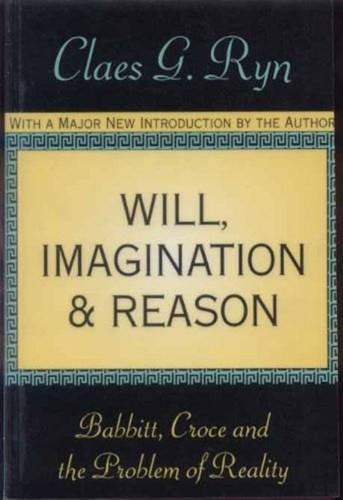
( Will, Imagination, and Reason sets forth a new understa...)
Will, Imagination, and Reason sets forth a new understanding of reality and knowledge with far-reaching implications for the study of man and society. Employing a systematic approach, Claes Ryn goes to the philosophical depths to rethink and reconstitute the epistemology of the humanities and social sciences. He shows that will and imagination, together, constitute our basic outlook on life and that reason derives its material and general orientation from the interaction between them. The imaginative master-minds―novelists, poets, composers, painters, and others―powerfully affect the sensibility and direction of society. Sometimes a distorting, self-serving willfulness at the base of their visions draws civilization, including reason, into dangerous illusion. More penetrating and balanced vision and rationality spring from a different quality of will. Ryn explains the kind of interplay between will, imagination, and reason that is conducive to a deepened sense of reality and to intellectual understanding. He argues that human life and self-knowledge are inescapably historical. In developing his dialectical view of intellect, he draws from Irving Babbitt, Benedetto Croce, and other philosophers to refute positivistic, formalistic, and ahistorical theories of knowledge and to develop his alternative. Advancing a systematic epistemological argument, Ryn throws much new light on the nature of reason but also on central issues of ethics and aesthetics. This trenchant and original work is indispensable to philosophers, social, political and cultural theorists, literary scholars, and historians.
http://www.amazon.com/gp/product/1560009187/?tag=2022091-20

http://www.amazon.com/gp/product/B011820V52/?tag=2022091-20
institute administrator research science educator author
Ryn, Claes Gösta was born on June 12, 1943 in Norrköping, Sweden. Permanent resident of the United States, 1979, naturalized, 2002. Son of Gösta Karl and Cecilia Edit (Blom) Ryn.
Doctor of Philosophy candidate, Uppsala University, Sweden, 1967. Postgraduate, Uppsala University, Filikand Sweden, 1969—1971. Postgraduate, Syracuse University, 1968—1969.
Doctor of Philosophy, Louisiana State University, 1974.
Assistant professor politics, Catholic U. American, Washington, 1974-1978;
associate professor politics, Catholic U. American, Washington, 1978-1982;
professor politics, Catholic U. American, Washington, since 1982;
assistant dean, School Arts and Sciences, Catholic U. American, Washington, 1977-1979;
department chairman politics, Catholic U. American, Washington, 1979-1985. Visiting associate professor of University Virginia, Charlottesville, 1981. Co-founder, chairman National Humanities Institute, Washington, since 1984.
Referee, evaluator National Endowment for Humanities, Dept.Edn., United States Information Agency, others. Director numerous scholarly conferences and lecture series. Member Richard M. Weaver fellowship selection committee, since 1980.
Faculty sponsor Earhart Foundation, since 1989. Member awards committee Ingersoll Prizes, 1990. Member Salvatori doctoral fellowship selection committee Intercollegiate Studies Institute, since 1990.
( This strongly and lucidly argued book gave early warnin...)
( Will, Imagination, and Reason sets forth a new understa...)
( A great challenge of the twenty-first century is the da...)
(Ryn provides a thorough examination of the ideas of Irvin...)
(Ryn provides a thorough examination of the ideas of Irvin...)
( Urged on by a powerful ideological and political moveme...)
( This study goes to the heart of ethics and politics. St...)
(CAN DEMOCRACY SURVIVE?)
Member vestry St. Francis Episcopal Church, Potomac, Maryland, 1986-1988. Served with Swedish Army, Royal Life Company I 4 Regiment, 1963, Signal Corps S1 Regiment, 1967-1968. Member Philadelphia Society (trustee 1999, Second vice president 2000-2001, president 2001-2002), Academy Philosophy and Letters (co-founder, member, board directors since 2006, president, since 2007).
Married Marianne Carin Tedhagen, August 30, 1969. Children: Charlotte, Viveka, Elisabet.
