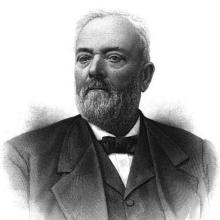
David Wilber was an American businessman, banker, farmer, and Republican politician from New York. He represented the state in the U.S. House during three periods between 1873 and 1890, while also leading the Wilber National Bank and participating in regional railroad and local-government affairs.
Background
David Wilber was born on October 5, 1820, near Quaker Street in Duanesburg, Schenectady County, New York. His parents moved the family to Milford in Otsego County, where he attended the common schools. Milford was an agricultural community in central New York, and Wilber's early work developed within the region's farm, lumber, and hop-producing economy.
Before entering Congress, Wilber worked as a farm laborer, farmed land on shares, acquired real estate, and became active in the lumber trade and hop business. The hop trade was an important commercial activity in central New York during the nineteenth century, linking local agriculture with wider markets and transportation networks.
Education
Wilber attended the common schools after his family moved to Milford, Otsego County, New York. His education was typical of the local elementary schooling available in rural communities during the period and preceded a career developed through business, agriculture, banking, and public service rather than through a documented college education.
Career
Wilber began his working life in agriculture, lumbering, real-estate ownership, and the hop business. A nineteenth-century Congressional directory described him as having worked first as a farm laborer and on shares before becoming an owner of real estate and an established participant in the lumber and hop trades.
He entered local public life through the Otsego County Board of Supervisors, serving in 1858, 1859, 1862, 1865, and 1866. County boards in nineteenth-century New York administered local taxation, roads, public buildings, and other county affairs. Wilber also became a director of the Albany and Susquehanna Railroad, a regional line that connected communities in the Hudson Valley and central New York and later formed part of the Delaware and Hudson railway system.
Wilber was a director of the Second National Bank of Cooperstown and became president of the Wilber National Bank of Oneonta in 1874, holding that position until his death. National banks chartered under federal law provided commercial credit and a standardized banking framework during the post-Civil War era; his banking career placed him among the business leaders involved in the financial development of Otsego County.
He was elected as a Republican to the Forty-third Congress and served from March 4, 1873, to March 3, 1875. He was elected again to the Forty-sixth Congress, serving from March 4, 1879, to March 3, 1881. After moving to Oneonta in 1886, he returned to the House in the Fiftieth Congress and was reelected to the Fifty-first Congress. He served from March 4, 1887, until his death; because of ill health, he took the oath of office at home and never attended a session of the Fifty-first Congress.
Wilber represented a period when congressional service, regional banking, transportation investment, agriculture, and party organization were closely connected in upstate New York. He was a delegate to the Republican National Conventions of 1880 and 1888 and remained president of the Wilber National Bank while completing his final period of public service.
Achievements
Wilber represented New York in four Congresses, serving during the Forty-third, Forty-sixth, Fiftieth, and Fifty-first Congresses between 1873 and 1890.
Wilber helped develop the commercial and financial infrastructure of Otsego County through leadership of the Wilber National Bank and directorships in the Second National Bank of Cooperstown and the Albany and Susquehanna Railroad.
Politics
Wilber was a Republican whose public career combined local government, banking, transportation development, and service in the United States House of Representatives. The Republican Party, founded in the 1850s in opposition to the expansion of slavery, became the dominant national party in New York during much of Wilber's political life and associated itself with Union preservation, economic modernization, protective tariffs, and the development of transportation and financial infrastructure.
Wilber represented New York in the Forty-third Congress from 1873 to 1875, the Forty-sixth Congress from 1879 to 1881, and the Fiftieth and Fifty-first Congresses beginning in 1887. He also served as a delegate to the Republican National Conventions of 1880 and 1888. His reelection to the Fifty-first Congress occurred while he was in poor health; he took the oath of office at his home and did not attend a session before his death.
Connections
Wilber was the father of David Forrest Wilber, who later represented New York in the United States House of Representatives from 1895 to 1899. The two men formed part of a New York political and banking family associated with Oneonta and the Wilber National Bank.
Son:
David Forrest Wilber
Represented New York in the United States House of Representatives from 1895 to 1899 and was associated with the Wilber National Bank of Oneonta.
Historical souvenir of Oneonta, N.Y.
Local historical account describing Wilber's banking career, business prominence, connection with Oneonta, and family.