

Background
Southern, David W. was born on February 19, 1938 in Great Bend, Kansas, United States. Son of Arnett D. Southern and Maxine Loretto Windon.

( In this comprehensive, unflinching account, David W. So...)
In this comprehensive, unflinching account, David W. Southern persuasively argues that race was the primary blind spot of the Progressive Movement. Based on the voluminous secondary works produced over the last forty years and his own primary research, Southern’s synthesis vividly portrays the ruthless exploitation, brutality, and violence that whites inflicted on African Americans in the first two decades of the twentieth century. In the former Confederate states, where almost 90 percent of blacks resided, white progressives followed the lead of racist demagogues such as “Pitchfork” Ben Tillman and James Vardaman by consolidating the Jim Crow system of legal segregation and the disfranchisement of blacks, resulting in the emergence of the one-party Democratic South. When legal discrimination did not sufficiently subordinate blacks, southern whites resorted liberally to fraud, intimidation, and violence—most notably in ghastly lynchings and urban race riots. Yet, most northern progressives were either indifferent to the fate of southern blacks or actively supported the social system in the South. Yankee reformers obsessed over the concept of race and became ensnared in a web of “scientific racism” that convinced them that blacks belonged to an inferior breed of human beings. The tenures of both Theodore Roosevelt, who wrote more about race than any other American president, and Woodrow Wilson, who was reared in the Deep South, proved disastrous for African Americans, who reached their “nadir” even as Wilson led the United States on a crusade to make the world safe for democracy. Southern goes on to persuasively reveal that African Americans courageously fought to change the implacably racist system in which they lived, against overwhelming odds. Indeed, it was the rise of the militant “New Negro” during the Progressive Era that provoked much of the anti-black repression and violence. Dr. Southern further examines how the origins of the modern civil rights movement emerged in the wake of the rivalry between Booker T. Washington and W.E.B. Du Bois, going beyond an analysis of their leadership to illuminate other important African American activists who held strong views of their own. Finally, an epilogue assesses the malignant racial heritage of the progressives by looking at the discrimination against African Americans, both those in and newly returned home from the armed forces, during World War I and the numerous race riots in northern cities that were in part occasioned by the large-scale migration of southern blacks.
http://www.amazon.com/gp/product/088295234X/?tag=2022091-20
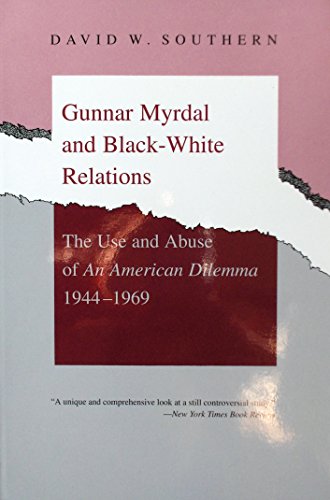
(In 1944, the Swedish economist Gunnar Myrdal published An...)
In 1944, the Swedish economist Gunnar Myrdal published An American Dilemma, his report on black-white relations in the United States. A large work of more than one thousand pages, the book was an important subject of race for twenty years, helping to influence government studies and Supreme Court cases. This book, by David W. Southern, is the story of the long and troubled process of the making and completion of the Myrdal report.
http://www.amazon.com/gp/product/0807118842/?tag=2022091-20
http://www.amazon.com/gp/product/B011MDG1P6/?tag=2022091-20

http://www.amazon.com/gp/product/B011MG54YM/?tag=2022091-20

( Before Vatican II, before the race riots of the 1940s, ...)
Before Vatican II, before the race riots of the 1940s, the white Jesuit priest John LaFarge decried America's treatment of blacks. A man ahead of his church on the race issue who nevertheless did not press hard enough in ridding it of an institutional bias against African Americans is the portrait David W. Southern paints in the first scholarly biography of LaFarge. According to Southern, LaFarge was the foremost Catholic spokesman on black-white relations in America for more than thirty years. In a series of books and articles -- he served on the staff of the influential Jesuit weekly America from 1926 until his death -- he significantly improved the image of the Church in the eyes of black, Jewish, and Protestant leaders. In 1934 he founded the Catholic Interracial Council of New York, the most important Catholic civil rights organization in the pre-Brown era. His declaration in 1937 that racism is a sin and a heresy so impressed the pope that he employed LaFarge to write an encyclical on the subject. Although lauded in his time for his achievements in race relations, LaFarge, Southern contends, espoused too gradualist an approach. Southern maintains that LaFarge was fettered by a fierce loyalty to the Church, a staunch clericalism, an intense concern with the image of Catholicism in Protestant America, an aristocratic background, and Eurocentric thinking -- producing in him an abiding paternalism and lingering ambivalence about black culture, and a tendency to conceal the Church's discriminatory practices rather than reveal them. Moreover, he was too slow to condemn segregation and approve the nonviolent direct action of Martin Luther King, Jr. Still, Southern sees in LaFarge a redeeming capacity for liberal growth, citing his inspiration of a younger, more militant generation of Catholics and his joining in the 1963 March on Washington. Based on extensive archival research, this impressive, engrossing biography fills a serious gap in Catholic social history and race relations history.
http://www.amazon.com/gp/product/0807119717/?tag=2022091-20

http://www.amazon.com/gp/product/B01182F6QG/?tag=2022091-20

http://www.amazon.com/gp/product/B004ORC8XW/?tag=2022091-20
Southern, David W. was born on February 19, 1938 in Great Bend, Kansas, United States. Son of Arnett D. Southern and Maxine Loretto Windon.
Bachelor, Alderson-Boraddus College, West Virginia, 1964. Master of Arts, Wake Forest University, North Carolina, 1965. Doctor of Philosophy, Emory University, Atlanta, 1971.
Instructor North Carolina Wesleyan College, Rocky Mount, North Carolina, 1965—1966. Professor Westminster College, Fulton, Missouri, 1970—2005. With United States Air Force, 1956-1960.
(In 1944, the Swedish economist Gunnar Myrdal published An...)
( Before Vatican II, before the race riots of the 1940s, ...)
( In this comprehensive, unflinching account, David W. So...)
Member of Southern History Association, Organization American Historians.
Married Judith Marie Jarvis (divorced). 1 child Sheri Lee.
