

Background
Bahr, Ehrhard was born on August 21, 1932 in Kiel, Germany. Son of Klaus and Gisela (Badenhausen) Bahr. came to the United States, 1956.
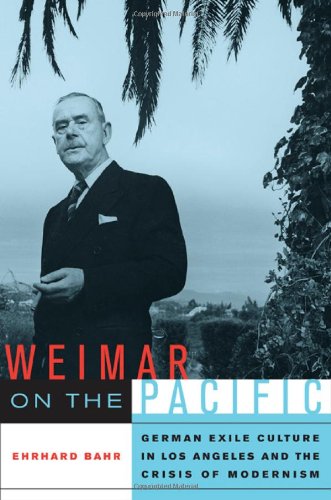
( In the 1930s and 40s, Los Angeles became an unlikely cu...)
In the 1930s and 40s, Los Angeles became an unlikely cultural sanctuary for a distinguished group of German artists and intellectualsincluding Thomas Mann, Theodore W. Adorno, Bertolt Brecht, Fritz Lang, and Arnold Schoenbergwho had fled Nazi Germany. During their years in exile, they would produce a substantial body of major works to address the crisis of modernism that resulted from the rise of National Socialism. Weimar Germany and its culture, with its meld of eighteenth-century German classicism and twentieth-century modernism, served as a touchstone for this group of diverse talents and opinions. Weimar on the Pacific is the first book to examine these artists and intellectuals as a group. Ehrhard Bahr studies selected works of Adorno, Horkheimer, Brecht, Lang, Neutra, Schindler, Döblin, Mann, and Schoenberg, weighing Los Angeles’s influence on them and their impact on German modernism. Touching on such examples as film noir and Thomas Mann’s Doctor Faustus, Bahr shows how this community of exiles reconstituted modernism in the face of the traumatic political and historical changes they were living through.
http://www.amazon.com/gp/product/0520251288/?tag=2022091-20

http://www.amazon.com/gp/product/B010BDEEMA/?tag=2022091-20
http://www.amazon.com/gp/product/3406060714/?tag=2022091-20
Germanic languages and literature educator
Bahr, Ehrhard was born on August 21, 1932 in Kiel, Germany. Son of Klaus and Gisela (Badenhausen) Bahr. came to the United States, 1956.
Student, University Heidelberg, Germany, 1952-1953; student, University Freiburg, Germany, 1953-1956; Master of Science Educated (Fulbright scholar), U. Kansas, 1956-1958; postgraduate, U. Cologne, 1959-1961; Doctor of Philosophy, University of California, Berkeley, 1968.
Assistant professor German, University of California at Los Angeles, 1968-1970;
associate professor, University of California at Los Angeles, 1970-1972;
professor, University of California at Los Angeles, since 1972;
department chairman Germanic languages, University of California at Los Angeles, 1981-1984, 93-98;
chair graduate council, University of California at Los Angeles, 1988-1989. Author: Irony in the Late Works of Goethe, 1972, Georg Lukacs, 1970, Ernst Bloch, 1974, Nelly Sachs, 1980. Editor: Kant, What is Enlightenment?, 1974, Goethe, Wilhelm Meister's Journeyman Years, 1982, History of German Literature, 3 volumes, 1987-1988.
Co-editor: The InternalizedRevolution: German Reactions to the French Revolution, 1789-1989, 1992. Commentary: Thomas Mann: Death in Venice, 1991. Contributor articles to professional journals.
( In the 1930s and 40s, Los Angeles became an unlikely cu...)
Member Modern Language Association, American Society 18th Century Studies, American Association Teachers German, Western Society 18th Century Studies, German Studies Association (president 1987-1988), Philological Association Pacific Coast, Lessing Society, Goethe Society North America (executive secretary 1979-1989, president 1995-1997).
Married Diana Meyers, November 21, 1973. Stepchildren: Gary, Timothy, Christopher.
