Background
He was born in 480 B. C. A descendant of the last high priest before the destruction of the First Temple.

He was born in 480 B. C. A descendant of the last high priest before the destruction of the First Temple.
He was “a skilled scribe in the law of Moses” in Babylonia, that is, he made copies of the Pentateuch. In the seventh year of the rule of King Artaxerxes of the Persian dynasty that ruled the region, Ezra received permission from the king to lead a iarge group of 1,754 families of Jews to Jerualem to join those already settled there.
The king was in all probability Artaxerxes I, in which case Ezra would have gone to Jerusalem in 458 BCE; however, many scholars have suggested that it was Artaxerxes II, in which case Ezra would have gone in 397. Ezra was moved in his decision by reports of the absence of spiritual leaders in the Jerusalem community, the lax religious life, and the unsatisfactory situation in the Temple. Before setting out, he received broad authority from the king, with many rights, including permission to receive gifts for the Temple, to exempt Temple officials from paying tax, to teach the Torah, and to appoint judges. He selected compatible priests, Levites, and teachers to join him. He did not ask Artaxerxes for military protection for the four-month journey as he had told the king that the returning Judeans relied solely on God to guarantee their safety.
His story is contained in Ezra 7-10 and Nehe- miah 8-9. No mention is made of his death. Josephus records the tradition that he was buried in Jerusalem, but another tradition locates his grave near the banks of the River Tigris in Babylonia (modern Iraq).
Once in Jerusalem, he instituted a number of religious reforms, based on the Torah, which were to mold the future of Judaism. When he realized the extent of mixed marriages contracted by the Jews of Judah with women from other peoples, he convened a mass assembly in which the populace voluntarily agreed to dissolve alliances with for¬eign wives and repudiate children of such marriages (his success could not have been complete because he later had to fight this practice again).
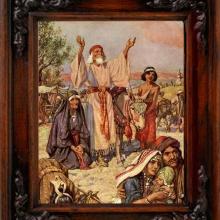
His other major action was the reading of the Torah to a mass assembly at the New Year festival. This met with a popular response in which the people confessed their sins, made a covenant to observe the Torah, reiterated their opposition to mixed marriages, and undertook not to work on the Sabbath and to support the Temple. This great demonstration seems to have been inspired by and followed immediately upon Nehemiah’s completion of the wall of Jerusalem.
The last act of Ezra mentioned in the Bible was his participation in the dedication of the wall. His memoirs end after recording about one year of active leadership. Nevertheless, he made a great impression on the Jewish people and was highly respected in rabbinic tradition. He was seen as the father of the oral law and an essential link in the chain of tradition.
It was believed that he founded the Great Assembly (or its precursor), which was the key legislative institution for most of the Second Temple period. According to the rabbis he ordained ten crucial decrees including the regular reading of the Torah and the change from the ancient Hebrew script to the square script that is still standard, and it was held that he participated in the final codification of the Pentateuch. Indeed he was esteemed so highly that it was said, “If God had not given the Law through Moses, he would have given it through Ezra.”