

Background
Francis Brown was born on January 11, 1784 at Chester, New Hampshire and was the son of Benjamin and Prudence (Kelly) Brown.
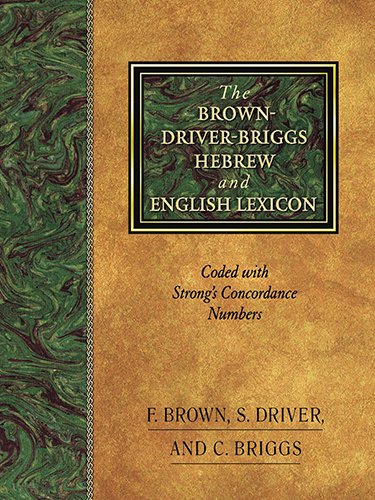
(A trio of eminent Old Testament scholars--Francis Brown, ...)
A trio of eminent Old Testament scholars--Francis Brown, R. Driver, and Charles Briggs--spent over twenty years researching, writing, and preparing "The Brown-Driver-Briggs Hebrew and English Lexicon." Since it first appeared in the early part of the twentieth century, BDB has been considered the finest and most comprehensive Hebrew lexicon available to the English-speaking student. Based upon the classic work of Wilhelm Gesenius, the "father of modern Hebrew lexicography," BDB gives not only dictionary definitions for each word, but relates each word to its Old Testament usage and categorizes its nuances of meaning. BDB's exhaustive coverage of Old Testament Hebrew words, as well as its unparalleled usage of cognate languages and the wealth of background sources consulted and quoted, render BDB and invaluable resource for all students of the Bible.
https://www.amazon.com/Bdb-Hebr-Eng-Lexicon-Francis-Brown/dp/1565632060?SubscriptionId=AKIAJRRWTH346WSPOAFQ&tag=prabook-20&linkCode=sp1&camp=2025&creative=165953&creativeASIN=1565632060
(Crisp copy with a sturdy binding and light shelf wear. No...)
Crisp copy with a sturdy binding and light shelf wear. No marks! Came out of personal library.
https://www.amazon.com/Brown-Driver-Briggs-Hebrew-English-Lexicon-Publisher/dp/B004SG81SU?SubscriptionId=AKIAJRRWTH346WSPOAFQ&tag=prabook-20&linkCode=sp1&camp=2025&creative=165953&creativeASIN=B004SG81SU

(A trio of eminent Hebrew Bible scholars-Francis Brown, R....)
A trio of eminent Hebrew Bible scholars-Francis Brown, R. Driver, and Charles Briggs-spent over twenty years researching, writing, and preparing The Brown-Driver-Briggs Hebrew and English Lexicon. Since it first appeared, BDB has been considered the finest and most comprehensive Hebrew lexicon available to the English-speaking student. Based upon the classic work of Wilhelm Gesenius, the "father of modern Hebrew lexicography," BDB gives not only dictionary definitions for each word, but relates each word to its Hebrew Bible usage and categorizes its nuances of meaning. BDB's exhaustive coverage of Hebrew Bible, Hebrew words, as well as its unparalleled usage of cognate languages and the wealth of background sources consulted and quoted, render BDB and invaluable resource for all students of the Bible.
https://www.amazon.com/Brown-Driver-Briggs-Hebrew-English-Lexicon-Francis/dp/1607963175?SubscriptionId=AKIAJRRWTH346WSPOAFQ&tag=prabook-20&linkCode=sp1&camp=2025&creative=165953&creativeASIN=1607963175

(Hebrew and English Lexicon of the Old Testament)
Hebrew and English Lexicon of the Old Testament
https://www.amazon.com/Hebrew-English-Lexicon-Old-Testament/dp/B0007AHT8Y?SubscriptionId=AKIAJRRWTH346WSPOAFQ&tag=prabook-20&linkCode=sp1&camp=2025&creative=165953&creativeASIN=B0007AHT8Y
Francis Brown was born on January 11, 1784 at Chester, New Hampshire and was the son of Benjamin and Prudence (Kelly) Brown.
His father was a country merchant of limited means, but thanks to his stepmother, who seems to have had a better appreciation of the boy's possibilities, Francis Brown secured a good education, attending Atkinson Academy and graduating from Dartmouth College in 1805.
After a year's experience as a private tutor Francis Brown received an appointment as tutor at Dartmouth. He remained at the college for three years, studying theology in addition to carrying on his teaching duties.
On January 11, 1810, Brown began his pastorate at North Yarmouth, Maine, where he remained for the next five years. Soon after ordination he declined the offer of a professorship in languages at Dartmouth, but his continued interest in educational matters is apparent in his service as overseer (1810 - 14) and trustee (1814 - 15) of Bowdoin College and in his close friendship with President Appleton of that institution.
His pastorate at North Yarmouth was successful but without special incident. By training and association Brown naturally belonged among the conservative and orthodox Congregationalist clergy.
His political views are to found in a published sermon (July 23, 1812) on the occasion of the declaration of war against Great Britain, in which he denounced the Madison administration for its subservience to France, "Babylon the great, the mother of harlots and abominations of the earth. " In the meantime there was developing in New Hampshire, its genesis in an obscure parochial quarrel, the controversy which resulted in the "Dartmouth College case. "
On August 26, 1815, the trustees removed President Wheelock and offered the position to Francis Brown who assumed the duties of president a month later. The local quarrel, because of the religious and political affiliations of the participants, rapidly assumed state-wide importance with legislative intervention as a natural result.
Until Chief Justice Marshall handed down the final decision in February 1819, the life of the college hung in the balance.
With its charter virtually annulled by the Act of June 27, 1816, with a new institution, "Dartmouth University, " functioning under the sanction of the state, with funds unavailable because of litigation, with the student body depleted, and confronted with public hostility and internal dissension, there was need of the highest qualities of leadership. President Brown proved equal to the occasion.
His correspondence shows that he had a clear perception of the constitutional and political issues involved, and their bearing on the future of chartered institutions throughout the country. That his services were appreciated elsewhere is seen by the fact that Hamilton and Williams honored him with the degree of D. D.
His health broke under the strain of constant work and anxiety and he did not live to take part in the rehabilitation which followed the victory of 1819, a task for which he would have been admirably qualified. After a vain effort to recover his health in the milder climate of the South he returned to Hanover in June 1820, his death occurring a few weeks later.
(A trio of eminent Old Testament scholars--Francis Brown, ...)
(A trio of eminent Hebrew Bible scholars-Francis Brown, R....)
(Crisp copy with a sturdy binding and light shelf wear. No...)
(Hebrew and English Lexicon of the Old Testament)
He was a devout Calvinist in theology like most members of that body. By training and association Brown naturally belonged among the conservative and orthodox Congregationalist clergy. His faith in the former is set forth in two bulky and controversial pamphlets in defense of Calvin and Calvinism which he published at Portland in 1815.
Francis Brown was a Federalist in politics.
The college work went on in spite of severe handicaps. He conducted classes, raised money, defended the cause before the public, advised with counsel, and by the dignity and tact displayed toward opponents, kept the controversy from degenerating into either a brawl or a comedy as might easily have happened under less competent guidance.
Brown's portrait, now in the possession of the college, is chiefly expressive of the gentle and scholarly character of the youthful teacher and clergyman but the artist has also caught something of the shrewdness, courage, and determination of the Federalist leader and executive, ready to fight to the death against what he regarded as Democratic encroachment on private rights.
Francis Brown was elected a member of the American Antiquarian Society in 1813.
On February 4, 1811, Francis Brown married Elizabeth, daughter of Rev. Tristram Gilman of the same town. Brown's son, Samuel Gilman Brown, was for many years a professor at Dartmouth and later president of Hamilton College; his grandson, Francis Brown, became president of Union Seminary.
