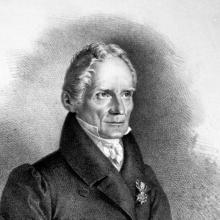
Friedrich Mohs was a German geologist, mineralogist, and physicist. He is best known for developing the Mohs Hardness Scale. Mohs presented his system for classifying minerals in Outline of Mineralogy, published in 1822.
Background
Friedrich Mohs was born Carl Friedrich Christian Mohs on January 29, 1773, in Gernrode, Holy Roman Empire (now Sachsen-Anhalt, Germany) to the family of a merchant August Emanuel Christian Mohs and Wilhelmine Elisabetha Stark. He showed a clear interest in science at an early age.
Education
Friedrich Mohs received a private education before entering the University of Halle in 1797. In 1798 he matriculated at the mining academy at Freiberg, where in addition to physics and mathematics he studied mineralogy under Werner.
In 1802 Mohs was invited to Great Britain by his fellow students George Mitchell and Robert Jameson to participate in the planning of a mining academy at Dublin. Although the proposed academy was never established, the journey enabled Mohs to study the geology and mineralogy of Ireland and Scotland and to make lasting friends among Scottish geologists.
On Mitchell’s recommendation, Mohs in 1802 was commissioned by J. F. von der Null, a Viennese banker, to prepare a systematic description of his important mineral collection. In 1804 Mohs published a two-volume description of this collection and two other works, Beschreibung des Gruben gebäudesHimmelfürst ohnweit Freiberg and Über die oryktognostische Klassifikation, nebst Versuch eines auf blosse äussere Kennzeichen gegründeten Mineral-systems, in which he first expressed his misgivings with Werner’s approach to mineralogy. In 1810, while on one of his frequent mining and mineralogical explorations, he encountered Werner at Carlsbad. Failing to convince Werner of the inadequacy of his mineralogical method, Mohs determined to establish systematic mineralogy on a completely new basis.
In 1811 Archduke Johann established the Johanneum in Graz, and Mohs was appointed curator of the mineral collection and charged with adding to it the minerals and rocks of Styria. Mohs enlisted the young scholar Wilhelm Haidinger to help in this work, and Haidinger remained with Mohs until 1822. In 1812 Mohs became professor of mineralogy at the Johanneum and in the same year revealed the basis of his new classificatory system in his Versuch einer ElementarMethode zur naturhistorischen Bestimmung und Erkennung der Fossilien, in which he first proposed his hardness scale for minerals. Miners and mineralogists had long been accustomed to scratch a mineral to aid in determining the species. In an attempt to make this method more certain, Mohs proposed a scale of increasing hardness from one to ten as follows: talc, 1; gypsum, 2; calcite, 3; fluorite, 4; apatite, 5; feldspar, 6; quartz, 7; topaz, 8; corundum, 9; and diamond, 10. Intermediate degrees of hardness were subsequently added to the Mohs scale. Mineralogists did not commonly employ the scale until the 1820s, after the publication of the English translation of Mohs’s Die Charaktere der Klassen, Ordnungen, Geschlecter, und Arten der naturhistorischen Mineral-Systems, in which the scale was prominently featured.
Mohs remained at Graz until 1817. During this period he worked at perfecting his method of mineral classification, giving particular attention to the possible arrangements of minerals in crystal systems based on external symmetry. In 1817 he again traveled extensively in Great Britain, impressing Scottish mineralogists in particular with his novel ideas. Following Werner’s death in 1817 Mohs was called to Freiberg as a professor of mineralogy, and he assumed this post in the autumn of 1818.
In 1822 and 1824 Mohs published his two-volume Grund-Riss der Mineralogie, the first volume of which was largely devoted to the explanation of his ideas concerning crystallography and the second to a systematic description of minerals.
In 1826 Mohs resigned his professorship at Freiberg to accept a position in Vienna, first to reorganize the imperial collection, which he augmented by the acquisition of the von der Null collection, and then as a professor of mineralogy at the university in 1828. In 1835 he resigned to become an imperial counselor of the exchequer in charge of mining and monetary affairs. This position required him to travel frequently to all parts of the Austro-Hungarian empire. He died while on a journey to inspect the volcanic areas of southern Italy.
Friedrich Mohs is remembered as the creator of the Mohs scale of mineral hardness. Mohs also introduced a classification of the crystal forms in crystal systems independently of Christian Samuel Weiss. Mohsgasse is named after him in Vienna Landstrasse (3rd district) and in Graz-Lend. Mohs' monument was erected at his birthplace in Gernrode in his honor.
Mohs was a Protestant that's why he was for 26 years buried outside the Catholic cemetery in Agordo.
Politics
There is no information left about Friedrich Mohs' possible involvement in politics.
Views
Mohs postulated four crystal systems based on external symmetry: rhombohedral (hexagonal), pyramidal (tetragonal), prismatic (orthorhombic), and tessular (cubic). These divisions were similar to those proposed in 1816-1817 by Christian Samuel Weiss, who had approached the problem in much the same manner. Mohs, however, did not refer to Weiss’s prior publication, and Weiss publicly accused him of plagiarism. Mohs defended himself in a letter to the Edinburgh Philosophical Journal, explaining that his dissatisfaction with Haüy’s crystallographic concepts had led him to develop his own ideas.
Mohs, however, had surpassed Weiss in his analysis. In the first volume of Grund-Riss, he mentioned the possible existence of symmetry systems in which the crystallographic axes were not mutually perpendicular; and in the second volume, he affirmed their existence. These new systems, the monoclinic and the triclinic, were described by K. F. Naumann in 1824 and were fully developed by Mohs in 1832. Grund-Riss, substantially amended and revised, was translated into English by Wilhelm Haidinger as Treatise on Mineralogy (1825). Mohs’s classificatory system, based primarily on crystal form, hardness, and specific gravity, was not received favorably by most mineralogists.
Membership
Friedrich Mohs was a member of the Royal Prussian Academy of Sciences and German Academy of Sciences Leopoldina.
Now Berlin-Brandenburg Academy of Sciences and Humanities
Royal Prussian Academy of Sciences
,
Germany
German Academy of Sciences Leopoldina
,
Germany
Personality
Except for his native German Mohs also had a good command of the French language.
Connections
In 1828 Friedrich Mohs married an Austrian Catholic Josephine Fiala, sister of his friend Franz Fiala. They had no children.