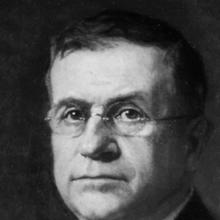
Background
Of Scottish and German ancestry, Ickes was born in Hollidaysburg, Pennsylvania, the son of Matilda (McCune) and Jesse Boone Ickes.


http://www.amazon.com/gp/product/0837174988/?tag=2022091-20

http://www.amazon.com/gp/product/B0006ATISO/?tag=2022091-20

http://www.amazon.com/gp/product/B000GSC9FK/?tag=2022091-20

http://www.amazon.com/gp/product/B000OK8698/?tag=2022091-20

http://www.amazon.com/gp/product/B000R0CT9I/?tag=2022091-20

http://www.amazon.com/gp/product/1330260384/?tag=2022091-20
Of Scottish and German ancestry, Ickes was born in Hollidaysburg, Pennsylvania, the son of Matilda (McCune) and Jesse Boone Ickes.
He moved to Chicago at the age of 16 upon his mother's death and attended Englewood High School there. He was the class president while at Englewood. After graduating, he worked his way through the University of Chicago, finishing with a B.A. in 1897. At Chicago, Ickes was a charter member re-establishing the Illinois Beta Chapter of Phi Delta Theta.
dmitted to the Illinois bar in 1907, Ickes early developed an aroused social conscience; he worked as a volunteer in a settlement house, frequently handled civil liberties cases without pay, and fought for municipal reform and the curbing of public utilities. Vacillating for many years between the two major political parties, he helped swing liberal Republicans to the opposition in the 1932 elections; he was, therefore, a natural choice for secretary of the interior when Roosevelt was seeking a progressive Republican for his Cabinet. Ickes became one of the most energetic and dedicated New Dealers in Washington and a lifelong supporter of the President. In his new post he fought for the preservation of natural resources against exploitation by private interests.
Ickes won a wider reputation as head of the Public Works Administration (PWA; 1933–39). He spent money so carefully that many of his projects—ranging from highways and public buildings to huge Western dams—were slow getting under way, thereby failing to stimulate the depressed national economy as early as desired. Despite the expenditure of more than $5,000,000,000, however, Ickes’ numerous PWA contracts were virtually graft-proof. One of his most valuable services to consumers was in establishing “yardsticks” for electric-power rates through federal and municipal power projects.
During presidential campaigns, Ickes became known as “Roosevelt’s hatchet man” because of his colourful attacks upon Republican candidates; between campaigns he feuded with almost equal vigour with several of his Democratic colleagues, and his trenchant opinions of many others were recorded in his lively diary, published posthumously (The Secret Diary of Harold L. Ickes, 3 vol., 1953–54). He resigned in February 1946 after a dispute with Pres. Harry S. Truman.
Ickes married divorcee Anna Wilmarth Thompson in 1911. He had one son, Raymond, with Anna and a stepson, Wilmarth, from her first marriage. The couple also adopted daughter Frances and son Robert. She died in an automobile accident on August 31, 1935.
At the age of 64, he married 25-year-old Jane Dahlman (1913–1972), the younger sister of Wilmarth Ickes' wife, Betty, on May 24, 1938. Children resulting from this marriage were daughter Elizabeth Jane and son Harold McEwen Ickes, who became Deputy Chief of Staff under Bill Clinton.
Ickes' sister Mary Ickes was the first wife of psychologist John B. Watson.
There was a Chicago Housing Authority public housing project in the on the south side of Chicago named the Harold L. Ickes Homes, Built between 1954 and 1955; the buildings have since been demolished.
The Harold Ickes Playground, a 1.82-acre park located in the Red Hook neighborhood of the Brooklyn borough of New York City, New York, is named in his honor.
Born in Chicago, Illinois, Wilmarth went to the South Division High School and to the University of Chicago. In 1897, she married James Westfall Thompson, who was an instructor at the University of Chicago; in 1909, they were granted a divorce. On September 16, 1911, she married Harold L. Ickes, an attorney. Anna Ickes supported the Women's Trade Union League and the Hull House in Chicago. In 1912, Ickes and her husband Harold Ickes supported the Progressive Party. In 1920, Anna and Harold Ickes supported James M. Cox for President of the United States. From 1924 to 1929, Ickes served on the University of Illinois Board of Trustees. Ickes then served in the Illinois House of Representatives, as a Republican from 1929 to 1935. In 1935, Ickes went to New Mexico to study the customs and ceremonies of the Navajos and the Pueblos Native Americans. In 1933, she wrote a book: "Mesa Land" about the Native Americans. Ickes was killed in an automobile accident in Velarde, New Mexico.
He was White House Deputy Chief of Staff for President Bill Clinton. Ickes is a graduate of Stanford University (1964, AB, Economics) and Columbia Law School. Ickes was a student civil rights activist in the 1960s and took part in Freedom Summer. He has practiced labor law for many years in New York City.
He was the model for the Primary Colors character Howard Fergerson.