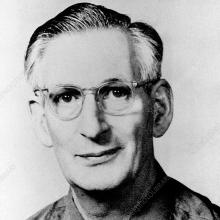
Heinz received a classical education but was also interested in mathematics and science, especially chemistry. He attended the University of Bonn from 1926 to 1927 and after six months with the W. C. Heraeus chemical company completed undergraduate studies in Berlin and Munich.
Gallery of Heinz London
plac Uniwersytecki 1, 50-137 Wrocław
London's graduate work on superconductivity was done at Breslau under F. E. Simon, and his Ph.D., issued early in 1934, was one of the last awarded to a Jew in Nazi Germany.
Heinz received a classical education but was also interested in mathematics and science, especially chemistry. He attended the University of Bonn from 1926 to 1927 and after six months with the W. C. Heraeus chemical company completed undergraduate studies in Berlin and Munich.
London's graduate work on superconductivity was done at Breslau under F. E. Simon, and his Ph.D., issued early in 1934, was one of the last awarded to a Jew in Nazi Germany.
Heinz London was a German-British physicist. He worked with his brother Fritz London on superconductivity, discovering the London equations.
Background
London was born on November 7, 1907, in Bonn, Germany, into a liberal Jewish-German family. His father, Franz London, was professor of mathematics at the University of Bonn and his mother, Luise Burger, was the daughter of a prosperous textile manufacturer. His father died of heart failure when Heinz was nine years old. His brother, Fritz London, exercised close parental influence on him after their father’s early death.
Education
Heinz received a classical education but was also interested in mathematics and science, especially chemistry. He attended the University of Bonn from 1926 to 1927 and after six months with the W. C. Heraeus chemical company completed undergraduate studies in Berlin and Munich. His graduate work on superconductivity was done at Breslau under F. E. Simon, and his Ph.D., issued early in 1934, was one of the last awarded to a Jew in Nazi Germany.
In 1934 London joined Simon and other members of the Breslau group at Oxford, where they were establishing the first center of low-temperature research in England since the time of James Dewar. Fritz London was already in Oxford, and Heinz lived there with the family for two years. In 1936 he moved to Bristol, where he remained until 1940, when he was for a brief time interned as an alien. After his release he worked with Simon and others on the British atomic bomb project and then spent two years at Birmingham before transferring to Harwell in 1946, where he continued to work until his death.
While at Oxford, London continued to search for alternating-current losses in superconductors, but had no success, even though he raised the operating frequency to 150 MHz. After his move to Bristol he took the subject up once more and finally in 1939 succeeded in demonstrating the occurrence of high-frequency losses at 1500 MHz. London’s work on high-frequency losses was terminated by World War II, but the subject was revived in 1946 by several other investigators, using resonant cavity techniques from radar research.
At Bristol, London also investigated superconductivity of thin metallic films in collaboration with E. T. S. Appleyard, A. D. Misener, and J. R, Bristow. From measurements of critical fields they were able to determine the penetration depth experimentally. Measurements on the magnetic susceptibilities of superconducting particles by D. Shoenberg about the same time gave comparable results. This work on thin films was another example, like the experiments on alternating-current losses, of work begun by London which became a major field of research studied by hundreds of other investigators. A third subject of study from the same period was his work on helium, which included an experiment that helped establish the two-fluid model, and the thermodynamic analysis mentioned in the previous entry, which proved that the superfluid component carries no entropy. A by-product of the analysis was London’s prediction of the mechanocaloric or inverse fountain effect, a temperature difference generated by the moving superfluid.
Achievements
In their theoretical contributions Fritz’s genius consisted in identifying the deep conceptual issues, Heinz’s in the vital and far from simple task of bringing experiment into fruitful contact with theory. As an experimentalist he belonged to that not undistinguished class of workers, among whom was J. J. Thomson, whose junior colleagues wisely protect them by various subterfuges from too close contact with apparatus. Both brothers brought a remorseless thoroughness to everything they did. Heinz’s attitude to physics had also an element of spiritual passion.
Views
London’s work on the atomic bomb project had been on methods of separating uranium 235 by ionic migration and liquid thermal diffusion. At Harwell after the war he continued to work on isotope separation, concentrating on the production of carbon 13 as a stable tracer element for medical research. He developed a method of low-temperature distillation and designed a fractionating column using carbon monoxide for the enrichment of C13 and O18. This machine has operated successfully for many years and currently supplies all the C13 used in Great Britain and the United States.
During the last fifteen years of his life London worked in collaboration with various colleagues on three main topics, neutron production and neutron-scattering experiments in liquid helium, techniques for producing high field superconducting magnets, and, most important, the He3-He4 dilution refrigerator, one of the most ingenious and useful contributions to cryogenic technology in many years. He had suggested the essential idea of the dilution refrigerator in 1951 at the Oxford Conference on Low-Temperature Physics.
Membership
Fellow
Royal Society of London
,
United Kingdom
1961
Personality
The two London brothers form a study of unusual psychological interest. Fritz’s influence on Heinz in the critical years after their father’s death was strong, yet despite their close professional relationship they are in many ways contrasting figures. Fritz was well-organized, Heinz shockingly untidy. It is customary to think of Fritz as a theoretician and Heinz as an experimentalist, but actually neither fits exactly into ordinary categories.
Quotes from others about the person
Of Heinz, D. Shoenberg has said: “Though he spent much time on experiments his most valuable contributions have been ideas and inventions. Perhaps he might be described as a cross between a theoretical physicist and an inventor.”
Connections
In 1939 London married Gertrude Rosenthal, but the marriage broke up soon afterward. In 1946 he married Meissner; they had four children.
Fritz London: A Scientific Biography
Fritz London was one of the twentieth century's key figures in the development of theoretical physics. A quiet and self-effacing man, he was one of the founders of quantum chemistry, and was the first to give a phenomenological explanation of superconductivity. This thoroughly researched biography gives a detailed account of London's life and work in Munich, Berlin, Oxford, Paris, and finally in the United States.