

Background
Cross was born in Douai, Nord, France, on May 20, 1856. His ancestors were connected with ironmongery. Cross was the son of Alcide Delacroix, a French adventurer, and Fanny Woollett. He had no surviving siblings.

Henri-Edmond Cross, self-portrait.
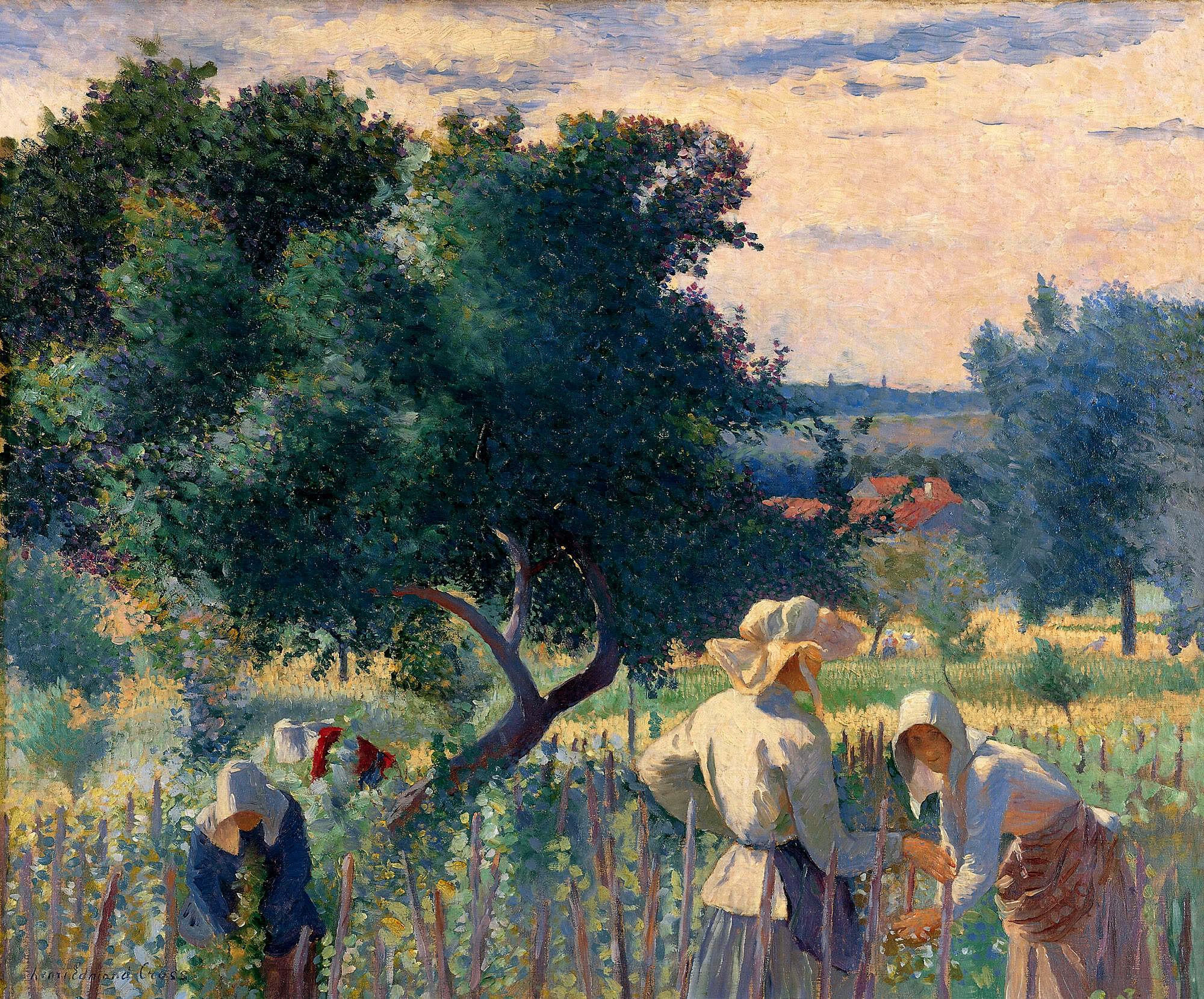
Portrait of Henri-Edmond Cross by Maximillien Luce.


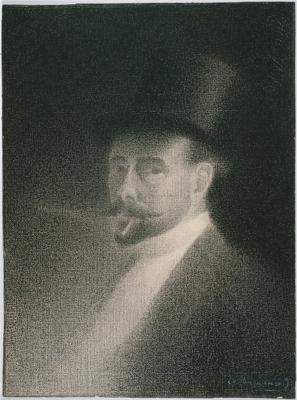




Cross was born in Douai, Nord, France, on May 20, 1856. His ancestors were connected with ironmongery. Cross was the son of Alcide Delacroix, a French adventurer, and Fanny Woollett. He had no surviving siblings.
In 1865 Henri-Edmond Cross's family moved to a place near Lille, a northern French city not far from the Belgian border. His uncle, Dr. Auguste Soins, was the first to recognized Cross's artistic talent and was very supportive of his artistic inclinations. In 1866 Soins even paid for the boy's first drawing instructions under painter Carolus-Duran. Henri was Duran's disciple for a year.
Cross continued his studies in Paris in 1875. There he was trained by François Bonvin before returning to Lille. He attended the École des Beaux-Arts, and in 1878 he became a student of the Écoles Académiques de Dessin et d'Architecture, attending for three years Alphonse Colas' studio. After moving to Paris in 1881, his art education continued under Émile Dupont-Zipcy.
Cross's early artworks, mainly portraits and still lifes, were created in the dark colours of Realism. 1881 was the year of his first exhibition at the Salon des Artistes Français. He painted many landscapes on an 1883 trip to the Alpes-Maritimes, during which he met Paul Signac, who became a close friend and artistic influence.
Cross co-founded the Société des Artistes Indépendants 1884; it consisted of artists dissatisfied with the practices of the official Salon, and presented unjuried exhibitions without prizes. There, Henri-Edmond Cross met and became friends with many artists connected with the Neo-Impressionist movement, including Georges Seurat, Albert Dubois-Pillet, and Charles Angrand.
Despite the artist's association with the Neo-Impressionists, Henri-Edmond Cross did not immediately adopt their style. His works were still greatly influenced by Jules Bastien-Lepage and Édouard Manet, as well as by the style of Impressionism. The change from his early, gloomy, Realist works was gradual. His colour palette subsequently became lighter, he began working in the brighter colours of Impressionism. He also created some of his works en plein air.
In the latter part of the 1880s, Cross painted pure landscapes influenced by Claude Monet and Camille Pissarro. Soon he became one of the first proponents of Pointillism along with Signac and used Divisionist colour theory in his art pieces. In 1891 Cross began working in the Neo-Impressionist style, and presented his first large piece using this technique during an Indépendants show. The artwork was a portrait of the lady who he went on to marry a couple of years down the line - Madame Hector France.
Henri-Edmond Cross suffered from rheumatism and in 1891, moved to warmer climes in the south of France, initially to live in Cabasson near Le Lavandou and after some time, in Saint-Claire where he spent the remainder of his life, leaving only for trips to Italy in 1903 and 1908, and for his annual Indépendants exhibits in Paris. In 1892 Cross's friend Paul Signac moved to nearby Saint-Tropez; there they frequently hosted gatherings in Cross's garden, attended by such celebrities as André Derain, Henri Matisse, and Albert Marquet.
In 1905 Galerie Druet in Paris organized Cross's first one-man exhibition, which featured thirty paintings and thirty watercolours by the artist. The show was extremely successful, receiving critical acclaim, and a lot of works were sold. Belgian Symbolist poet Emile Verhaeren, an avid supporter of Neo-Impressionism in his native country, provided the introduction for the exhibition catalogue.

Henri-Edmond Cross was a leading Neo-Impressionist painter, a pioneer of Pointillism, and also a founding member of the Salon des Indépendants. His works were instrumental in the development of Fauvism.
Henri-Edmond Cross' best-known artworks include Beach at Cabasson (1892), L’Air du Soir (1894), The Washerwoman (1896), Cypresses at Cagnes (1900), The Flowered Column (1901), A Pine Wood, Provence (1906), Bathers (1907).
Matisse and other artists were greatly inspired by the late-career Cross. Among the other artists influenced by Cross were Albert Marquet, André Derain, Henri Manguin, Charles Camoin, Jean Puy, and Louis Valtat.
Today, Cross's works can be found in various museums and public art galleries, including the Allen Memorial Art Museum, Oberlin College, Ohio; the Barnes Foundation, Philadelphia, Pennsylvania; Finnish National Gallery, Helsinki, Finland; the State Hermitage Museum, Saint Petersburg, Russia; the Kunstmuseum Basel, Switzerland; the Museum of modern art André Malraux, Le Havre, France; the Wallraf-Richartz-Museum, Cologne, Germany, etc.
Family of Swans
Chaine des Maures
Bathers
The Clearing
Cabasson Landscape
A Pine Wood, Provence
Sailboats near Chicago
Ronde
Flowers
Provence Landscape
Cypress, April
In the Shade
Rio San Trovaso, Venice
Trees by the Sea
Pines by the Sea
Women Tying the Vine
A Garden in Provence
Landscape
San Giorgio Maggiore, Venice
Landscape
Bathers
Antibes
Woded Landscape
The Bay of Cavalieri
Beach on the Mediterranian
Toulon, Winter Morning
Plage de la Vignassa
Landscape, the Little Maresque Mountains
The Canal near St. Tropez
Coastal View with Cypress Trees
Barges
An Incoming Storm
The Evening Air
Peasant Woman Stretched out on the Grass
The Grape Harvest
Excursion
Study for The Grape Pickers
View of Menton
La Donana, Venice
The Beach, Evening
The Forest
The Flowered Terrace
Rocks at Trayas
Saint-Clair Landscape
Around My House
The Flowered Column
Lavender
The Maures
Study for The Clearing
The Farm, Morning
Bathers
Cape Layet, Provence
Landscape with Sunset
The Hair
River in Saint-Clair
The Mediterranean, East Wind
In the Luxembourg Gardens
La Dogana
The Bay of Cavaliere (study)
The Viaduct
The Fourth of July by the Sea
Flowers in a Glass
The Choppy Sea
Sunset on the Lagoon, Venice
In the Woods
Boats in the Port of St. Tropez
Land by the Sea
The Flowered Column
Venetian Canal
Provence Landscape
Landscape
The Pink House
Ponte San Trovaso
Under the Pines
Landscape
Woman in the Park
Sunset
Landscape
Cypresses
Siesta by the Water
The Return of the Fisherman
Venice, Palazzo Venier dei Leoni
The Washerwoman
Young Woman (Study for The Clearing)
Antibes, Afternoon
Canal de la Guidecca, Venice
Landscape with Stars
Untitled
The Iles d'Or, Var
Regatta
Fisherman
The Undergrowth
La Plage de Saint-Clair
Portrait of Madame Cross
The Port of Marseilles
Coastal Landscape
Antibes, Morning
By the Mediterranean
Les Petits, Montagnes Mauresques
Shepherd and Sheep
A Venetian Canal
The Farm, Evening
Afternoon at Pardigon, Var
View of the Church of Santa Maria degli Angeli, near Assisi
Aguttes
The Wood
Corner of the Garden in Monaco
Landscape with Goats
A Pine Tree
Coast Near Antibes
The Pink Cloud
The Mediterranean Coast
The Shipwreck
Still Life with Bottle of Wind
The Excursionists
Pines by the Sea
Beach at Cabasson
Bathers
Ranelagh
The Blue Boat
Mme. Hector France, nee Irma Clare
Study for The Grape Pickers
The Wreck
The Cypresses at Cagnes
Sailboats
The Seine by the Trocadero
Boats
Henri-Edmond Cross believed in anarchist principles, hoping for a utopian society. In 1896 Cross produced a lithograph, L'Errant (The Wanderer). The piece was featured anonymously in Les Temps Nouveaux, Jean Grave's anarchist journal. The artist's anarchist sentiments influenced his choice of subjects: he painted scenes depicting a utopian world that could exist through anarchism.
Henri-Edmond Cross changed his name in 1883 because it was too similar to that of Henri-Eugène Delacroix, another French painter.
Physical Characteristics: In the early 1880s, Henri-Edmond Cross began to experience trouble with his eyes, which grew more severe in the 1900s. He also suffered from arthritis. In 1909 Cross was diagnosed with cancer.
Henri-Edmond Cross married Madame Hector France, née Irma Clare, in 1893. The couple never had children.

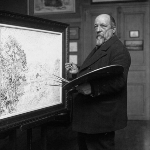
Paul Signac (1863-1935) was a French painter, who represented Neo-impressionism movement and helped to develop the Pointillist style. Also, he was known as a co-founder of the Société des Artistes Indépendants in Paris.
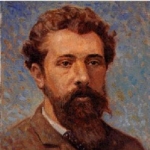
Georges-Pierre Seurat (1859-1891) was a French painter and leading figure in the neo-impressionist movement of the 1880s. He was considered the creator of the "pointillism", a style of painting in which small distinct points of primary colours create the impression of a wide selection of secondary and intermediate colours.

Albert Dubois-Pillet (1846-1890) was a French amateur painter and a military officer. He worked in Post-Impressionism style and was one of the pioneers of Pointillism.

Charles Théophile Angrand (1854-1926) was a French painter and draftsman. He was an important member of the Neo-Impressionist movement in the late 1880s and early 1890s.


