Background
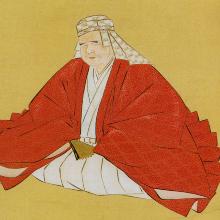
Hokiichi Hanawa was born in 1746 in the province of Musashi. He was the son of a farmer named Ogino Uhei. His childhood name was Toranosuke and his literary name was Suiboshi. In 1752 at the age of six, he lost his sight.

Hokiichi Hanawa was born in 1746 in the province of Musashi. He was the son of a farmer named Ogino Uhei. His childhood name was Toranosuke and his literary name was Suiboshi. In 1752 at the age of six, he lost his sight.
In 1760 Hanava went to Edo and studied acupuncture under a kengyo, or highest-ranking blind official, named Anatomy Sugaichi.In his enthusiasm for learning, he also studied Japanese fiction and poetry, Shinto, the legal and administrative system of early times, and other subjects under such men as Hagiwara Soko, Kawashima Kirin, and Yamaoka Matsuakira. In 1769 he became a disciple of the eminent scholar Kamo no Mabuchi, specializing in the Rikkokushi, the six official histories of early Japan written in Chinese, but he had been at such studies little over half a year when Kamo no Mabuchi died.
In 1775 he was assigned the rank of the koto, the second highest official rank for blind persons, and took the surname Hanawa, and in 1783 he was raised to the rank of kengyo. In 1785 he was invited to the domain of Mito, where he worked to produce collated editions of the Gempei seisuiki.
He founded Wagaku Kodansho, a school of Japanese classics, in 1793 and taught many disciples. Started compiling Gunsho-Ruiju, a collection of classics in 1779 and completed it in 1819. The collection, divided into 25 departments and comprising 530 volumes, contained 1,273 books and documents.
In 1703 he received permission from the shogunate to found a school of Japanese studies called the Wagaku Kodansho. His students included such men as Yashiro Hirokata, Matsuoka Tokikata, Inayama Yukinori, and Ishihara Masaaki.
Over a period of more than forty years, he supervised his students in the task of collecting and collating the texts that went into the Seihen Gunsho ruijü, which contains a total of 1,779 works and has been of incalculable importance in the study of Japanese history and culture and the preservation of source materials. After the publication of this great work, he was ordered by the shogunate to undertake the compilation of a lengthy encyclopedia on military affairs entitled the Buke myômokushô. While he was in the midst of this task, and of gathering together texts for a continuation of the Gunsho ruijü, he died. The continuation eventually appeared under the title Zoku Gunsho ruijü. The Gunsho ruijü and its continuation contain a total of 2,103 works and have been of enormous value in preserving historical and literary texts that might otherwise have become lost. These two works constitute Hanawa Hokiichi's most important contribution to scholarship, one that continues to be appreciated down to the present day.