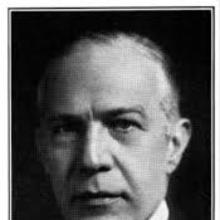
Horace Edward Boucher was an American ship modeler and architect. Although best known for its marine models, the Boucher name is usually identified with the wide range of museum-quality models found in the most prestigious collections.
Background
Horace Edward Boucher was born on April 24, 1873 in Italy. He was the youngest of the family of seven sons of Henry and Sarah Ann (Rodgers) Boucher, residents of Brooklyn, New York.
His father, an importer, was of Belgian descent; his mother, of English descent.
Education
After attending Trinity Church School, New York City, Horace, in 1890, entered the Navy Department.
Career
At first, Boucher was employed in the New York navy yard, chiefly as ship draftsman, and later in the Washington navy yard, where he specialized in the building of ship models, in which craft he became very proficient.
For three years, he was in charge of the navy's model shops. Here important experiments in ship construction were made, and the preliminary designs in naval vessels were threshed out.
After an experience of fourteen years in the Navy Department, Boucher resigned from the government and established a modeling shop at 105 Maiden Lane, New York City. Previously marinemodeling in the United States had been carried on at home, in an obscure way, by a few private persons. Boucher established this ancient art, which dates from the Egyptians, as a business. Such was his success that within a year his shop was working night and day.
One of his early commissions, necessitating a visit to France, was a model of Morton F. Plant's steam yacht Iolanda. Of a historical character is his group of 175 warships, showing the growth of the navy from the Bonhomme Richard to modern dreadnoughts and submarines, and including the Constitution and Constellation.
Another historical group began with the transatlantic liner America and ended with the Leviathan, the latter eight feet in length and complete down to the oil valves in the engine room and kitchen utensils in the galleys. He made a miniature of the clipper Flying Cloud and of Columbus' Santa Maria. His models of the Royal George and Royal William have been valued at more than $25, 000 each.
In 1930, he completed a model in ceramics of the George Washington Bridge and vicinity, showing traffic lanes, streets, houses, trees, and other objects.
At the time of his death, he was president of the H. E. Boucher Manufacturing Company, and vice-president of the Boucher Playthings Manufacturing Corporation.
Achievements
Boucher arranged the naval display at the Louisiana Purchase Exposition at St. Louis in 1904, and that at the Lewis and Clark Centennial Exposition at Portland in 1905, each of which attracted much favorable notice.
Boucher's work eventually expanded into other types of models, such as lighthouses, factories, coal and gold mines, hotels, office buildings, bridges, townsites, and children's playthings. He made a sectional model of the great concrete and steel caissons of the Woolworth Building. Much of his best work is now in private collections and in the model room of the New York Yacht Club.
Boucher's chief achievement was in his appointment as president of the H. E. Boucher Manufacturing Company, and vice-president of the Boucher Playthings Manufacturing Corporation. He also served on the model committee of the New York Yacht Club, 1923-35.
Membership
Boucher was a member of the New York Yacht Club.
Interests
Sport & Clubs
Boucher was an enthusiastic yachtsman and was a member of several leading yacht clubs.
Connections
On March 2, 1897, Horace Edward Boucher was married, in Brooklyn, to Zelia A. Schumacher, who survived him. There were no children.