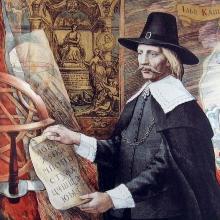
Ilya Fyodaravich Kapiyevich was a popularizer of science, a publisher, a translator, an encyclopedist and a developer of the Russian type (called also a civil script introduced in place of Church Slavonic).
Background
Ilya Fyodaravich Kapiyevich was born around 1651 into a family of petty gentry. His exact birth-place is not known, it could be in Minsk or Brest regions. It was an uneasy time as the war of Russia with Rzeczpospolita of 1654-1667 was going on. When a 9-year-old boy, Ilya was taken to Tver area from where he soon fled to Moscow. Six years later he returned to his homeland with M. Ciechanowiecki, the governor of the Mstislavl Province, who had come to Moscow for peace talks.
Education
Ilya’s studies at Slutsk Calvinist school were of crucial importance for the formation of his outlook. He received a thorough knowledge at school and mastered several foreign languages. It was there that he revealed his knack for the humanities.
Still a student, Ilya Fyodaravich Kapiyevich took a position of a lecturer-tutor for junior classes in 1674. It is not known exactly when and how Ilya Kapiyevich got to Holland. Some researchers put forward religious motives, charges with the treason against the king, the accusation of his parents of the treason against Rzeczpospolita during the war. The known fact is that their family estate got into possession of the Catholic Church and Ilya had to leave his homelandto find himself in Amsterdam.
In 1697, a Russian mission headed by Peter I arrived in Holland. A meeting of Kapiyevich, who was then the candidate for the priest at Amsterdam Cathedral, with the Russian tsar changed his life radically. The tsar noticed the modest church assistant who spoke Russian and was also an expert in many sciences. That was the reason why Ilya Fyodaravich Kapiyevich was invited immediately to be a teacher of foreign languages and of some sciences for Peter I himself and for other members of the mission. Leaving Amsterdam, the tsar commissioned Kapiyevich not only to continue teaching the Russian nobility, who came to the West to master "foreign sciences", but also to compile a number of books needed for establishing education in Russia itself. Ilya Fyodaravich Kapiyevich agreed to do it with pleasure and devoted the rest of his life to educational activities for the benefit of East Slavic nations.
In 1707, Ilya Fyodaravich Kapiyevich swore allegiance to Russia and became a translator at the Posolsky Prikaz (foreign affairs department). In 1708, Kapiyevich arrived in Warsaw, where on the tsar’s order he joined the Russian troops commanded by I.Brus. Ilya Fyodaravich Kapiyevich spent the rest of his life in Moscow.
Achievements
In 1698-1706 Ilya Kapiyevich compiled, translated and published 20 books on the humanities, natural, technical and military sciences: mainly textbooks on history, military and marine sciences, Latin and Russian grammars, etc. He compiled the Russia’s first text-book on arithmetic, dictionaries, including the Russian-Latin-German dictionary. The handbooks compiled and published by him were especially useful for young people devoting themselves to science, technology, navigation or military studies. Those handbooks were used in Russian schools for quite a long time. Ilya Fyodaravich Kapiyevich started the process of translating into Russian and publishing works by ancient writers. He published Russia’s first calendar and drew the country’s first celestial map. He was one of the first (if not the first) who elaborated the scientific terminology for East Slavs in many fields of knowledge.
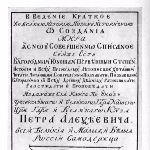
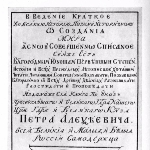
His best-known works include "A Short Introduction to Any History…" (1699). His interpretation of history was a step forward as compared to earlier theological and medieval conceptions. He was the author of "The Chronicle", "The Times Description", "Annals or Acts", "The Day Chronicle", "The Description of Power" (on political life), "The Description of Lives (on particular persons and events).
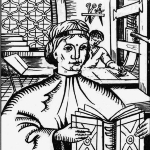
The enlightener published books in various printing houses, including his own in Amsterdam and Copenhagen. He traveled across Europe with his printing press. In 1701 in Berlin, 1704 in Copenhagen he tried to start producing books for Russia. He corresponded with G.Leibniz, who proposed him collaboration in publishing books. Their correspondence is preserved at the Academy of Sciences of Germany. The books by Ilya Fyodaravich Kapiyevich were of great importance for the development of education in Russia, which lacked at that time educational or secular publications in general.
Ilya Fyodaravich Kapiyevich developed his own Cyrillic type for title-pages of his books. In 1708 the Russian tsar approved a new script based on Kapiyevich’s letters. Thus, a reform of the Russian alphabet took place by the introduction of civil i.e. non-ecclesiastical letters. For a long time, the new letters were called "Amsterdam letters" or the "Belarusian alphabet". Nowadays the "civil" type developed by Kapievich is used by Belarusians, Ukrainians, Macedonians, Bulgarians, Serbians and other peoples that employ the Cyrillic alphabet.