



Background
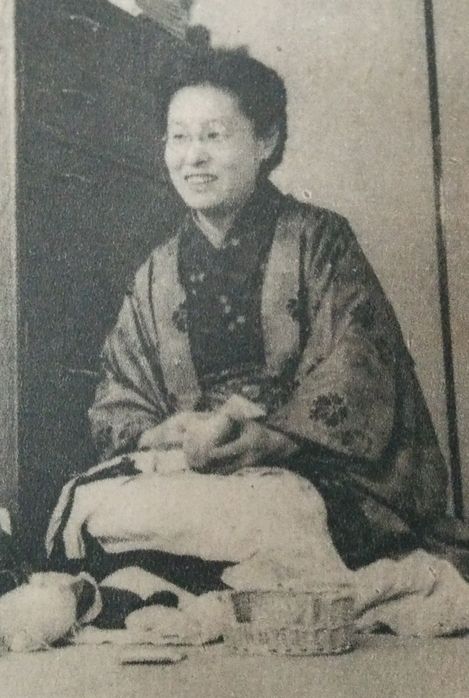
Sata Ineko was born on 1904 in Nagasaki Prefecture, Japan to young, unmarried parents (her father was 18, her mother 15), Sata moved to Tokyo while still a child.

http://www.amazon.com/gp/product/B01GQ2G0QI/?tag=2022091-20

http://www.amazon.com/gp/product/4120012409/?tag=2022091-20
佐多 稲子
Sata Ineko was born on 1904 in Nagasaki Prefecture, Japan to young, unmarried parents (her father was 18, her mother 15), Sata moved to Tokyo while still a child.
Without having finished primary school, her first job was in a caramel factory, but she later went on to work in restaurants where she befriended several writers, including Ryunosuke Akutagawa. In 1922 her poems were published for the first time in Shi to jinsei ("Poetry and life").
Working at the Koroku café-bar in Hongo, near Tokyo University, she met Nakano Shigeharu who would remain a lifelong friend. Along with Nakano, left-wing writers Hori Tatsuo and Tsurujiro Kubokawa ran the progressive literary magazine Roba (Donkey). Nakano inspired Sata to write her first short story, Kyarameru koba kara (From the Caramel Factory) in 1928. Having already divorced her first husband, she then married Kubokawa.
In 1929, she spoke out against the treatment of women workers in cigarette factories. In 1931, she defended the striking workers of the Tokyo Muslin Factory. As a member of the Proletarian Literature Movement, she wrote a series of short stories about the lives of ordinary working men and women.
Most of Sata's work was translated into Russian in the Sixties and Seventies. Two short stories from the prize-winning collection Toki ni tatsu (Standing Still in Time) have been translated into English.
In 1973, she was offered the Geijutuin Onshisho (Imperial Art Academy Prize) for her life's work, but she refused the award as she regarded it as a nationalist congratulation prize. She accepted the Kawabata Prize for short stories in 1977.
In 1983, Sata received the Asahi Prize for the entire body of her work.
In 1932 she joined the outlawed Japan Communist Party (JCP). She became close to JCP leaders Kenji Miyamoto and Takiji Kobayashi, the former imprisoned until 1945 and the latter tortured to death by police in 1933. In 1935 she was arrested for anti-war activism and spent two months in jail. This experience is described in part in her semi-autobiographical novel, Kurenai (Crimson), which was serialized from 1936-1938 and focuses on the troubled married life of a woman writer much like Sata. Sata's strong opinions were often at odds with the official Communist Party platform, juggling the many demands she faced as a writer, activist, mother and wife, she eventually became estranged from her husband, whom she finally divorced in 1945. Having been forced by the authorities to sever her connection with the Communist Party in the mid-1930s, she eventually collaborated with the authorities by writing literature in support of the Japanese war effort during WWII.
With the end of the war in 1945 Sata's writing re-emerged as part of the new democratic movement. In 1946 she rejoined the JCP (Japanese Communist Party), although, as before, she often voiced vehement criticism of the party.
By 1964 Sata had rejoined the JCP after yet another expulsion. She was one of the founders of the new Women's Democratic Club - her activities in the organization, judged divisive from the perspective of the party mainstream, led to another expulsion from the JCP.
After the war, she divorced Kubokawa and assumed her original family name of Sata.


