

Background
Ira Frederick Aldridge was born in New York City to Reverend Daniel and Luranah (also spelled Lurona) Aldridge on July 24, 1807.

1858
Portrait in pastel, by Taras Shevchenko
1860
As Othello in Poland
Ira Aldridge as Mungo in The Padlock
Aldridge as Aaron in Titus Andronicus
Walters Art Museum
Aldridge as Othello by William Mulready
His remains were buried in the city's Evangelical Cemetery; 23 years passed before a proper tombstone was erected. His grave is tended by the Society of Polish Artists of Film and Theatre.


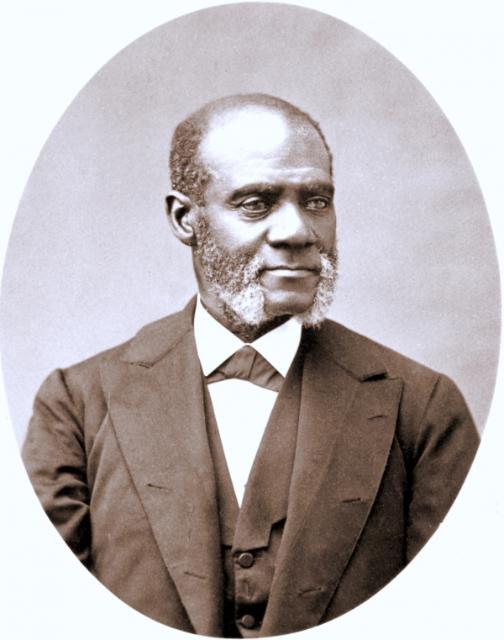
Ira Frederick Aldridge was born in New York City to Reverend Daniel and Luranah (also spelled Lurona) Aldridge on July 24, 1807.
At age 13, Aldridge went to the African Free School in New York City, established by the New York Manumission Society for the children of free black people and slaves. They were given a classical education, with the study of English grammar, writing, mathematics, geography, and astronomy. His classmates at the African free school included Charles L. Reason, George T. Downing, and Henry Highland Garnet.
His early exposure to theater included viewing plays from the high balcony of the Park Theatre, New York's leading theater of the time, and seeing productions of Shakespeare's plays at the African Grove Theatre.
Aldridge's first professional acting experience was in the early 1820s with the African Company, a group founded and managed by William Henry Brown and James Hewlett. In 1821, the group built the African Grove Theatre, the first resident African-American theatre in the United States.
Aldridge made his acting debut as Rolla, a Peruvian character in Richard Brinsley Sheridan's Pizarro. Confronted with the persistent discrimination which black actors had to endure in the United States, Aldridge emigrated to Liverpool, England, in 1824. During this time the Industrial Revolution had begun, bringing about radical economic change that helped expand the development of theatres. The British Parliament had already outlawed the slave trade and was moving toward abolishing slavery in the British colonies, which increased the prospect of black actors being able to perform.
Having limited onstage experience and lacking name recognition, Aldridge concocted a story of his African lineage, claiming to have descended from the Fulani princely line. By 1831 he had taken the name of Keene, a homonym for the then popular British actor, Edmund Kean.
On October 10, 1825, Aldridge made his European debut at London's Royal Coburg Theatre, the first African-American actor to establish himself professionally in a foreign country. He played the lead role of Oroonoko in The Revolt of Surinam, or A Slave's Revenge.
In innovation Aldridge introduced early in his career was a direct address to the audience on the closing night of his engagement at a given theatre. Especially in the years leading up to the emancipation of all slaves in the British colonies in 1832, he would speak of the injustice of slavery and the passionate desire for freedom of those held in bondage.
In 1831 Aldridge successfully played in Dublin; at several locations in southern Ireland, where he created a sensation in the small towns. In June 1844 he made appearances on stage in Exmouth (Devon, England).
Aldridge first toured to continental Europe in 1852, with successes in Germany, where he was presented to the Duchess of Saxe-Coburg-Gotha, and performed for Frederick William IV of Prussia; he also performed in Budapest. An 1858 tour took him to Serbia and to Imperial Russia, where he became acquainted with Count Fyodor Tolstoy, Mikhail Shchepkin and the Ukrainian poet and artist Taras Shevchenko, who did his portrait in pastel.
Now of an appropriate age, about this time, he played the title role of King Lear (in England) for the first time. He purchased some property in England, toured Russia again (1862), and applied for British citizenship (1863).
Aldridge spent most of his final years with his family in Russia and continental Europe, interspersed with occasional visits to England. He planned to return to the post-Civil-War United States, but he died in August 1867 while visiting Łódź, Poland.
Aldridge received awards for his art from European heads of state and governments: the Prussian Gold Medal for Arts and Sciences from King Frederick William III, the Golden Cross of Leopold from the Czar of Russia, and the Maltese Cross from Bern, Switzerland.
Aldridge is the only African American to have a bronze plaque among the 33 actors honored at the Shakespeare Memorial Theatre at Stratford-upon-Avon.
In 2002, scholar Molefi Kete Asante listed Ira Aldridge in his 100 Greatest African Americans.
Ira Aldridge possessed a frenzied temperament. His great role was Othello. In the final scene, he was so "heated" that he had foam from his mouth and his eyes were filled with blood. The performers of the role of Desdemona were terribly afraid to play with him.
Soon after going to England, in 1824 Aldridge married Margaret Gill, an English woman. They were married for 40 years until her death in 1864.
Aldridge's first son, Ira Daniel, was born in May 1847. The identity of his mother is unknown, but it could not have been Margaret Aldridge, who was 49 years old and had been in ill health for years. She raised Ira Daniel as her own; they shared a loving relationship until her death. He emigrated to Australia in February 1867.
Aldridge bought 5 Hamlet Road, in the prosperous suburbs of Upper Norwood, London in 1861 shortly before becoming a naturalised British citizen in 1863. It was where his wife, Margaret, and later his second wife, Amanda, brought up his children.
A year after Margaret's death, on April 20, 1865, Aldridge married his mistress, the self-styled Swedish countess Amanda von Brandt (1834-1915). They had four children: Irene Luranah, Ira Frederick and Amanda Aldridge, who all went on to musical careers, the two girls as opera singers. Their daughter Rachael Frederica was born shortly after Aldridge's death and died in infancy. Brandt died in 1915 and is buried at Highgate Woods, London.
Margaret Gill (1797-1864) was born in Yorkshire, England, and was the first wife of African-American actor Ira Frederick Aldridge. She married Aldridge in 1825. The couple's inter-racial marriage caused great anger from the pro-slavery lobby. She died in 1864. They had no children, although she raised his illegitimate son Ira Daniel, born in 1847. After her death Aldridge fathered four children with his second wife, Amanda Von Brandt.
(1860-1932)
(1866-1956)


