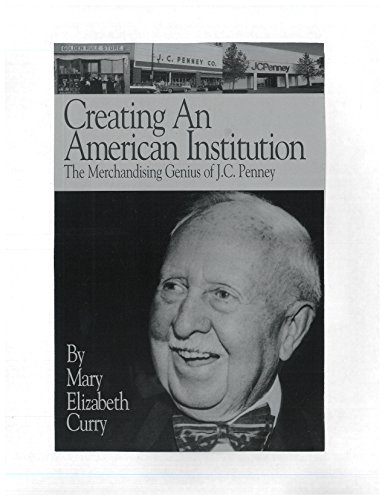
Creating An American Institution, The Merchandising Genius of J.C. Penney
(Many courtesies that today's consumers expect from a reta...)
Many courtesies that today's consumers expect from a retail store - such as standardizd pricing, high-quality merchandise, and friendly customer service - were not widely practiced in 1900. That they are today testifies to the merchandising genius of James Cash Penny.
Founder of the company that bears his name, Penney anchored his retail operations in the ethics of the Golden Rule. The practices that grew from that commitment fueled one of the great success stories in American business and revolutionized retailing.
Mary Elizabeth Curry tells the story behind the man, his beliefs, and his business acumen. Beginning with Penney's childhood in frontier Missouri, she recounts the founding of his company, the evolution of its partnership plan, its explosive growth in the 1920s, and its establishment as an American institution. Woven into the narrative are accounts of Penney's family life, his experiments in social reform, the loss of his fortune in the Great Depression, and his amazing recovery to become a revered figure in Fortune's Business Hall of Fame.
James Cash "J. C. " Penney Jr. was a Chain store executive, a pioneer in profit sharing, and a philanthropist.
Background
J. C. Penney was born on September 16, 1875, on his father's farm near Hamilton, Missouri, United States. The seventh of 12 children, only six of whom grew to maturity.
His father, the Reverend James Cash Penney, Sr. , served as an unpaid preacher for a fundamentalist sect known as Primitive Baptists and farmed to earn a living. His mother, Mary Frances Paxton Penney, was a Kentuckian. Life was joyless and difficult for the family, and at the age of eight young Penney was told that he had to buy his own clothes. This was not primarily because of necessity, but rather to teach him the value of money and self-reliance.
To earn money he purchased a pig, fattened it, and sold it for a profit, then bought others. Later his father ordered him to sell his pigs before they were ready for a top price because they were objectionable to the neighbors, so he turned to growing and selling watermelons.
Education
Penney graduated from Hamilton High School in 1893 but did not have the money for higher education.
Career
With the aid of his father he secured a position as a clerk in a local dry goods and clothing store. Starting on February 4, 1895, he was paid $25 a month. A little more than two years after he started working his health began to fail. On the advice of his physician he left in 1897 for Colorado to regain his health. He worked briefly at two stores and then bought a butcher shop but went bankrupt rather than donate whiskey to the cook of a local hotel in order to obtain business.
A promising new opportunity came when Penney was employed by a Longmont, Colorado, merchant, T. M. Callahan, to work in Callahan's first store in his small Golden Rule Mercantile Company chain. In March 1899 Callahan sent the young man to work at his Evanston, Wyoming, store at a salary of $50 a month. Three years later, Penney was sent to the town of Kemmerer, Wyoming, to open a new Golden Rule Store there. The store was capitalized at $6, 000, of which one-third was Penney's, making him a junior partner.
The chance to share in ownership increased his ambition, excited his imagination, and gave him the idea of someday having a chain of stores of his own based on the same principle of partner-owners who shared in the profits. He lived frugally in an attic room over the store at first. He opened the store at 7:00 a. m. , closed at 9:00 or 10:00 p. m. , and worked half a day on Sunday. In 1903 he acquired one-third interest in another Golden Rule store, and a year later he supervised a third store in which he was sold a one-third interest. In 1907 Penney bought the other two-thirds interest in these three Golden Rule stores.
He found, selected, and trained men, convinced that store managers had the duty to share their experience with their promising salesmen. He delegated responsibility, put his faith in his people, and eventually made them partners when new stores were opened. Individual store managers shared one-third of the profits, a motivating factor for success in business according to Penney.
By 1909 he gave up personal management of the Kemmerer store and moved to Salt Lake City to establish a headquarters for all his stores. In January 1913 Penney's chain was incorporated and the name was changed to J. C. Penney Company. The headquarters for the 48-store chain moved to New York City in 1914. Penney continued the expansion and in 1924 opened the 500th store in his hometown of Hamilton, Missouri.
The company continued to operate as a partnership until 1927, when there were over 1, 000 stores, necessitating full incorporation. Managers had from 1907 been given stock in the chain, the amount determined by the profits of their individual stores. In 1927 they exchanged this stock for stock in the company as a whole. Penney was president of the company until 1917, chairman of the board of directors from 1917 to 1946, and honorary chairman of the board from 1946 to 1958.
By the time of his death on February 12, 1971, he had created a vast corporate empire. There were 1, 660 stores with annual sales of over $4 billion, making J. C. Penney second only to Sears, Roebuck and Co. in nonfood retailers in the country. All 50, 000 employees, or "associates" as Penney called them, shared in the profits.
After leaving the presidency of the company in 1917, Penney spent more time on his outside interests. He ran a 705-acre farm in New York state from 1922 to 1953 raising purebred Guernsey dairy cattle. He operated another farm in New York state and eight or nine farms in Missouri.
Penney's rise to fame and fortune was not an unmarred success story. A major financial disaster struck in the 1929 stock market crash. Penney lost $40 million when several banks from which he had borrowed foreclosed on loans secured by his personal holdings of stock. He let his servants go and wound up weakened in spirit and health and facing a $7 million debt at the age of 56. But Penney was able to start over again with borrowed money and soon regained control of his "empire. "
Achievements
He built a corporate empire J. C. Penney stores following business precepts based on the Golden Rule.
Although he had only a limited education, he was the recipient of 17 honorary degrees and many other honors, awards, and citations. Mr. Penney was inducted into the Junior Achievement U. S. Business Hall of Fame in 1976. In 1994, Penney was inducted into the Hall of Famous Missourians, and a bronze bust depicting him is on permanent display in the rotunda of the Missouri State Capitol in Jefferson City.
(Many courtesies that today's consumers expect from a reta...)
Religion
He was active in the Young Men's Christian Association, Boy Scouts, National 4-H Club, Allied Youth Inc. , and Laymen's Movement for a Christian World. He founded a home for retired religious workers in Florida in memory of his parents.
Views
Quotations:
He claimed that "the ethical means by which my business associates and I have made money is more important than the fact that we have achieved business success. "
In his later years he reflected: "I believe in adherence to the Golden Rule, faith in God and the country. If I were a young man again, those would be my cardinal principles. "
Membership
Penney was a Freemason most of his adult life.
Personality
He was not athletic or physically robust. Penney was also involved with many charitable and religious endeavors and was a prodigious speaker.
Interests
His interest - cattle breeding.
Connections
During his 95 years, Penney was married three times and had five children and nine grandchildren. His first wife Bertha Alva Hess died in 1910, and in 1919 he married Mary Hortense Kimball. She died in 1923 after bearing a son, Kimball. Three years later, in 1926, he married Caroline B. Autenrieth, who bore two daughters, Mary Frances and Carol.