Jean-Paul Marat was a French journalist and political leader during the French Revolution.
Background
Marat was born in Boudry, Switzerland, on May 24, 1743, the son of lower-middle-class parents. He was the second of nine children born to Jean Mara (Giovanni Mara), a native of Cagliari, Sardinia, and Louise Cabrol, a French Huguenot from Castres. His father was a Mercedarian "commendator" and religious refugee who converted to Calvinism in Geneva. Of his early years very little is known.
Education
Marat went to France at age 16 to study. He studied medicine without gaining any formal qualifications.
Career
Unable to establish himself, in 1762 Marat went to England, where he lived as best he could, treating a few patients and attempting without success to enter English political circles. He passionately wanted to write. At his own expense and at the cost of severe deprivation, he published the scientific treatise Essai sur l'homme ("Essay on Man"), which later provoked the sarcasm of Voltaire, and a panorama of social history, Les Chaînes de l'esclavage ("The Chains of Slavery"). At the time his works passed unnoticed in England and France.
Marat returned to Paris in 1776. Securing a post as physician to the bodyguards of the Comte d'Artois, he was well paid and free to devote time to his own pursuits. He became interested in physics and attracted some notice in scientific circles. The Academy of Sciences proved skeptical, however, giving rise to his bitter polemics with the academicians. His acrimonious nature also seems to have created difficulties in the performance of his duties, and in 1783 the Comte d'Artois asked him to resign. Marat's financial difficulties increased, and on the eve of the Revolution he was utterly discouraged.
With the formation of the Estates General, Marat threw himself passionately into the political battle. His dream was to edit a newspaper, and he contracted with a bookseller to furnish single-handedly all the necessary copy for a nominal fee. Thus was born L'Ami du peuple ("The Friend of the People"), the paper with which he sympathized so strongly that he finally took its name for himself. His implacable criticism of the new administration involved him in legal action, and he was forced to live in hiding almost until the fall of the throne, on August 10, 1792, when his prestige as an inflexible defender of the principles of the Revolution won him a seat as deputy to the Convention.
The Gironde, whose equivocal policies Marat had criticized, and which now held a majority in the Convention, worked against him from the outset. Marat knew how to defend himself, however, and after several fruitless efforts the Girondins found a pretext in the aftermath of Gen. Charles F. Dumouriez' betrayal. Marat, who had repeatedly warned the government against the general (even Robespierre had been taken in by him), was named president of the Jacobin Society as a reward for his clairvoyance. As such, he was called upon to sign an address of the Society inciting the French to defend themselves by force against Dumouriez and his accomplices in the Convention. This address, falsely presented as the work of Marat, was considered "incendiary" and prejudicial to the safety of the state. Marat was arrested and delivered to the Revolutionary Tribunal, but was acquitted on April 2, 1793. Returned to the Convention in triumph, he again took his place as deputy.
Marat's triumph led ironically to his own death. Charlotte Corday, an idealistic young girl of Girondin sympathies from the provinces, came to Paris to seek revenge and to rid her country of the monster Marat. By this time his health had so deteriorated that he was living and working in seclusion in his apartment under a regimen of medicinal baths. On July 13, 1793, she managed to gain admittance to his apartment, under the pretense of bringing information to aid him in his continued campaign against the Girondins, and stabbed him to death in his bath.
Achievements
Marat was an influential advocate of extreme revolutionary views and measures, one of the most radical voices of the French Revolution. He became a vigorous defender of the sans-culottes, publishing his views in pamphlets, placards and newspapers, notably his periodical L'Ami du peuple (Friend of the People), which helped make him their unofficial link with the radical, republican Jacobin group that came to power after June 1793.
Marat was a member of Jacobin Club (1789-1790), and later of Cordeliers Club (1790-1793). In his opinion the moderate Revolution of 1789, although it had ended royal despotism, had left a new aristocracy of the rich in control, with the grievances of the poor still unsatisfied. Thus a radical revolutionary uprising was necessary, in his opinion, and he bluntly called time and again for popular executions and a temporary dictatorship to save the Revolution and bring about a regime of social justice.
Personality
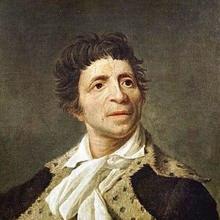
Marat has long been noted for physical irregularities. The nature of his debilitating skin disease, in particular, has been an object of ongoing medical interest. He was highly ambitious.
Many historians have exploited Marat's occasionally brutal and vehement expressions in order to portray him as a blood-thirsty megalomaniac whose extravagances obstructed the progress of freedom. But the real Marat may be seen in his lucid and implacable criticism of the leaders of the revolution, in his shattering arraignments which pilloried the faithless shepherds of the nation, and in his forceful dexterity in tearing away the mask of timidity and opportunism with which the "men of 1789" would hide the real face of the revolution.
Physical Characteristics:
His extreme ideas and language were matched by his informality of dress and unkempt appearance, which was heightened by the evidence of a chronic skin disease.
Connections
In January 1792, Marat married the 26-year-old Simonne Evrard in a common-law ceremony on his return from exile in London, having previously expressed his love for her.