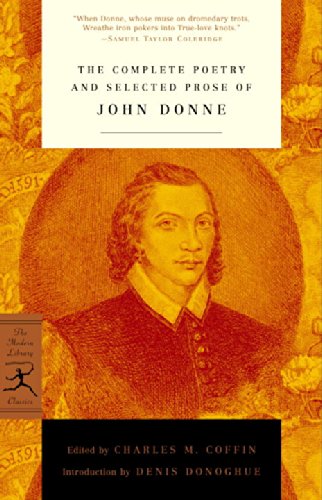
John Donne was an English metaphysical poet, Anglican divine, and pulpit orator. He is ranked as one of the greatest English poets who was also a supreme artist in sermons and devotional prose.
Background
Donne was born on January 22, 1572, in London, England. His mother, a great niece of Sir (later St. ) Thomas More, came from a cultured, devout family: her father, John Heywood, wrote interludes; her brother Jasper was a Jesuit; and her son Henry, John's brother, died in 1593 of a fever caught in Newgate Prison, where he was incarcerated for harboring a Roman Catholic priest. Donne's father died when John was 4, and his mother married a prominent physician.
Education
In 1583, the 11-year-old Donne began studies at Hart Hall, now Hertford College, Oxford. After three years of studies there, he was admitted to the University of Cambridge, where he studied for another three years. However, Donne could not obtain a degree from either institution because of his Catholicism, since he refused to take the Oath of Supremacy required to graduate. In 1591 Donne was accepted as a student at the Thavies Inn legal school, one of the Inns of Chancery in London. Appointed a royal chaplain in the same year, he also received a doctor of divinity degree from Cambridge.
After studying law at Lincoln's Inn, Donne became one of the first to write in English formal verse satires in the classical mode. It was also in 1590 that he wrote many of his amatory poems. Most of them are dramatic monologues expressive of attitudes toward love, ranging from cynical fleshly realism to platonic idealism. It is sounder to see them not as autobiographical but as exposing the extremes of carnal and spiritual love and as putting in a favorable light love in which they are complementary. He also composed verse letters, elegies, epithalamia, and epigrams; they were published after his death as Songs and Sonnets.
Donne partook in the Earl of Essex's expeditions against the Spanish in Cadiz and the Azores in 1596-1597 and reflected this military experience in his poems "The Storm" and "The Calm." By 1597-1598, when he became secretary to Sir Thomas Egerton, the lord keeper, he had dissociated himself from Roman Catholicism.
In 1601 he blasted the promise of a successful career by secretly marrying. He was dismissed from his post and temporarily imprisoned, and for about a decade he and his ever-increasing family were largely dependent on relatives and patrons. During this middle period Donne wrote Biathanatos, a treatise on instances of justifiable suicide which may have been intended as a satire on casuistry; it was published by his son in 1646.
His Conclave (1611) was popular in both English and Latin versions: it brilliantly satirized the Jesuits but is interesting today because it reflects the then new astronomy of Galileo and toys with the notion of colonizing the moon. Donne continued to write secular poems and, about 1609-1610, a powerful series of "Holy Sonnets," in which he meditated on sickness, death, sin, and the love of God.
In 1611 he composed two companion poems, The Anniversaries, on the Idea of woman, the decay of the physical universe, the vanity of this world, and, in contrast, the permanence of God and spiritual values. These commemorated the death of little Elizabeth Drury and won him the patronage of her father, with whom Donne traveled to France and Germany. He briefly served as a member of Parliament in 1601 and again in 1614.
About 1606 Thomas Morton offered Donne a benefice if he would take Anglican orders. But it was not until 1615, after long pious and practical hesitations, that he was ordained a priest. In 1616-1622 he was reader in divinity at Lincoln's Inn, where he preached regularly. He preached frequently at court and in 1619 was an embassy chaplain in Germany. In 1621, on James I's nomination, Donne became dean of St. Paul's Cathedral, attracting huge congregations with his brilliant oratory. A serious illness in 1623 gave rise to his Devotions, those moving meditations on sickness, death, and salvation from which Ernest Hemingway derived the title For Whom the Bell Tolls.
On February 25, 1631, Donne left his sickbed to preach his last and most famous sermon, "Death's Duel." On March 31 he died.
Achievements
Donne became one of the first to write in English formal verse satires in the classical mode. He is considered the pre-eminent representative of the metaphysical poets.
A memorial statue of him by Nicholas Stone was erected, it was one of the few to survive the Great Fire of London in 1666 and is now in St Paul's Cathedral. In 2012 a bust of the poet by Nigel Boonham was unveiled outside in the cathedral churchyard.
Donne is commemorated as a priest in the calendar of the Church of England and in the Calendar of Saints of the Evangelical Lutheran Church in America on 31 March.
Donne became an Anglican priest, although he did not want to take Anglican orders. In his sermons Donne preferred exhortation and moral edification to doctrinal controversies between the Church of England and Catholicism.
Views
Donne was professionally committed to intellectual disciplines and he had also read widely in alchemy, neoplatonism, hermeticism, and contemporary science.
Personality
Donne's was a complex personality, an unusual blend of passion, zeal, and brilliance; God and women were his favorite themes, but his subject matter otherwise ranged over the pagan and the pious, the familiar and the esoteric, the cynical and the sincere, the wittily bright and the theologically profound.
Physical Characteristics:
His youthful portraits show black hair, clear skin, intense eyes, an ample brow, and a pointed, bearded chin. His later pictures reveal the same intensity and alertness.
Quotes from others about the person
John Dryden had written of Donne in 1693: "He affects the metaphysics, not only in his satires, but in his amorous verses, where nature only should reign; and perplexes the minds of the fair sex with nice speculations of philosophy, when he should engage their hearts, and entertain them with the softnesses of love."
Connections
Donne fell in love with Egerton's niece Anne More, and they were secretly married just before Christmas in 1601, against the wishes of both Egerton and George More, who was Lieutenant of the Tower and Anne's father.
Anne bore John 12 children in 16 years of marriage. Three died before they were ten. In a state of despair that almost drove him to kill himself, Donne noted that the death of a child would mean one mouth fewer to feed, but he could not afford the burial expenses. His wife died on 15 August 1617, five days after giving birth to their twelfth child, a still-born baby. Donne mourned her deeply, and wrote of his love and loss in his 17th Holy Sonnet.