Background
John Roebuck was born in 1718 in Sheffield, England, the third son of John Roebuck, a prosperous Sheffield cutler, manufacturer, and merchant, and Sarah Roe.

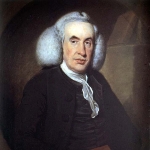
John Roebuck of Kinneil (1718 – 17 July 1794) was an English inventor and industrialist who played an important role in the Industrial Revolution and who is known for developing the industrial-scale manufacture of sulphuric acid.

University of Edinburgh, Edinburgh, Scotland, United Kingdom
Roebuck studied medicine at the University of Edinburgh, where he was imbued with a taste for chemistry by the lectures of William Cullen and Joseph Black.

Leiden University, Leiden and The Hague, South Holland, Netherlands
Roebuck graduated with a Doctor of Medicine degree at the University of Leiden in 1742.

James Watt and John Roebuck perfected the workings of the Steam Engine by Frank Lea.

Royal Society of Edinburgh, New Town, Edinburgh, Scotland
Roebuck was a fellow of the Royal Society of Edinburgh.

1764 - 1794
Royal Society of London, London, England, United Kingdom
Roebuck was a fellow of the Royal Society of London.
Royal Society of Edinburgh, New Town, Edinburgh, Scotland
Roebuck was a fellow of the Royal Society of Edinburgh.
Royal Society of London, London, England, United Kingdom
Roebuck was a fellow of the Royal Society of London.
University of Edinburgh, Edinburgh, Scotland, United Kingdom
Roebuck studied medicine at the University of Edinburgh, where he was imbued with a taste for chemistry by the lectures of William Cullen and Joseph Black.
Leiden University, Leiden and The Hague, South Holland, Netherlands
Roebuck graduated with a Doctor of Medicine degree at the University of Leiden in 1742.
James Watt and John Roebuck perfected the workings of the Steam Engine by Frank Lea.

James Watt (30 January 1736 (19 January 1736 OS) – 25 August 1819) was a Scottish inventor, mechanical engineer, and chemist.


(Volume 65)
Volume 65
https://www.amazon.com/Philosophical-Transactions-Royal-Society-London/dp/1345346271/ref=sr_1_1?keywords=Philosophical+Transactions+of+the+Royal+Society%2C+65&qid=1576674675&sr=8-1
1775
chemist inventor physician scientist
John Roebuck was born in 1718 in Sheffield, England, the third son of John Roebuck, a prosperous Sheffield cutler, manufacturer, and merchant, and Sarah Roe.
After attending the grammar school at Sheffield and Doctor Philip Doddridge's Academy at Northampton, Roebuck studied medicine at Edinburgh, where he was imbued with a taste for chemistry by the lectures of William Cullen and David Hume, and he finally graduated with a Doctor of Medicine degree at the University of Leiden in 1742. His dissertation, dated 1743, is entitled “An Investiga¬tion Into the Effects of Rarefied Atmosphere on the Human Body.”
Following graduation Roebuck settled as physician in Birmingham. He disliked medical practice, however, and turned progressively to chemistry as manufacturer and consultant, finally becoming a refiner (recoverer) of gold and silver for the Birmingham jewelry trade. By 1746, in conjunction with the Birmingham merchant Samuel Garbett, Roebuck was established as a metal refiner and consultant chemist. Later he began to produce sulfuric acid, made in lead instead of glass vessels, which greatly reduced the cost.
In 1749 Roebuck and Garbett opened a second vitriol works at Prestonpans, near Edinburgh; the market for sulfuric acid there was probably as a “sour” in bleaching. An export trade soon built up with the Low Countries. Roebuck and Garbett did not register a patent until 1771, but their application in Scotland was rejected by the Court of Session on the ground that the process had been used in England since 1756.
Despite setbacks, the Prestonpans vitriol works prospered. Roebuck added ceramic production and, most important, after carefully weighing the prospects, founded the Carron ironworks near Falkirk, Stirlingshire, in 1759. His partners were his brothers Benjamin, Thomas, and Ebenezer Roebuck; Samuel Garbett; and the Cadells of Cockenzie, shipowners and timber traders who had already attempted iron production.
Carron was the real foundation of the Scottish iron industry. The first furnace, in which coke replaced charcoal, was blown on 1 January 1760; and the same year John Smeaton installed a blowing engine. Malleable iron was produced from 1762. In 1773 George III granted the Carron works a royal charter, and from 1779 it made the ordnance known as “carronades.”
The success of the Carron works led Roebuck to lease coal mines and saltworks at Borrowstounness, West Lothian. The pumping engines there were inadequate; Roebuck brought in James Watt, and they experimented with Watt’s improved engine. Watt owed Joseph Black £1,200 and Roebuck took over the debt in exchange for a two-thirds share in Watt’s patent, but this transaction, coupled with other activities, overtaxed his financial resources. He was forced to withdraw capital from his Birmingham, Prestonpans, and Carron firms.
Matthew Boulton of Birmingham canceled a loan in exchange for the two-thirds share in Watt’s patent and so led to the foundation of the firm of Boulton and Watt. Roebuck remained at Borrowstounness, where he managed the coal mines and saltworks and engaged in various scientific experiments, including an attempt to produce synthetic alkali.
Roebuck's major achievement was the development of the industrial-scale manufacture of sulphuric acid. He established an ironworks at Carron in Stirlingshire (now in Falkirk) Scotland, where he introduced various improvements in production, including the conversion of cast iron into malleable iron by burning coke derived from bituminous coal. In utilizing coke instead of charcoal, he revived in Britain a practice that had been introduced by the ironmaster Dud Dudley in the early 1620s.
Another Roebuck's major achievement was in the successful subsidization of experiments of the Scottish engineer James Watt that led to the development of the first commercially practical condensing steam engine (1769).
In recognition of his great scientific achievements in the field of chemistry, he was elected a fellow of the Royal Society of London in 1764.
(Volume 65)
1775Roebuck was a fellow of the Royal Society of Edinburgh and of London and a freeman of Edinburgh.

30 January 1736 (19 January 1736 OS) – 25 August 1819, a Scottish inventor, mechanical engineer, and chemist who improved on Thomas Newcomen's 1712 Newcomen steam engine with his Watt steam engine in 1776, which was fundamental to the changes brought by the Industrial Revolution in both his native Great Britain and the rest of the world.
1717– 5 December 1803, a prominent citizen of Birmingham England, during the Industrial Revolution.