John Peter Russell was an Australian impressionist painter.
Background
John Peter Russell was born on June 16, 1858 in Sydney, Australia. The eldest of four children of John Russell, a Scottish engineer, and his wife Charlotte Elizabeth, née Nicholl, from London. He had a sister, Christine (Russell) Roberts, and two brothers, Percy Russell and William Reid Russell.
John Peter Russell was also a nephew of Sir Peter Nicol Russell.
Education
John Russell was educated at the Goulburn School in Garrooriagang. Then Russell moved to England at the age of eighteen, initially to take up an engineering apprenticeship.
He later used the considerable inheritance he received from his father to enrol at the Slade School of Fine Art, University College London, on 5 January 1881 and studied under Alphonse Legros for three years.
Russell then went to Paris to study painting under Fernand Cormon. His fellow students there included Henri de Toulouse-Lautrec and Émile Bernard.
John Peter Russell settled at Belle Île off the coast of Brittany, where he designed his own home and established an artists' colony.
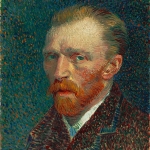
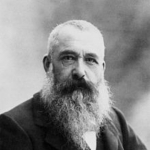
Russell had met Vincent van Gogh in Paris and formed a close friendship with him. They particularly bonded over being foreigners in the Parisian avant-garde scene. Claude Monet often worked with Russell at Belle Île and influenced his style, though it has been said that Monet preferred some of Russell's Belle Île seascapes to his own. In 1890, Russell left Belle Île and traveled to Antibes in a horse-drawn cart, where he rented a house for the winter and produced some of his most acclaimed work. Due to his substantial private income Russell did not attempt to make his pictures well known. In the 1880s and 1890s, Russell hewed closely to pure French impressionist style.
Russell destroyed 400 of his oils and watercolours after the death of his wife in 1907.
After 1912, he moved between Italy, Switzerland, and the United Kingdom. In 1921, Russell returned to the Sydney area, where he lived in a fisherman's cottage in suburb of Watsons Bay and had a small wooden studio on Sydney Harbour. In 1922, he briefly lived in New Zealand where he helped one of his sons start a citrus farm.
Russell suffered a fatal heart attack on April 30, 1930 in Sydney, Australia while lifting rocks to build a wall outside his cottage.
Achievements
John Peter Russell was known as Australia's Impressionist. He was the only Australian artist to be directly in touch with Monet and the mainstream French impressionists in the late 19th century. Among his most noted works were "Antibes" and "Peonies and head of a woman".
Currently, he is represented by many of Australia's most prominent galleries.
Auguste Rodin: "Your works will live, I am certain. One day you will be placed on the same level with our friends Monet, Renoir, and Van Gogh."
Henri Matisse: "Russell was my teacher, and Russell explained colour theory to me."
Connections
Russell was married to a beautiful Italian seamstress and model of Auguste Rodin's, Marianna Antonietta Mattiocco. He had 11 children with Mattiocco, of whom six, five sons and a daughter, survived. Russell's daughter, Madame Jeanne Jouve, was known in Paris as a singer. In 1907, Marianna Russell died in Paris of cancer.
In 1912, Russell married his second wife, an American singer Caroline de Witt Merrill, who was a friend of Russell's daughter's and went by the stage name of Felize Medori.
Russell had met Vincent van Gogh in Paris and formed a close friendship with him. The two artists particularly bonded over being foreigners in the Parisian avant-garde scene. Van Gogh spoke highly of Russell's work, and after his first summer in Arles in 1888 he sent twelve drawings of his paintings to Russell, to inform him about the progress of his work.
Claude Monet often worked with Russell at Belle Île and influenced his style, though it has been said that Monet preferred some of Russell's Belle Île seascapes to his own.
In 1897 and 1898 Henri Matisse visited Belle Île. Russell introduced him to impressionism and to the work of van Gogh, who was relatively unknown at the time. Matisse's style changed radically, and he would later say: "Russell was my teacher, and Russell explained colour theory to me."