

Background
Joseph Wood Krutch was born on November 25, 1893 in Knoxville, Tennessee, United States. He was the son of Edward Waldemore Krutch, an employee of a wholesale drug firm, and Adelaide Wood.


( Krutch's incisive examination of the dilemmas faced by ...)
Krutch's incisive examination of the dilemmas faced by modern man has proved remarkably prophetic. This book stands as an unflinchingly honest examination of the major moral questions of our era.
https://www.amazon.com/Modern-Temper-Joseph-Wood-Krutch/dp/0156617579?SubscriptionId=AKIAJRRWTH346WSPOAFQ&tag=prabook-20&linkCode=sp1&camp=2025&creative=165953&creativeASIN=0156617579

(Excerpt from The Voice of the Desert: A Naturalist's Inte...)
Excerpt from The Voice of the Desert: A Naturalist's Interpretation Not many months ago the creosote was covered with bright yellow pealike flowers; the mesquite with pale yel low catkins. N ow the former is heavy with gray seed and on the mesquite are forming long pods which Indians once ate and which cattle now find an unusually rich food. About the Publisher Forgotten Books publishes hundreds of thousands of rare and classic books. Find more at www.forgottenbooks.com This book is a reproduction of an important historical work. Forgotten Books uses state-of-the-art technology to digitally reconstruct the work, preserving the original format whilst repairing imperfections present in the aged copy. In rare cases, an imperfection in the original, such as a blemish or missing page, may be replicated in our edition. We do, however, repair the vast majority of imperfections successfully; any imperfections that remain are intentionally left to preserve the state of such historical works.
https://www.amazon.com/Voice-Desert-Naturalists-Interpretation-Classic/dp/1334924023?SubscriptionId=AKIAJRRWTH346WSPOAFQ&tag=prabook-20&linkCode=sp1&camp=2025&creative=165953&creativeASIN=1334924023

( "The author deftly weaves the materials of natural and ...)
"The author deftly weaves the materials of natural and human history into a radiant, tightly woven fabric. . . . This classic is a book for all seasons—to be reread and savored over the years."—Latin America in Books "His superb writing style and the timelessness of his subject (the natural world and the interaction of human beings with it) make this every bit as enjoyable today as it was in the 1960's."—Books of the Southwest "Well-written and fascinating."—Journal of Arid Environments
https://www.amazon.com/Forgotten-Peninsula-Naturalist-Baja-California/dp/0816509875?SubscriptionId=AKIAJRRWTH346WSPOAFQ&tag=prabook-20&linkCode=sp1&camp=2025&creative=165953&creativeASIN=0816509875
( Now back in print, Joseph Wood Krutch’s Burroughs Award...)
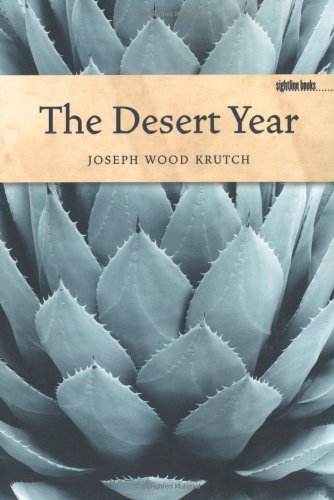
Now back in print, Joseph Wood Krutch’s Burroughs Award–winning The Desert Year is as beautiful as it is philosophically profound. Although Krutch—often called the Cactus Walden—came to the desert relatively late in his life, his curiosity and delight in his surroundings abound throughout The Desert Year, whether he is marveling at the majesty of the endless dry sea, at flowers carpeting the desert floor, or at the unexpected appearance of an army of frogs after a heavy rain. Krutch’s trenchant observations about life prospering in the hostile environment of Arizona’s Sonoran Desert turn to weighty questions about humanity and the precariousness of our existence, putting lie to Western denials of mind in the “lower” forms of life: “Let us not say that this animal or even this plant has ‘become adapted’ to desert conditions. Let us say rather that they have all shown courage and ingenuity in making the best of the world as they found it. And let us remember that if to use such terms in connection with them is a fallacy then it can only be somewhat less a fallacy to use the same terms in connection with ourselves.” This edition contains 33 exacting drawings by noted illustrator Rudolf Freund. Closely tied to Krutch’s uncluttered text, the drawings tell a story of ineffable beauty.
https://www.amazon.com/Desert-Year-Sightline-Books/dp/1587299011?SubscriptionId=AKIAJRRWTH346WSPOAFQ&tag=prabook-20&linkCode=sp1&camp=2025&creative=165953&creativeASIN=1587299011

https://www.amazon.com/Measure-Man-Freedom-Values-Survival/dp/B000SFM1RW?SubscriptionId=AKIAJRRWTH346WSPOAFQ&tag=prabook-20&linkCode=sp1&camp=2025&creative=165953&creativeASIN=B000SFM1RW
(Binding tight, very minor shelf and reading wear, has wat...)
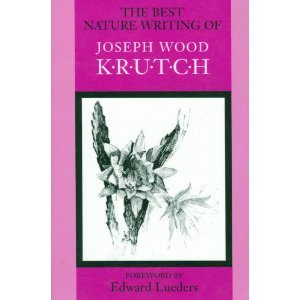
Binding tight, very minor shelf and reading wear, has water damage, all text legible, no sticking pages, staining on edges. usps delivery confirmation included fre with all shipments.
https://www.amazon.com/Best-Nature-Writing-Joseph-Krutch/dp/0874804809?SubscriptionId=AKIAJRRWTH346WSPOAFQ&tag=prabook-20&linkCode=sp1&camp=2025&creative=165953&creativeASIN=0874804809

(FIRST HARDCOVER EDITION)
FIRST HARDCOVER EDITION
https://www.amazon.com/More-Lives-Than-Joseph-Krutch/dp/0688021077?SubscriptionId=AKIAJRRWTH346WSPOAFQ&tag=prabook-20&linkCode=sp1&camp=2025&creative=165953&creativeASIN=0688021077

(Essays on the contemplative nature of man's relationship ...)
Essays on the contemplative nature of man's relationship with nature, animals, other people.
https://www.amazon.com/Twelve-Seasons-Joseph-Wood-Krutch/dp/B000NX1XLO?SubscriptionId=AKIAJRRWTH346WSPOAFQ&tag=prabook-20&linkCode=sp1&camp=2025&creative=165953&creativeASIN=B000NX1XLO
Joseph Wood Krutch was born on November 25, 1893 in Knoxville, Tennessee, United States. He was the son of Edward Waldemore Krutch, an employee of a wholesale drug firm, and Adelaide Wood.
Neither parent was notably committed to the arts, and the education young Krutch enjoyed in the Knoxville public schools was unexceptional. As an undergraduate at the University of Tennessee, which he entered in 1911, Krutch prepared for a career teaching high school mathematics. But several literature courses and his editorship of the university's student magazine persuaded him to pursue graduate study in English at Columbia University, where he enrolled following his graduation from Tennessee in 1915.
He earned his master's degree in 1916 with a thesis on nineteenth-century American drama. In the spring of 1918 he interrupted his doctoral studies to enlist in the Army Psychological Corps. Following the armistice, he returned to Columbia to write a dissertation on English Restoration comedy. He received a fellowship that enabled him to spend the 1919-1920 academic year in Europe along with a fellow graduate student, Mark Van Doren, who had become and would remain his closest friend. In 1924 Krutch's dissertation was published and he was awarded Doctor of Philosophy.
Krutch reveled in the cultural opportunities of New York City, and imagined himself an urban sophisticate. His love of the theater, first stimulated by performances of touring companies in Knoxville, was reinforced.
Following his return from Europe, Krutch taught English at Brooklyn Polytechnic Institute and contributed book reviews and essays to some of the leading periodicals of the day.
Unhappy in the classroom, Krutch resigned his position at Brooklyn Polytechnic in 1924 and became associate editor of the Nation, where his responsibilities included drama criticism. During the next quarter-century, he attended some 2, 000 Broadway plays and wrote more than 500 reviews. He also contributed book reviews, essays, and unsigned editorials. He was proud to associate himself with the Nation's outspoken liberalism, and in Edgar Allan Poe: A Study of Genius (1926) he embraced another of the fashionable literary and intellectual movements of the day by viewing Poe's career in terms of Freudian psychopathology. Heartened by the critical success of his book on Poe, Krutch wrote a series of long essays, collected as The Modern Temper (1929). Examining the origins and consequences of contemporary attitudes and beliefs, the book portrayed man's sense of emotional impoverishment in a world dominated by the debilitating, corrosive reason of science. The Modern Temper remains an eloquent synopsis of the modernist thought of the day. Krutch's uneasiness with the radical political thought of the 1930's was reflected in Was Europe a Success? (1934), a forceful liberal critique of the attraction Marxism held for many American intellectuals. Increasingly alienated from the literary and political enthusiasms of his contemporaries, Krutch also distanced himself physically from the urban life he had earlier relished.
Since the mid-1920's, he and his wife had summered in rural Connecticut. In 1932 they purchased a home in Redding, Connecticut, which soon became their primary residence. In Redding, Krutch became an avid student of nature and discovered there a source of spiritual solace from the despair of modernism. Krutch resigned his editorial position at the Nation in 1937, but retained his post as drama critic. That year he became professor of English at Columbia, where his courses on drama were highly popular. Two critical biographies, Samuel Johnson (1944) and Henry David Thoreau (1948), renewed Krutch's standing as a critic while paying tribute to two quite different writers whose outlooks Krutch was embracing as his own. His writing during the 1950's and 1960's evidenced his debt both to Johnson's commonsense philosophy and respect for the intelligent layperson and to Thoreau's demonstration that science could enhance man's appreciation of the human significance of nature. The publication of Thoreau was soon followed by the first of Krutch's essays about the natural universe in and around his Redding home. The Twelve Seasons (1949) marked the beginning of his successful career as a nature writer. Drawing upon his own daily observation, these essays combined scientific explanation of both common and unfamiliar natural phenomena with reflection upon their human significance.
During a 1950-1951 sabbatical in Tucson, Arizona, Krutch found material for a second such collection, The Desert Year (1952), and decided to make his home in Arizona. In 1952 Krutch resigned his professorship, relinquished his post as drama critic, and moved to Tucson. Free of academic and other responsibilities, and now dependent wholly upon his earnings as a writer, his literary output was prodigious in quantity though uneven in quality. In addition to several collections of essays on the flora and fauna of the Southwest, he published books on the Grand Canyon and Baja California. That plants and animals could survive--even joyously--amid the heat and aridity of the desert implied for Krutch man's capacity to endure and find meaning in a modern world bereft of traditional beliefs.
His rejection of positivism and mechanistic determinism and his assertion of the reality of consciousness and value announced his new sense of man's potentialities. In numerous essays of social and literary criticism, he offered a humanist's indictment of the materialism, moral relativism, and artistic nihilism he found in contemporary society. First published in journals such as the Saturday Review and the American Scholar, many of those essays were collected in Human Nature and the Human Condition (1959), If You Don't Mind My Saying So (1964), and And Even If You Do (1967). Krutch, having abandoned his earlier ambition to be counted among the modernist thinkers of his day, enjoyed the admiration of a large readership along with considerable financial success.
(Excerpt from The Voice of the Desert: A Naturalist's Inte...)
( Now back in print, Joseph Wood Krutch’s Burroughs Award...)
(Binding tight, very minor shelf and reading wear, has wat...)
( "The author deftly weaves the materials of natural and ...)
( Krutch's incisive examination of the dilemmas faced by ...)
(Essays on the contemplative nature of man's relationship ...)
(FIRST HARDCOVER EDITION)
On February 10, 1923 Krutch married Marcelle Leguia, who had come to America from her native France shortly before the outbreak of World War I and had been trained in America as a public health nurse. She was an admiring helpmate who patiently accommodated his valetudinarian demands.

