Background
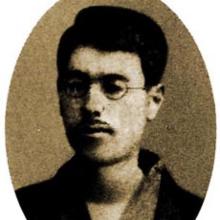
Kitamura Tōkoku was born on the 29th of December, 1868 in Odawara, Japan.


https://www.amazon.com/Kindainihonnnomeityo-Vol8-KyorinsyaBunko-Japanese-Nitobe-Inazo-ebook/dp/B00TCNKXJ4/ref=sr_1_3?dchild=1&qid=1614432939&refinements=p_27%3AKitamura+Tokoku&s=digital-text&sr=1-3&text=Kitamura+Tokoku
2015

(Tokoku Kitamura (1868-1894) is a Japanese poet and essayi...)
Tokoku Kitamura (1868-1894) is a Japanese poet and essayist. He is one of the founders of the romantic movement in the Modern Japan. He is also the most famous Japanese follower of Ralph Waldo Emerson (1803-1882), one of the leading figure of American Transcendentalism. This ebook is the first English translation of one of his major works, An Essay on the Inner Life. In this very short essay, Tokoku briefly explains his philosophical and literary position about the natural and inner spirituality of men. And his argument reflects many problems that occured in the process of Westernization of Meiji Japan, such as the generational change from the old Edo literature to the new Meiji literature, religious conflict between Buddhism and Christianity, and cultural collision between the materialist enlightenment of Japanese utilitarianism and the spiritualist reaction of emerging romanticism.
https://www.amazon.com/Essay-Inner-Life-Tokoku-Kitamura-ebook/dp/B07W8WZ2MR/ref=sr_1_2?dchild=1&qid=1614432939&refinements=p_27%3AKitamura+Tokoku&s=digital-text&sr=1-2&text=Kitamura+Tokoku
2019

https://www.amazon.com/Kitamura-Tokoku-Japanese-ebook/dp/B08F4Q5X3N/ref=sr_1_1?dchild=1&qid=1614432528&refinements=p_27%3AKitamura+Tokoku&s=digital-text&sr=1-1&text=Kitamura+Tokoku
2020
Kitamura Tōkoku was born on the 29th of December, 1868 in Odawara, Japan.
Studied at the Tokyo Semmon Gakko School (later Waseda University) (1883–87). He adhered to radical views, for which he was expelled from school.
From a samurai-class family of Ashigarashimo District, Kanagawa (part of present-day Odawara, Kanagawa Prefecture), Kitamura was interested in liberal politics at an early age, and played a minor role in the Freedom and People"s Rights Movement. After almost a year of vigorous political activities, which occasionally involved robbery to raise funds, he started questioning the purpose of the movement and left to become a writer He was also baptized as a Christian in 1888.
Kitamura married Ishizaka Mina at the age of 19 in 1888, and in the same year he self-published the long verse Soshū no shi ("The Poem of the Prisoner"), which was the longest Japanese poem written in free verse up until that time.
He followed this with the poetic drama Hōrai kyoku ("The Drama of Mount Hōrai"). His attempts to explore the nature of the self and the potential for the individual, particularly in his seminal work Naibu seimei ron ("Theory of Inner Life"), are regarded by some as the starting point of modern Japanese literature.
In 1893 he became one of the founders of the magazine Bungaku-kai (World of Literature), which united Japanese romantics. He published essays and critical articles there. Creativity K. developed under the influence of the poetry of J. Byron (a number of his works are considered free transcriptions of poems by Byron), T. Carlyle and R.W. Emerson.
Kitamura was also drawn to the Quaker movement, and found a pacifist society, the Japan Peace Association (日本平和会) in 1889. Kitamura was hired as an English teacher at the Friends Girl"s School in 1890.
He frequented the Azabu Christian Church.
In 1893, he took over the post held by Shimazaki Tōson at Meiji Girl"s School (now Meiji Gakuin University). He also submitted literary criticism to the literary magazine Bungakukai, which he helped launch with Shimazaki Tōson in 1893. Around this time he began to show signs of mental instability and depression.
Before dawn on 16 May 1894, he hanged himself in his garden at his home near Shiba Park in Tokyo.
The most significant works - "The Poem of the Captive" ("Sosyu-no si", 1888), "The Lyric Poem about the Paradise Mountain Horai" ("Horai kyoku", 1891); essay "Theory of Inner Life" (Naibu Seimeiron, 1893).
Kitamura's works are often full of despair, permeated with the pathos of rejection of reality. He wrote in the genre of Shintaisi (free-form poetry).
(Tokoku Kitamura (1868-1894) is a Japanese poet and essayi...)
2019In 1888 he converted to Christianity.
He attended the Tōkyō Senmon Gakkō (which later became Waseda University), but was expelled due to his radical political views.
As a supporter of Western anthropocentrism, Kitamura defended the freedom of the individual and the open expression of emotions, proclaimed love to be the highest manifestation of the human spirit.
Kitamura married Ishizaka Mina at the age of 19.