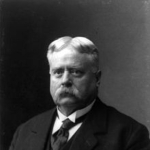
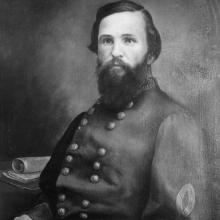
Lunsford Lindsay Lomax was American military personnel. He served as a major general in the Confederate States of America during the American Civil War.
Background
Lunsford Lindsay Lomax was born on November 4, 1835 at Newport, Rhode Island, United States. He was the son of Mann Page Lomax of Virginia, major of ordnance in the United States Army, and of Elizabeth Virginia Lindsay, a descendant of Captain William Lindsay of Light-Horse Harry Lee's cavalry in the Revolutionary army.
Education
Lunsford was educated in the schools of Richmond and Norfolk, Virginia, and appointed to the Military Academy at West Point in 1852. He was graduated in 1856 with his lifelong friend, Fitzhugh Lee.
As the second lieutenant of cavalry Lomax did frontier duty in Kansas and Nebraska. He was serving as the first lieutenant when Virginia seceded, and on April 25, 1861, he resigned his commission and was appointed captain in the state forces of Virginia, serving first as assistant adjutant-general on the staff of General Joseph E. Johnston. Later he was transferred to the Confederate Army as inspector-general on the staff of brigadier-general McCulloch in Van Dorn's army.
After McCulloch's death, he served as inspector-general with the rank of lieutenant-colonel on Van Dorn's staff until October 1862, when he was made inspector-general of the army in East Tennessee. He took part in battles in Arkansas, Mississippi, Louisiana, and Tennessee, and in 1863 was called to the eastern campaign as colonel of the 11th Virginia Cavalry. He participated in the raid into West Virginia with Jones's brigade, and in the campaign culminating in the battle of Gettysburg.
On July 23, 1863, Lomax was promoted brigadier-general, and his brigade was one of the principal factors in Fitz Lee's operations from Culpeper through the Wilderness campaign and the fighting around Richmond. On August 10, 1864, he was made a major-general and fought in the Valley campaign of General Jubal A. Early. He was captured at the battle of Woodstock by a cavalry company but overcame his captors and escaped in a few hours.
On March 29, 1865, Lomax was put in the entire command of the Valley District of the Army of Northern Virginia. After the fall of Richmond, he removed his troops to Lynchburg, and when General Lee surrendered he tried to effect a juncture with General Echols in order to continue the struggle, but he finally surrendered his division with Johnston at Greensboro.
Immediately after the close of the Civil War Lomax bought a place near Warrenton, Virginia, and settled down to farming. He remained here until his election in 1885 to the presidency of the Virginia Agricultural and Mechanical College (now Virginia Polytechnic Institute), at Blacksburg. In 1899 he resigned from this position and moved to Washington, where he took up the compilation, begun in 1880, of the Civil War records, published by the War Department under the title, "War of the Rebellion: Official Records of the Union and Confederate Armies." He was engaged in this task until it was completed and then in 1905 Lomax was appointed one of the commissioners of the military park at Gettysburg. To this work, he gave enthusiastic service until his death.
Achievements
Lunsford Lindsay Lomax distinguished himself at the Confederate Army during the American Civil War and rose to the rank of major-general. He also served as the 4th President of Virginia Agricultural and Mechanical College.
Personality
Lomax was distinguished in the manner and known for his great physical and mental vigor. He enjoyed the esteem and close friendship of leading men in both the Union and Confederate armies and won the affection of those associated with him in his college work.
Connections
Lomax was married, on February 20, 1873, to Elizabeth Winter. The couple had two children.