

Background
Thomas, Margaret Ann was born on April 5, 1952 in Woodbury, New Jersey, United States. Daughter of Robert H. and Elizabeth (Trent) Thomas.
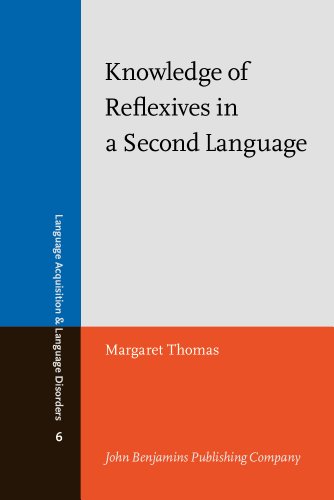
(This study addresses the debate about whether adult langu...)
This study addresses the debate about whether adult language learners have access to the principles and parameters of universal grammar in constructing the grammar of a second language. The data are based on two related experiments. The first examines the interpretation of English reflexive pronouns by native speakers of Japanese and of Spanish. The second experiment examines the interpretation of the Japanese reflexive zibun by native speakers of English and of Chinese. Three hypotheses are evaluated: (a) that UG is unavailable, and that processing strategies or other non-linguistic principles guide second language acquisition; (b) that UG is available only in the form in which it is instantiated in the learner's native language; (c) that UG is fully available, including the ability to re-set parameters to UG-sanctioned values not instantiated in the learner's native language. The results show that learners observe constraints defined by Manzini and Wexler's parameterized version of Principle A of the binding theory and support the proposal that adult learners have access to universal grammar. A final chapter reviews the experimental data in the light of recent accounts of cross-linguistic variation in the grammar of anaphors which reject parameterization of the binding principles in favor of a “movement to INFL” analysis.
http://www.amazon.com/gp/product/155619241X/?tag=2022091-20
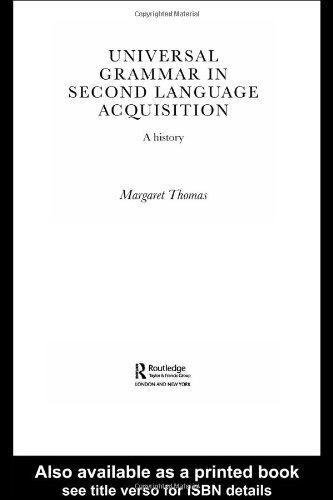
(From the ancient Mediterranean world to the present day, ...)
From the ancient Mediterranean world to the present day, our conceptions of what is universal in language have interacted with our experiences of language learning. This book tells two stories: the story of how scholars in the west have conceived of the fact that human languages share important properties despite their obvious differences, and the story of how westerners have understood the nature of second or foreign language learning. In narrating these two stories, the author argues that modern second language acquisition theory needs to reassess what counts as its own past. The book addresses Greek contributions to the prehistory of universal grammar, Roman bilingualism, the emergence of the first foreign language grammars in the early Middle Ages, and the Medieval speculative grammarians efforts to define the essentials of human language. The author shows how after the renaissance expanded people's awareness of language differences, scholars returned to the questions of universals in the context of second language learning, including in the 1660 Port-Royal grammar which Chomsky notoriously celebrated in Cartesian Linguistics. The book then looks at how Post-Saussurean European linguistics and American structuralism up to modern generative grammar have each differently conceived of universals and language learning. Universal Grammar in Second Language Acquisition is a remarkable contribution to the history of linguistics and will be essential reading for students and scholars of linguistics, specialists in second language acquisition and language teacher-educators.
http://www.amazon.com/gp/product/0415310377/?tag=2022091-20
http://www.amazon.com/gp/product/B00Y30IV0E/?tag=2022091-20
Thomas, Margaret Ann was born on April 5, 1952 in Woodbury, New Jersey, United States. Daughter of Robert H. and Elizabeth (Trent) Thomas.
Bachelor, Yale University, 1974. Master of Education, Boston University, 1983. AM, Harvard College, 1985.
Doctor of Philosophy, Harvard College, 1991.
Associate professor linguistics, Boston College, Chestnut Hill, Massachusetts, 1991-1996; associate professor, Boston College, Chestnut Hill, Massachusetts, since 1996.
(This study addresses the debate about whether adult langu...)
(From the ancient Mediterranean world to the present day, ...)
Member Modern Language Association, North America Society for History of Language Sciences, Linguistic Society of America, American Association Applied Linguistics.
Married Dayton William Haskin. Children: Thomas Henry, Peter William, Helen Marie.
