Background
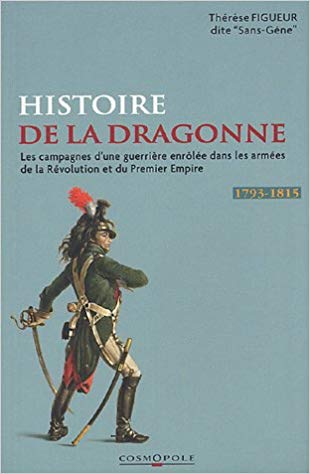
Marie-Thérèse Figueur was born near Dijon, France in 1774 and was orphaned by age nine. She was sent to live with her uncle, Joseph Viart, who was an officer in a French infantry unit. The life of a soldier immediately appealed to the young Figueur.
Education
Marie-Thérèse Figueur was trained in horsemanship and the use of firearms and sword.
Career
Stories vary about why Therese Figueur joined the military. Some say she was abandoned by a lover, causing her to renounce her sex and join the military; others claim she was trained by an uncle in the skills of a soldier. Figueur did, in fact, don a male disguise and join the Legion des Allobroges in 1793, where she continued to serve until 1795. During that time she met Napoleon Bonaparte at Toulon and served in the Army of the Pyrenees as well.
In spite of the law of 30 December 1793 that proscribed women from service as soldiers Figueur remained in the military. Such a position was uncommon, but not impossible if officers and peers allowed her to continue her service in disguise. From 1795 to 1799 she served in the Army of Italy, where she was wounded four times, had horses shot out from under her twice, and was made a prisoner of war. During the examination of the injuries she had received prior to her being captured, her sex was detected by the enemy. She was returned to the French, who pensioned her from the military in January 1800. Her pension, based on valorous service and combat-related injuries, amounted to 200 francs per year.
Returning to the military later in 1800, again in disguise, Figueur served in the 9th Dragoons in Austria and Prussia. In 1809 she campaigned in Spain, where three years later she was captured by guerrillas and made a prisoner of war until she was freed after Napoleon's abdication in 1815. In 1831, after repeated petitioning, Figueur was granted an additional pension of 100 francs based on her former husband's service record. By that time she had become the widow of Clement-Joseph-Melchior Sutter, a soldier like herself, who had died in 1823.
In 1839, feeling the long-term results of her injuries and without sufficient resources to subsist, Figueur petitioned for admission to the Hospice des manages in Paris. Her requests were granted because of her inability to care for herself and because she was denied admission to Les Invalides, the national veterans' hospital (a denial based solely on account of her sex). For the first several years of her confinement at the Hospice, Figueur dictated her lengthy memoirs, which were published in 1842.
Among the reasons for publishing her memoirs were Figueur's desire to claim her military nickname of "SansGene", which had, in other circles, been given to the former laundress and wife of Napoleonic general Frangois-Joseph Lefebvre, whose outspokenness was widely known.
After Waterloo, Marie-Thérèse opened a Table d'hôte restaurant in partnership with renowned balloonist and pioneer parachutist madame Jeanne Garnerin.
Politics
Marie-Thérèse Figueur discreetly supported the Royalist federalist at the beginning of the Revolution.
Views
"Following them to an asparagus field which was to be their 'champ de Bataille', I wanted to seize their brandished sabers in my tiny hands."
Personality
Marie-Thérèse Figueur first displayed her unique courage in her childhood, when her uncle was challenged to a duel by another soldier. On the morning of the duel, Figueur raced after her uncle to defend him and stop the duel.
Figueur had her own reasons for hating the French revolutionaries. She believed that her best friend, a Swiss drummer boy named Clément Joseph Melchior Sutter, had been killed during the overthrow of the monarchy. Figueur immediately distinguished herself in action as not only a fearless soldier under fire but as someone completely unconcerned with social convention.
At a time when women were expected to be discrete and well-mannered in public, Figueur was just as quick with a dirty joke as any of the men in her company. Figueur soon earned herself a nickname: Madame Sans-Gêne. It roughly translates as "Mrs. Without Embarassment". But it was never meant as a condemnation of un-ladylike behavior. Instead, the nickname was an admiring statement on her supreme self-confidence. Figueur wanted to fight, and she didn’t care what anyone thought of her for it.
Physical Characteristics:
Standing just 5 feet 4 inches, Figueur had a diminutive figure.
Quotes from others about the person
"I have never known a braver soldier." - One of the generals of the nascent Republic.