

Background
Marx Wartofsky was born on August 5, 1928 in Brooklyn, New York, United States. His parents were, in his terms, "working class socialist intellectuals".


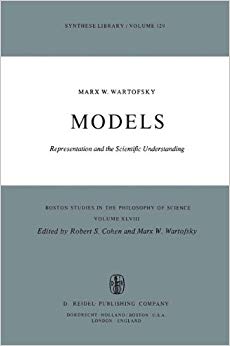
(Marx Wartofsky has been working for many years within an ...)
Marx Wartofsky has been working for many years within an unusual confluence of philosophical problems. He brings to these intersecting problems his comprehensive intelligence, at once imaginative and rigorous, analytic and historical. He is a philosopher's philosopher, but also Everyman's. Wartofsky is philosopher of the natural and the social sciences, of perception, esthetics and the creative arts, of the 18th century French and the 19th century Germans, of politics and morality, ofthe methods and morals of medicine, and it is plain, of all human existence. To a colleague, he seems Jack-of-all-philosophical-trades, and master of them too. The reader soon will learn that Wartofsky is a genial, lucid and relaxed philosophical companion, deeply serious but without noticeable anxiety. I need not highlight these selected epistemological papers gathered as, and about, Models, since Wartofsky's own introductory remarks are helpful and stimulating in that respect. I need only, after 21 years of friendship and collaboration with him, warn the reader to beware of how profound and provocative these papers will show themselves to be beneath their good-humored and swiftly-flowing surface. And I must publicly note the pleasure with which I welcome Marx Wartofsky's volume to our Boston Studies. Boston University R.S.C. Center for the Philosophy and History of Science September 1979 vii TABLE OF CONTENTS EDITORIAL PREFACE VII xi AC K NOWLEDGEMENTS xiii INTRODUCTION The Model Muddle: Proposals for an Immodest Realism 1.
http://www.amazon.com/gp/product/9027709475/?tag=2022091-20

(Feuerbach is now recognized as a central figure in the hi...)
Feuerbach is now recognized as a central figure in the history of nineteenth-century thought. He was one of Hegel's most influential pupils: he dominated German radical philosophy in the 1840s and was the leader of the Young Hegelians; his 'anthropological' critique of Hegel's idealism decisively influences the materialism and humanism of Marx and Engels; his critique of religion pointed the way for the philosophers of religion; and his psychological analyses found a place in Freudian thought and the existential and phenomenological traditions. In this 1977 text, Professor Wartofsky wishes to go beyond this conventional view to establish Feuerbach as much more than a transitional figure between Hegel and Marx or an influence on important later developments. He seriously considers Feuerbach's philosophy on its own terms and seeks to demonstrate its continuing importance. He therefore traces Feuerbach's development in detail, emphasizing its dialectical character, and finds fundamental originality in his epistemology.
http://www.amazon.com/gp/product/052121257X/?tag=2022091-20
Marx Wartofsky was born on August 5, 1928 in Brooklyn, New York, United States. His parents were, in his terms, "working class socialist intellectuals".
Wartofsky graduated from the High School of Music and Art.
Wartofsky took pride in his Brooklyn neighborhood from with its polyglot ambiance - Jewish, Black, Irish, and Italian - and he drew from it a lifelong commitment to diversity and inclusiveness. After a semester at Brooklyn College in 1945, he attended Columbia College on a Pulitzer scholarship, receiving a Bachelor of Arts degree with Honors and Special Distinction in Philosopphy in 1948 and was elected a member of Phi Beta Kappa. He went on to do his graduate work at Columbia too, as an Adam Leroy Jones Fellow, receiving Master of Arts degree in 1949 and Doctor of Philosophy degree in 1952.
As a philosophy professor and writer, Wartofsky’s interest was in the ways social customs influence a society’s philosophical themes.
Wartofsky taught for twenty-six years at Boston University. He began at the College of Basic studies there in 1957 and raise to Professor in the Philosophy Department, with a period of a chair from 1957 till 1973.
In 1967, he was named the philosophy department chair at the university. Wartofsky was a contributor to Diderot Studies II (1953), Marx and the Western World (1967), Planning for Diversity and Choice (1968), Human Dignity: This Century and Next (1970), and a lot of others. With his wife, Carol C. Gould, he co-edited Women and Philosophy (1976).
In 1970, Wartofsky also founded and edited The Philosophical Forum, a quarterly publication.
He was named Distinguished Professor of Philosophy at Baruch College and the Graduate Center of the City University of New York in 1983.
(Marx Wartofsky has been working for many years within an ...)
(Feuerbach is now recognized as a central figure in the hi...)
Wartofsky was active in the Socialist labor movement and the International Workers Order/Jewish Peoples Fraternal Order. These early political concerns came to play a role in his philosophical approach as well, in his emphasis on "praxis" and on the human and social bases of consciousness and of philosophical thought.
Wartofsky was married to Carol C. Gould. The couple had a son, Michael Gould-Wartofsky. Wartofsky had two sons from a previous marriage, Steven, of Round Lake Beach, Illinois, and David, of Fort Washington, Maryland. Also he had three grandchildren.
