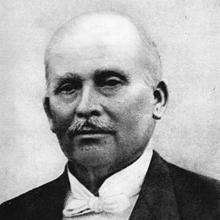
Mathias Lerch was a Czech mathematician. He published about 250 papers, largely on mathematical analysis and number theory.
Background
Lerch was born on February 20, 1860, in Milínov (near Sušice), South Bohemia (now Czech Republic). Like most people from that part of the world in that period he has both a German version of his name, Mathias, and a Czech version, Matyáš. However, things are not quite so simple since his given name (the one that appears on his birth certificate) is Matěj. However there is no evidence that he ever used the name Matěj and he always used Matyáš. His parents were Vojtěch Lerch and Barbora Adamovská, who worked on a farm, and had five children who survived past the baby stage, two boys and three girls. However, after the two eldest died as babies, a third boy, Vojtěch, died when a young child and a girl, Marie, drowned in a water tank on the farm when 3 or 4 years old. The remaining children, Matyáš, Ružena and Marie all grew to adulthood.
Education
Lerch should have begun his education at an elementary school at the age of six. However, although he had been a bright agile child up to that age, sadly when he was six years old he had a serious accident which left him badly crippled. Even after quite a while he was only able to walk with crutches, and could not attend school.
He was aiming at becoming a school teacher and, in the autumn of 1880, he enrolled in the Czech Polytechnic in Prague. He then studied in 1884 and 1885 at the University of Berlin under Weierstrass, Kronecker, and Lazarus Fuchs.
In 1886 Lerch became a Privatdozent at the Czech technical institute in Prague. Over the next few years Lerch produced, on average, about one paper per month, a quite stunning achievement. However as the years went by it became clear that he was not going to be promoted to a professorship in Prague. In fact during these years he only held positions of assistant to Eduard Weyr from 1885 to 1888 and assistant to Gabriel Blažek (1842-1910), from 1888 to 1896, who, in addition to working on pure mathematics, was a politician and a banker. Lerch lectured on analytical functions and on the geometry of rational curves while an assistant to Eduard Weyr, but, after becoming an assistant to Blažek, he gave lectures on potential theory, higher algebra, the theory of numbers, analytic geometry, and the theory of functions.
In 1896 Lerch became full professor at the University of Fribourg. He returned to his native country in 1906, following his appointment as full professor at the Czech technical institute in Brno. In 1920 Lerch became the first professor of mathematics at the newly founded Masaryk University in Brno. He died two years later, at the age of sixty-two. In 1900 he received the grand prize of the Paris Academy for his Essais sur le calcul du nombre des classes de formes quadratiques binaires aux coefficients entiers.
Lerch’s achievements in analysis were in general function theory, general and special infinite series, special functions (particularly the gamma function), elliptic functions, and integral calculus. His works are note-worthy with regard to methodology. In particular he described and applied to concrete questions new methodological principles of considerable importance: the principle of the introduction of an auxiliary parameter for meromorphic functions and the principle of most rapid convergence. He is also well known, however, for his work in analysis. In that topic he studied infinite series, and the gamma function as well as other special functions. He also studied elliptic functions and integral equations. Often the importance of his work is in the methods which he introduced rather than the specific results themselves. He introduced an auxiliary parameter for meromorphic functions. He also studied the principle of most rapid convergence of a series. He is remembered today for his solution of integral equations in operator calculus and for the 'Lerch formula' for the derivative of Kummer's trigonometric expansion for log G(v).
Lerch won the Grand Prize of the Paris Academy of Sciences in 1900 with a work on number theory, a great honour for any mathematician and an even greater achievement for a mathematician from outside France. He was also honoured with honorary membership of the Union of Czech Mathematicians and Physicists in 1907 and an honorary degree from the Czech University in Prague in 1909.
Achievements
Lerch was a remarkable Czech mathematician who published about 250 papers, some fifty of which were devoted to number theory. Some of his work is fundamental in modern operator calculus.
Views
Of Lerch’s 238 scientific writings, some of which are quite comprehensive, 118 were written in Czech. About 150 deal with analysis and about forty with number theory; the rest are devoted to geometry, numerical methods, and other subjects.
Membership
Union of Czech Mathematicians and Physicists
,
Czech Republic
1907
Connections
Lerch married Roůžena Sejpková on January 13, 1921.