

Background
Cowling, Maurice John was born on June 9, 1926 in London. Son of Reginald Frederick Cowling and May Roberts.
(In his book, Mr Cowling describes the relationship betwee...)
In his book, Mr Cowling describes the relationship between British party politics and the conduct of British foreign policy between Hitler's arrival in office in 1933 and Chamberlain's resignation in May 1940. He sets British policy in the context of European, Imperial, League, national and isolational sentiments and takes account of the strategic and financial limitations within which decisions were made. He shows how far prime ministers, foreign secretaries and the cabinet responded to parliamentary criticism, and argues that, from mid-1936 onwards, foreign policy and the prospects of the party system were so intimately connected that neither can be understood in isolation from the other.
http://www.amazon.com/gp/product/0226116603/?tag=2022091-20
(Mill and Liberalism was first published in 1963. Initial ...)
Mill and Liberalism was first published in 1963. Initial reactions varied from the uncomprehending to the splenetic. In the intervening quarter-century the intellectual climate has changed as reflected by its greatest exemplar, to warrant fresh consideration. Unlike many commentators, before or subsequently, Maurice Cowling endeavours to view Mill's thought as a coherent whole with a specific proselytising purpose, geared to the emasculation of Christianity and its replacement by a libertarian public doctrine. This interpretation aroused much contemporary hostility, and in a new introduction Cowling locates Mill and Liberalism within the broader intellectual history of post-war Britain, looking at the various strands of the 'new Right' and relating the academic to more specifically journalistic or political manifestations.
http://www.amazon.com/gp/product/0521388724/?tag=2022091-20
http://www.amazon.com/gp/product/B00MMSXDWK/?tag=2022091-20
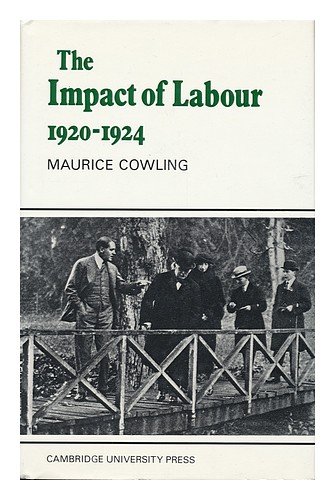
(Modern British politics begins with the Labour victory at...)
Modern British politics begins with the Labour victory at the Spen Valley by-election in early 1920. In the next four years, the challenge presented by its arrival as a major electoral force enabled the Conservative leaders to destroy the Coalition, the Liberal Party, and Lloyd George, to triumph as guardians of the social order under Baldwin at the General Election of 1924 and to establish the Labour-Conservative polarisation in the form which has persisted since. This conclusion emerges from Mr Cowling's detailed study of the high politics of these years, in which the various attempts to end and replace the Coalition are shown to have hinged on 'resistance to socialism'. This book is primarily an account of the initiatives of politicians and their reactions to one another. Mr Cowling's book is unique in the sources used; it is also the only study of this period to examine all three political parties in detail.
http://www.amazon.com/gp/product/0521079691/?tag=2022091-20
Cowling, Maurice John was born on June 9, 1926 in London. Son of Reginald Frederick Cowling and May Roberts.
Master of Arts, Cambridge University, 1952.
Fellow, Peterhouse, Cambridge, England, 1963-1993; reader in modern English history, Peterhouse, Cambridge, England, 1976-1988. Visiting professor Columbia University, 1988, Adelphi U., 1994. Literary editor London Spectator, 1970-1971.
(In Religion and Public Doctrine in Modern England, Mauric...)
(In his book, Mr Cowling describes the relationship betwee...)
(The passage of the Reform Bill of 1867 is one of the majo...)
(Modern British politics begins with the Labour victory at...)
(Mill and Liberalism was first published in 1963. Initial ...)
Parliamentary candidate Conservative Pary of British General Election, 1959. Member Cambridgeshire and Isle of Ely County Council, 1966-1970. Captain Queen's Royal Regiment, British Army, 1944-1948.
