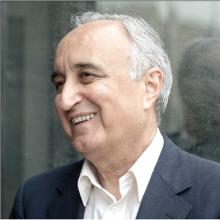
Mousa Ghaninejad is an Iranian economist, accountant and writer known for advocating free-market economics and for criticizing state control of Iran's economy. He was editor-in-chief of the daily newspaper Donya-e-Eqtesad and is a faculty member of the Petroleum University of Technology in Tehran, having also been an honorary visiting professor at Sharif University of Technology.
Background
Mousa Ghaninejad was born in 1951 in Tabriz, the principal city of East Azerbaijan Province in northwestern Iran. Tabriz has long been one of Iran's major commercial and cultural centers, and its urban life combined trade, religious institutions, and a substantial intellectual community.
He was born in the same year that Iran's parliament passed the law nationalizing the oil industry under Prime Minister Mohammad Mossadegh. Ghaninejad is a vocal critic of Mossadegh and of that nationalization, and his later economic writing focuses on the relationship between state control and economic performance.
His formative education moved from Tehran, where he studied accounting, to Paris, where he pursued economics, a path that shaped his later work on economic theory and Iranian economic policy.
Education
Ghaninejad earned a bachelor's degree in accounting at the University of Tehran after the 1979 Islamic Revolution. The University of Tehran is Iran's oldest and most prominent public university in the capital. Its origins lie in the Dar al-Funun, founded in 1851, and in the Tehran School of Political Sciences, established in 1899, while the modern university was officially inaugurated in 1934.
He then moved to Paris, where he completed a master's degree and a doctorate in economics at Panthéon-Sorbonne University. The institution is one of the successors of the historic University of Paris, which was reorganized into separate universities in 1970.
He later began a second doctorate at the same university, in the epistemology of economics, but returned to Tehran before defending the thesis, so that program was not completed. His continuing interest in the philosophy of economics and the history of economic ideas reflects this unfinished philosophical training.
Career
Ghaninejad's most prominent public role has been with Donya-e-Eqtesad, a Persian-language daily economic newspaper founded in Tehran in October 2002. He served as its editor-in-chief and, according to one biographical source, headed its Economic Research Center. The newspaper's media group also operates a book publishing imprint, through which several of his books and translations were issued.
In an editorial titled 'The Enigma of Iran's Economic System,' published in Donya-e-Eqtesad, he asked why Iran's economy had failed to meet expectations despite abundant economic resources and skilled human resources. In a May 2023 program on Channel 4, he debated the economy with Ali Alizadeh, blaming state-controlled markets for Iran's problems, while Alizadeh pointed to neoliberalism as the root cause.
He has been an honorary visiting professor in the graduate school of management and economics at Sharif University of Technology. Sharif was founded as Aryamehr University of Technology in 1966 and was renamed after the 1979 revolution; it is among Iran's leading institutions in engineering and the applied sciences.
He is a faculty member of the Petroleum University of Technology in Tehran. That institution began in 1939 as the Abadan Institute of Technology, created to train personnel for Iran's oil industry. It was upgraded to university status in 1989 under its present name, and its Tehran faculty of petroleum was established in 1957.
Politics
Ghaninejad's political outlook is best understood through his economic liberalism. He has argued that economic reform should take priority over political reform, a position that sources describe as unusual among Iranian intellectuals. He is a staunch advocate of free-market economics and has been a vocal critic of Mohammad Mossadegh and of the 1951 nationalization of Iran's oil industry.
His views developed within the Austrian school of liberal economic theory, which emphasizes market processes, limited government, and the limits of central economic planning. Friedrich Hayek is the figure most closely associated with that school, and Ghaninejad has translated and written about Hayek's thought. Within the Iranian debate, his criticism of state control is directed at the post-1979 economic order, which he has described as a politicized system of nepotism in which government-appointed managers and favored companies dominate the economy.
The newspaper with which he is most closely associated, Donya-e-Eqtesad, is generally described as an advocate of free markets and as having no formal affiliation with the Iranian government. His commentary in that paper therefore reflects the same free-market orientation that his books express.
Views
Ghaninejad is associated with the Austrian school of liberal economic theory, particularly the thought of Friedrich Hayek. His writings include a volume on Hayek and civil society and a work on freedom, economics, and politics, and he co-translated the third volume of Hayek's Law, Legislation and Liberty into Persian.
His scholarly interests extend to the philosophy of economics, epistemology, and the history of economic ideas. His unfinished doctoral project on the epistemology of economics reflects a concern with how economic knowledge is grounded, rather than only with policy outcomes.
In a 2023 debate he rejected the notion of an Islamic economy, stating that there is no such thing as Islamic economy, and he described the Iranian economy as a politicized system shaped by favoritism. His views therefore combine a commitment to market principles with skepticism toward ideological claims about economic organization.