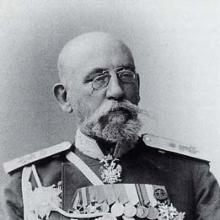
Nikolay Ivanovich Bobrikov was a Russian military officer and politician who served as Governor-General of Finland from 1898 until his assassination in 1904. A supporter of imperial centralization, he directed measures that curtailed Finland’s autonomy and advanced Russification, making him a central figure in the first period of Finnish resistance to Russian rule.
Background
Nikolay Ivanovich Bobrikov was born on January 27, 1839, in Strelna, near Saint Petersburg, in the Russian Empire. His parents were Ivan Bobrikov, a military physician and senior hospital officer, and Alexandra Seeland.
Bobrikov entered military service during the final decades of the Russian Empire's imperial expansion. His career developed within the officer corps and the General Staff system, institutions that trained officials for the administration and defense of the multinational empire. His later political work remained closely connected with the military and autocratic structures of the imperial government.
Education
Bobrikov received his early military education at the First Cadet Corps in Saint Petersburg and later graduated from the Nicholas Academy of the General Staff. Cadet corps education prepared young men for commissioned service in the imperial army, while the General Staff Academy provided advanced training for officers assigned to planning, administration, and senior command.
His education placed him within the professional officer culture that expanded in importance as the Russian Empire managed a large army and diverse imperial territories. The General Staff tradition combined military organization with administrative responsibilities, preparing officers for service in district headquarters, field commands, and high governmental appointments.
Career
Bobrikov entered the Russian Imperial Army as an officer in 1858. He served in the Kazan Military District and later held staff appointments connected with the Saint Petersburg Military District and the imperial guard. He became a colonel in 1869 and participated in the Russo-Turkish War of 1877–1878, after which his advancement continued through senior staff and command positions.
In 1884 he became chief of staff of the Saint Petersburg Military District. He was promoted to general of infantry in 1897 and served on the Military Council from 1898. He also became a member of the State Council in 1900, placing him among the senior military and administrative officials of the empire.
Nicholas II appointed Bobrikov Governor-General of Finland in 1898. The office combined civil authority in the Grand Duchy with responsibility for imperial military interests, and Bobrikov used it to pursue closer administrative and military integration with Russia. During his tenure, the February Manifesto of 1899 restricted Finland's legislative autonomy, Russian was given a stronger position in administration and education, and the Finnish military system was subordinated to imperial requirements.
In 1903 the tsar granted Bobrikov exceptional powers that enabled him to dismiss officials, restrict newspapers, and suppress opposition. His policies made him a symbol of Russification to Finnish constitutionalists and nationalists. On June 16, 1904, Eugen Schauman shot Bobrikov at the Senate House in Helsinki; Bobrikov died from his wounds in a Helsinki hospital on June 17.
Politics
Bobrikov was an appointed imperial official whose political position was rooted in Russian autocracy, military centralization, and the integration of Finland more closely into the Russian Empire. As Governor-General of Finland, he supported measures that narrowed the Grand Duchy's legislative autonomy and strengthened the authority of the emperor and Russian imperial institutions.
His administration formed part of the Russification policy of the late reign of Nicholas II. The February Manifesto of 1899 limited Finland's ability to legislate independently on matters defined as imperial, while the Language Manifesto of 1900 expanded the administrative role of Russian. The Conscription Act of 1901 sought to bring Finnish military service into line with imperial policy, and in 1903 Bobrikov received exceptional powers to dismiss officials and restrict the press. These measures intensified Finnish constitutional resistance and contributed to the political crisis that preceded his assassination.
Views
Bobrikov's documented political conduct reflected a belief in the authority of the Russian autocratic state and in the need to subordinate Finland's separate institutions to imperial security and administrative unity. His policies treated Finnish constitutional autonomy as incompatible with a more centralized conception of the empire.
This outlook belonged to the broader Russian nationalist and bureaucratic environment of the late nineteenth-century imperial government. It favored a common administrative language, coordinated military obligations, and the primacy of imperial legislation over regional constitutional traditions.
Connections
Bobrikov was appointed by Emperor Nicholas II to the governorship of Finland and worked within the senior military and administrative leadership of the Russian Empire. His principal public connection was with the imperial government whose centralizing policy he implemented in Finland. He was assassinated by Eugen Schauman, a Finnish civil servant and nationalist, in Helsinki in June 1904.