

Background
Dorato, Peter was born on December 17, 1932 in New York City. Son of Fioretto and Rosina (Lachello) Dorato.
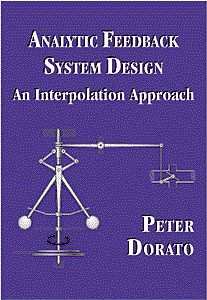
(This supplement presents the use of a technique derived f...)
This supplement presents the use of a technique derived from research conducted over the last 20 years. This technique, called interpolation theory in analytic design, is still not found in major introductory textbooks. Most introductory-level books teach trial and error design methods, not analytic design. Using this new technique, a mathematical existence theorem, and a solution algorithm, are posited and then used to solve a problem. Interpolation theory, which requires a minimal amount of mathematics, is the technique used to solve analytical design problems. The analytical design techniques presented in this book reflect modern approaches to problem-solving developed over the past 20 years (especially in the area of frequency domain), and are thoroughly up-to-date, as compared to the trial-and-error approach, which is now more than 30 years old.
http://www.amazon.com/gp/product/0534369170/?tag=2022091-20
(Softcover, 145 pages. In English. Engineering.)
Softcover, 145 pages. In English. Engineering.
http://www.amazon.com/gp/product/7800464709/?tag=2022091-20

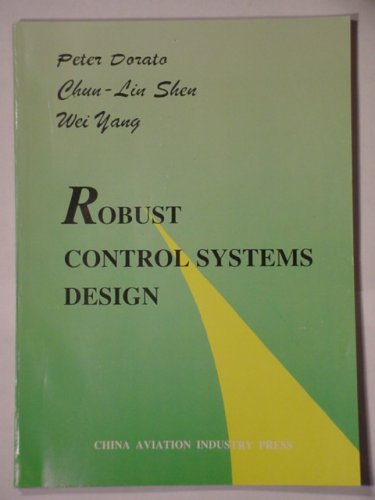
(These lecture notes focus on the synthesis of robust con-...)
These lecture notes focus on the synthesis of robust con- trollers for feedback systems, in the presence of unstruc- tured perturbations. It is assumed, as a prerequisites, that the reader is familiar with the basic linear system and au- tomatic control concepts. In part I interpolation theory is used to solve various single-input-single-output (Siso) ro- bust control problems. While the interpolation approach is awkward for multivariable systems, it provides a very natu- ral and simple approach for Siso systems. In particular the interpolation approach requires only elementary knowledge of complex variables, and provides a great deal of physical insight into various robust control problems. The required interpolation theory is developed in some detail. Part Ii is devoted to multivariable systems. Two approaches are out- lined: the Hankle-norm approach and the two-Riccati-equa- tion approach. In this part only a limited number of results are proven. However Matlab software is presented for nu- merical solution. The book is addressed to researchers, practicing engineers, and students who wish to get an intro- duction to robust control theory for unstructured plant perturbations. The organization of the book as lecture notes and the presence of examples and of exercises at the end of many chapters allow to use the book as an introductory text in Robust Control courses.
http://www.amazon.com/gp/product/354054920X/?tag=2022091-20
electrical and computer engineering educator
Dorato, Peter was born on December 17, 1932 in New York City. Son of Fioretto and Rosina (Lachello) Dorato.
Bachelor of Electrical Engineering, City College of New York, 1955; Master of Science in Electrical Engineering, Columbia University, 1956; DEE, Polytechnic Institute New York, 1961.
Lecturer electrical engineering department City College of New York, 1956-1957. Instructor electrical engineering Polytechnic Institute New York, Brooklyn, 1957-1961, professor, 1961-1972. Professor electrical engineering, director Resource System Analysis University Colorado, Colorado Springs, 1972-1976.
Gardner-Zemke professor electrical and computer engineering University New Mexico, Albuquerque, 1984—2004, chairman department, 1976-1984, professor emeritus, since 2005. Honorary chaired professor Nanjing Aeronautical Institute, 1989. Visiting professor Politecnico di Torino, Italy, 1991-1992l director Center for Intelligent Systems Engineering University New Mexico, 2001.
(These lecture notes focus on the synthesis of robust con-...)
(This supplement presents the use of a technique derived f...)
(Presents an introduction to Linear-Quadratic (LQ) Control...)
(Softcover, 145 pages. In English. Engineering.)
Fellow Institute of Electrical and Electronics Engineers (3rd Millenium medal). Member Institute of Electrical and Electronics Engineers Control Systems Society (Distinguished Member award)., World Automation Congress (Life Achievement award 2002).
Married Marie Madeleine Turlan, June 2, 1956. Children: Christopher, Alexander, Sylvia, Veronica.
