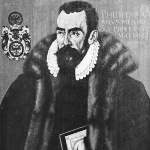
Petrus Apianus (April 16, 1495 – April 21, 1552), also known as Peter Apian, Peter Bennewitz, and Peter Bienewitz was a German humanist, known for his works in mathematics, astronomy and cartography.
School period
College/University
Gallery of Petrus Apianus
From 1516 to 1519 Apianus studied mathematics and astronomy at the University of Leipzig.
Gallery of Petrus Apianus
In 1519, Apianus moved to Vienna and continued his studies at the University of Vienna, which was considered one of the leading universities in geography and mathematics at the time and where Georg Tannstetter taught.
Career
Gallery of Petrus Apianus
Petrus Apianus Date: 1544 / 1553 (published) Antwerp Dimensions: 7.5 x 10.8 inches (19 x 27.4 cm) This is an authentic antique map of the world, by Petrus Apianus. This is the second woodblock cut for the world map in Apian’s Cosmographia, published out Antwerp in 1553. The map displays early 16th century knowledge of the world in a truncated cordiform projection. Much of the geographic information that makes up the map was based on a larger map of the world by Gemma Frisus, published in 1540, which has since been lost. The main differences from this second block example to the previous first block are the additions of Anglia and Scotia, and the word Europe has been leveled out. Throughout much of the map, a lack of geographic detail is replaced by place names, and numerous vignettes of animals and natives. North America appears as an elongated peninsula that bears the title Baccalearium, which is a reference to the exceptional cod fishing off the north Atlantic coast of the new world. Just below is one of the earliest depictions of a Yucatan peninsula (as opposed to an island). South America features a vignette of natives with reference to their cannibalistic means of survival. The oceans are embellished with sailing ships and sea monsters. The map displays an exceptional amount of decorative and allegorical detail. Atop are two deistic figures, one of which are wearing armor bearing the holy Roman double eagle and are believed to be a dedication to Emperor Charles V. The border is made up of constellations (right) and levels of climate (left). Surrounding the map, within a web of clouds are twelve wind-heads, three of which are presented with a cadaverous appearance, representing the southern winds believed to carry the plague.
Gallery of Petrus Apianus
Astronomicum Caesareum, 1540 by Petrus Beteiligte Apian.
Gallery of Petrus Apianus
Peter Apian, Caesar's Cosmology.
Gallery of Petrus Apianus
Peter Apian's 'Cosmographia' (1533).
Gallery of Petrus Apianus
Pages from ‘Astronomicum Caesareum’ (1540), by Peter Apian.
In 1519, Apianus moved to Vienna and continued his studies at the University of Vienna, which was considered one of the leading universities in geography and mathematics at the time and where Georg Tannstetter taught.
Petrus Apianus Date: 1544 / 1553 (published) Antwerp Dimensions: 7.5 x 10.8 inches (19 x 27.4 cm) This is an authentic antique map of the world, by Petrus Apianus. This is the second woodblock cut for the world map in Apian’s Cosmographia, published out Antwerp in 1553. The map displays early 16th century knowledge of the world in a truncated cordiform projection. Much of the geographic information that makes up the map was based on a larger map of the world by Gemma Frisus, published in 1540, which has since been lost. The main differences from this second block example to the previous first block are the additions of Anglia and Scotia, and the word Europe has been leveled out. Throughout much of the map, a lack of geographic detail is replaced by place names, and numerous vignettes of animals and natives. North America appears as an elongated peninsula that bears the title Baccalearium, which is a reference to the exceptional cod fishing off the north Atlantic coast of the new world. Just below is one of the earliest depictions of a Yucatan peninsula (as opposed to an island). South America features a vignette of natives with reference to their cannibalistic means of survival. The oceans are embellished with sailing ships and sea monsters. The map displays an exceptional amount of decorative and allegorical detail. Atop are two deistic figures, one of which are wearing armor bearing the holy Roman double eagle and are believed to be a dedication to Emperor Charles V. The border is made up of constellations (right) and levels of climate (left). Surrounding the map, within a web of clouds are twelve wind-heads, three of which are presented with a cadaverous appearance, representing the southern winds believed to carry the plague.
Qvadrans Apiani Astronomicvs Et Iam Recens Inventvs Et Nvnc Primvm Editvs Huic adiuncta sunt + alia instrumenta obseruatoria perinde noua, adcommodata horis discernendis nocturnis simul + diurnis
Horoscopion Apiani Generale Dignoscendis Horis Cvivscvmqve generis Aptissimum (replica edition, 1533)
(Astrology, Horoscope, Zodiac, text is only in Latin. -- E...)
Astrology, Horoscope, Zodiac, text is only in Latin. -- Excerpt from wikipedia about the author: Petrus Apianus (April 16, 1495 to April 21, 1552; also known as Peter Apian) was a German humanist, famous for his works in mathematics, astronomy and cartography. The crater Apianus on the Moon is named in his honour.
Petrus Apianus was a German mathematician, astronomer, cartographer, philosopher, and humanist. He was a pioneer in astronomical and geographical instrumentation, and one of the most successful popularizers of these subjects during the sixteenth century. His monumental work titled Cosmographicus liber (1524) was a highly respected work on astronomy and navigation that had at least 30 reprints in 14 languages.
Background
Petrus Apianus was born on April 16, 1495 in Leisnig, Germany. His father, Martin, was a shoemaker and the family was relatively well off, belonging to the middle-class citizenry of Leisnig. Later, while studying at the University of Leipzig, he Latinized his name to Apianus (lat. apis means "bee"; "Biene" is the German word for bee).
Education
At first, Apianus was educated at the Latin school in Rochlitz. Then from 1516 to 1519 he studied mathematics and astronomy at the University of Leipzig and Vienna, and quickly established a reputation as an outstanding mathematician.
In 1519, Apianus moved to Vienna and continued his studies at the University of Vienna, which was considered one of the leading universities in geography and mathematics at the time and where Georg Tannstetter taught. When the plague broke out in Vienna in 1521, he completed his studies with a B.A. and moved to Regensburg and then to Landshut.
Apian’s first published work was Typus orbis universalis, a world map, based on the work of Martin Waldseemüller, which illustrated the 1520 Vienna edition of Solinus’ Polyhistor sen de mirabilibus mundi. The following year he published the Isagoge, a commentary on the Typus and on geography.
In 1527, Peter Apian was called to the University of Ingolstadt as a mathematician and printer. His print shop started small. This print shop was active between 1543 and 1540 and became well known for its high-quality editions of geographic and cartographic works. It is thought that he used stereotype printing techniques on woodblocks.The printer's logo included the motto Industria superat vires in Greek, Hebrew, and Latin around the figure of a boy
Apian’s first major work, Cosmographia seu descriptio totius orbis (1524), was based on Ptolemy. Starting with the distinction between cosmography, geography, and chorography, and using an ingenious and simple diagram, the book defines terrestrial grids; describes the use of maps and simple surveying; defines weather and climate; and provides thumbnail sketches of the continents. In its later form, as modified by Gemma Frisius, the Cosmographia was one of the most popular texts of the time and was translated into all major European languages. The success of this and his previous works led to Apian’s appointment as professor of mathematics at the University of Ingolstadt, where he remained until his death. He was knighted by Charles V.
In his Cosmographia, Apian suggests the use of lunar distances to measure longitude; in his second major work, Astronomicon Caesareum (1540), he supports the use of solar eclipses for that purpose. The Astronomicon is notable for Apian’s pioneer observations of comets (he describes the appearances and characteristics of five comets, including Halley’s) and his statement that comets point their tails away from the sun.
Also important is his imaginative use of simple mechanical devices, particularly valvelles, to provide information on the position and movement of celestial bodies. Of greater scientific significance, however, is Apian’s lnstrumentum sinuum sive primi mobilis (1534), where he calculates sines for every minute, with the radius divided decimally. These are the first such tables ever printed.
Apian’s contribution to cartography was as a compiler and publisher, rather than as a mapmaker. His cordiform world map and maps of Hungary and France survive; his large-scale map of Europe (1534), the first of its kind, is lost.
In Landshut, Apian produced his Cosmographicus liber (1524), a highly respected work on astronomy and navigation that was to see at least 30 reprints in 14 languages and that remained popular until the end of the 16th century. Another publication between 1524 and 1540 was Apian's most important contribution to mathematics itself, rather than its applications. This was his book Instrumentum sinuum sive primi published in 1534 which contained the first sine tables calculated for every minute of arc. Like all other works by Apian this book contained a host of applications of mathematics, and the sine tables are applied to problems of astronomy, navigation and architecture. In 1534 Apian published the first large scale map of Europe but sadly this work is no longer extant.
Apian is the first to make the important observation that a comet's tail always points away from the Sun. Astronomicon Caesareum delighted Charles V who on the strength of the work appointed Apian court mathematician and he knighted Apian and his three brothers. He also designed a quadrant and an armillary sphere that were popular in his day.
Through his work, Apian became a favourite of emperor Charles V. Charles had praised his work (the Cosmographicus liber) at the Imperial Diet of 1530 and granted him a printing monopoly in 1532 and 1534. In 1535, the emperor made Apian an armiger, i.e. granted him the right to display a coat of arms.
The lunar crater Apianus and minor planet 19139 Apian are named in his honour.
Following 1540 Apian became famous and wealthy. Charles V granted him more privileges such as the power to make illegitimate children legally legitimate, and also the power to grant higher degrees.
Quotes from others about the person
Kish sums up Apian's contribution:
Apian was a pioneer in astronomical and geographical instrumentation, and one of the most successful popularisers of these subjects during the sixteenth century.
Connections
Petrus Apianus married the daughter of a councilman of Landshut, Katharina Mosner, in 1526. They would have 14 children together, five girls and nine sons, one of which was Philipp Apian.
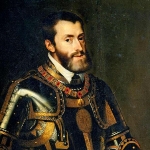
Charles V, the Holy Roman emperor, ruled over large parts of Europe as King of Spain and Archduke of Austria with a Spanish and Habsburg empire covering Europe from Spain and the Netherlands to Austria and Italy. It seems likely that Charles himself had studied cosmography, a useful subject for a ruler of so large an empire, under Apian around 1530. The evidence for this, however, is not conclusive. We know for certain that by the early 1530s Apian had special privileges granted by Charles and in 1540 Apian dedicated his next major work Astronomicon Caesareum to Charles.