Background
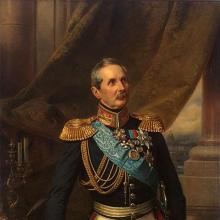
Pyotr Andreyevich Kleynmikhel was born on 30.11(11.12).1793 in St. Petersburg. He was a Russian statesman, count (1839). He was the son of A. A. Kleynmikhel, the director of the 2nd cadet corps.

state official Minister of Transport
Pyotr Andreyevich Kleynmikhel was born on 30.11(11.12).1793 in St. Petersburg. He was a Russian statesman, count (1839). He was the son of A. A. Kleynmikhel, the director of the 2nd cadet corps.
After graduating from the Cadet Corps, he enlisted in the Grenadier Regiment (1808).
He fought at the Battle of Leipzig and the Battle of Borodino. He dispatched Kleinmichel to warn them and advise them to return to Basel. After succeeding in this, Kleinmichel was made Aide-de-Camp to the Tsar.
The event also brought him to the attention of the future Tsar Nicholas I
Lieutenant was rumored that Nicholas I promoted his career because Kleinmichel adopted the Emperor"s illegitimate children as his own.
March 1812 Lieutenant of the Preobrazhensky Regiment; A.A. Arakcheev's aide-de-camp (1812).
Director of the Department of Military Resettlements till 1842. He was under the patronage of Arakcheev.
Adjutant General of H.I.V. (1826). In 1828-29 he was a member of the Committee for the Construction of Houses of Labor and Patriotism.
Adjutant General of the General Staff of H.I.H. (1832).
Chairman of the Committee for the telegraph line between St. Petersburg and Warsaw (1834). He was the Chairman of the Committee for the description of clothing and armament of the Russian Army (1837-55), chief of work for "Historical description of clothing and armament of the Russian Army" (vol. 1-30, 1841-62). Senator and member of the State Council (1842). The State Council (1842). The Chief Superintendent of Railways and Public Buildings (1842-1855).
He headed the construction of the Annunciation Bridge (1842-50, the first permanent bridge across the Great Neva River), building of the New Hermitage (opened in 1852), as well as reconstruction of the Winter Palace (1837/38-1839) in St. Petersburg after the fire.
He is the member of the Committee and Building Commission for arrangement of St. Petersburg-Moscow railway. (1842). In April-August 1842 he temporarily managed the War Ministry.
.
He was responsible for building the Moscow – Saint St. Petersburg Railway and for restoring the Winter Palace after the 1837 fire.
He distinguished himself at the Battle of Leipzig (1813) and the capture of Paris (1814).
He led the construction of the longest electromagnetic telegraph line at that time in 1839-54.
He enjoyed the special trust and favour of Emperor Nicholas I. In 1838 he was given the task of rebuilding the Winter Palace after the fire, which he performed with remarkable speed, for which he was elevated to the dignity of count (1839) and received a mock nickname "Kleynmikhel-Dvoretsky"[2]. At the same time, a gold medal with the inscription: "Zeal overcomes all" was struck in Kleinmichel's honour.
Kleinmichel was married twice, first in 1816 to Varvara Kokoshkina (died 1842), the granddaughter of the business magnate Alexei Turchaninov.
They divorced, according to rumours, because of his impotence. In 1832 Kleinmichel married Kleopatra Petrovna Ilyinskaya (October, 17 1811–January, 17 1865), the relative of Varvara Nelidova.
She died of tuberculosis in Paris, and was buried in Saint St. Petersburg.
She was known in the society as the woman who adopted Nicholas I"s illegitimate children. They had eight children.
Married the lieutenant general Pilar von Pilchau.
Lady-in-waiting
Married the countess Maria von Keller (1846–1931), granddaughter of Countess Amalie zu Sayn-Wittgenstein-Berleburg-Ludwigsburg, sister of Prince Peter zu Sayn-Wittgenstein, who, as Marie Kleinmichel, was the author of Memories of a Shipwrecked World. They had one surviving daughter, Olga.
Died in Paris