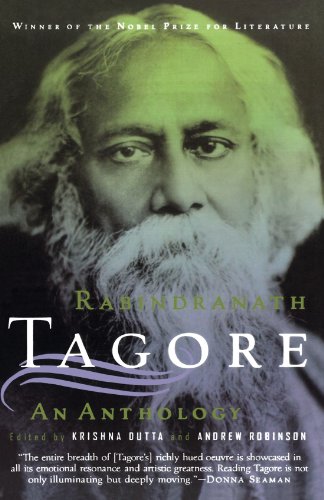
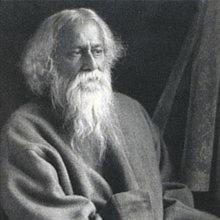
Rabindranath Tagore was a Bengali poet, philosopher, social reformer, and dramatist who came into international prominence when he was awarded the Nobel Prize for literature in 1913.
Background
Rabindranath Tagore or simply Rabindranath as he is known in India, was born into an affluent and brilliantly talented Calcutta family on May 7, 1861. His grandfather Dwarkanath Tagore had amassed great wealth through investment and speculation in coal mines, indigo, and sugar. Rabindranath's father, Debendranath, was outstanding in fields of learning ranging from mathematics to ancient scripture and was a man of profound religious concern. He was one of the founders of the religious society called the Brahmo Samaj, which, confronted by Christianity, attempted to purge popular Hinduism of "idolatry" and to reconstruct the "pure monotheism" of classical Indian religion. With his father frequently away and his mother ill, Rabindranath was cared for in his early childhood largely by servants and teachers who confined him strictly, breeding in him, as he later wrote, a longing for the freedom of the outside world and a detestation of conventional and restrictive scholastic education. The boy showed unmistakable poetic talent, and as early as 8 he was urged by his brothers and cousins to express himself in poetry. This encouragement, which continued throughout his formative years, caused his talent to flourish.
Education
Tagore largely avoided classroom schooling. When he was 11, his father took him on a trip to upper India and the Himalaya Mountains. Alone in the mountains, Debendranath instructed him in Sanskrit, English, and astronomy and taught him the ancient Hindu religious texts.
He loathed formal education—his scholarly travails at the local Presidency College spanned a single day.
Career
Rabindranath's first public recitation of his poetry came when he was 14 at a Bengali cultural and nationalistic festival organized by his brothers; his poem on the greatness of India's past, expressing sorrow at its present state, under British rule, was acclaimed. When he was 17, his brother Satyendranath, the first Indian ever admitted to the Indian civil service, took him on a trip to England; and the pattern of his life was established. These three elements occur throughout his life: a profound desire for freedom, both personal and national; an idea of the greatness of Asia's, and especially India's, contribution to the world of the spirit; and poetry expressing both of these.
Rabindranath spent many years as overseer of his family's vast estates in East Bengal and during that time worked hard for the betterment of the tenant farmers, being repaid by learning to know and love the songs and poetry of the people of the countryside; the folk arts of rural Bengal deeply influenced his own later work. And his experimental village called Sriniketan anticipated by many years the Village Development Program instituted by independent India and paralleled Gandhi's own experiments with the village as a viable economic and social unit.
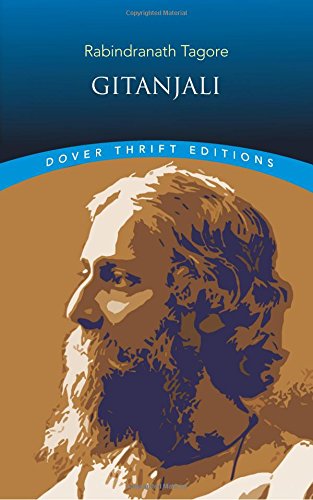
Rabindranath's ideas of Asia's unity, and later of the unity of the world, and his longing for personal freedom were both expressed in his continual and almost compulsive travel-to Japan, China, Europe, and the United States. In all of these places he lectured and wrote, and it was on one trip to England in 1912 that he fatefully found himself in the company of William Butler Yeats and Ezra Pound. He had prepared some prose versions of his Bengali collection of poems called Gitanjali (Song Offerings), religious poems for the most part of a lyrical and devotional sort very much akin to the songs of the ancient Hindu sect called Vaishnava. These he read to Yeats, who was entranced by them; and Pound, then representing Harriet Munroe's Poetry magazine of Chicago, cabled the editor to hold the next edition for the inclusion of some "very wonderful" poems by Tagore. Gitanjali was then published as a book, with an introduction by Yeats, and in 1913 came the Nobel Prize.
Rabindranath looked upon the award as a mixed blessing. In the years previous to its receipt he had retired more and more from the world to devote himself to writing, and he foresaw, correctly, that his peace would be disturbed by fame. He was beleaguered not only in his homeland, where the people, their pride rubbed raw by British dominance, suddenly saw him as a hero, but especially in the United States, where the atmosphere was right for the advent of a tall, handsome, whiterobed, and bearded wise man from the East. The reaction in India he greeted with disappointment; he saw his sudden prominence as nothing more than shallow chauvinism. And his reaction to the West's acclaim was confusion: he began to wonder whether India was as spiritual, and the West as materialistic, as he had thought. And this doubt was compounded by the fact that he had to look to the West for material support of his many projects, although he longed to live a simple life in the groves and fields of his "golden Bengal."
It would be a mistake to consider Rabindranath, as many, especially in the West, do, as only a poet. Late in his life he took up brush and ink, and his moody and often humorous wash drawings are a unique contribution to modern Indian art. Collections of essays like The Religion of Man and Sadhana (originally a series of lectures at Harvard) are thoughtful and provocative additions to the huge religious and philosophical literature of India. The essays in Toward Universal Man show him as a social and political theorist.
Such novels as Gora, Seser kavita (Farewell My Friend) and Ghare baire (The Home and the World) demonstrate not only Rabindranath's skill with the novel form but, even in translation, some of the innovations he brought to the Bengali novel: social realism, colloquial dialogue, light satire, and psychologically motivated plot development. His dramas, one of which was produced on Broadway as The King of the Dark Chamber, sometimes bordering on whimsy and fantasy, are often complex political or social commentary. His stories, some of the best of which are collected in translation under the title The Housewarming and Other Stories, range from ghost stories to lighthearted humor to scathing social satire to gentle warmth, the last being illustrated by the famous Kabuliwalla (The Man from Kabul).
An accomplished musician, Rabindranath was a vocal performer as well as composer. He developed a new style of vocal music which is called, after him, Rabindra-sangit. Never afraid to break the canons of the rigidly structured classical music of India, Rabindranath combined ragas (modes in the classical tradition strictly associated with time and place), brought in elements of the folk music of boatmen and wandering religious, mingled these with semiclassical forms of love songs, and drew from it all a unique style and form of music immensely popular on every level of Bengali society.
The deaths of almost all of his beloved immediate family in rapid succession, and painful illness, did not diminish Rabindranath's spirit. Until his death he remained a simple, tender man full of humor and love of life, deep in his sympathy, and strong in his ideals. His last poems, some of them dictated when he became too weak to hold a pen, show his love of nature and of man. He died on August 7, 1941, in Calcutta.
Achievements
He was awarded the Nobel Prize in 1913. Tagore was the first person (excepting Roosevelt) outside Europe to get the Nobel Prize.
Tagore modernised Bengali art by spurning rigid classical forms and resisting linguistic strictures. His novels, stories, songs, dance-dramas, and essays spoke to topics political and personal.
He was highly influential in introducing Indian culture to the West and vice versa, and he is generally regarded as the outstanding creative artist of early 20th-century India.
Although Rabindranath cherished freedom and had great pride in India and in Bengal, his gentle heart caused him to withdraw from the radical political activity with which many of his countrymen were trying to drive the British from their shores. Like Mohandas Gandhi, whom he knew well, Rabindranath abhorred terrorism; but he could not agree even with Gandhi on such political moves as boycott and burning of British-made goods. Rabindranath chose to express himself in other, more personal ways, such as resigning in 1919 the knighthood which he had received from the British crown and establishing a school and later a university at Shantiniketan, the ideals of which were education in a free atmosphere, in the open air, untrammeled by traditional restrictions, and the participation of students from all countries in common experience.
Views
Quotations:
“Every person is worthy of an infinite wealth of love - the beauty of his soul knows no limit.”
“Who are you, reader, reading my poems a hundred years hence? I cannot send you one single flower from this wealth of the spring, one single streak of gold from yonder clouds. Open your doors and look abroad. From your blossoming garden gather fragrant memories of the vanished flowers of an hundred years before. In the joy of your heart may you feel the living joy that sang one spring morning, sending its glad voice across an hundred years.”
“Trust love even if it brings sorrow. Do not close up your heart.”
“The roots below the earth claim no rewards for making the branches fruitful.”
“We read the world wrong and say that it deceives us.”
“Once we dreamt that we were strangers. We wake up to find that we were dear to each other.”
Personality
He remained a simple, tender man full of humor and love of life, deep in his sympathy, and strong in his ideals.
Connections
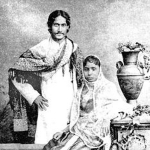
In 1883 he married 10-year-old Mrinalini Devi, born Bhabatarini, 1873–1902 (this was a common practice at the time). They had five children, two of whom died in childhood.