

Background
Ramsay, Raylene was born on August 28, 1945 in Dunedin, New Zealand.
( "Adds significant new insights into the mental, psychol...)
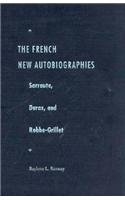
"Adds significant new insights into the mental, psychological, and rhetorical laboratory of three major contemporary French novelists. . . . Its rigorous focus on autofictional narratives also reflects the widening of the scope of contemporary critical theory and practice."--Raymond Gay-Crosier, University of Florida Raylene Ramsay explores the significance of the new autobiographical genre--the "autofictions"--that emerged from the nouveau roman in the 1980s in France. She focuses on the work of Nathalie Sarraute, Marguerite Duras, and Alain Robbe-Grillet, major figures of French avant-garde writing whose complex autobiographies slide between true and false memories and between fact and fiction, examining the limits imposed by the conventions of the traditional autobiography. While she questions the ability of memory to capture the past and the ability of language to record the experience of an ever-elusive self, Ramsay grounds the three authors in their particular historical, political, and sexual context. In this light she reads Sarraute's negative portrait of her mother, Duras' lyrical evocations of the intensity and pain of desire, and Robbe-Grillet's pirouetting "confession" of his family's anti-Semitism and pro-German feeling during World War II as deriving from the individuated (the "auto" and the "bios") rather than from the collective (the "graphy"), the forms of a shared language. In the final instance, Ramsay claims, the new autobiography, seeking individuated truths, offers the power to rewrite inner life--for example, Sarraute comes to identify with the "feminine" in the self; Duras casts the writing of her relationship with her Chinese lover as a form of liberation; even Robbe-Grillet, staging his predilection for young girls as the most banal of stereotyped sexual impulses, comes closer to self-knowing. She broadens the scope of her study by showing how this new kind of writing reflects contemporary critical movements, such as postmodernism and the scientific theory of "complementarity," as it telescopes the private and the public, the past experience and the present writing. Raylene Ramsay is professor of French at Auckland University in New Zealand. She is the author of Robbe-Grillet and Modernity: Science, Sexuality, and Subversion (UPF, 1992) and of many articles in journals such as French Review, College Literature, Language Quarterly, European Studies Journal, and Literature and History.
http://www.amazon.com/gp/product/0813013976/?tag=2022091-20
(Although more women in France have entered political life...)
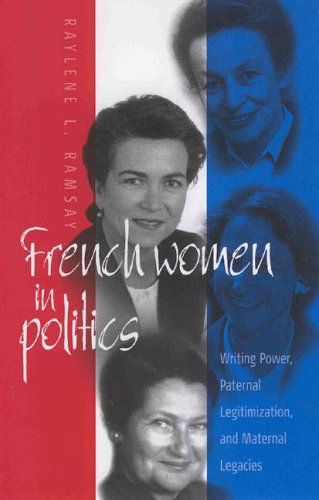
Although more women in France have entered political life than ever before, the fact remains that there are fewer women representatives in the French parliament than there were after the Second World War. In a new and original approach, the author presents an overview and analysis of the emerging body of text by or on women who have held high political office in France. The argument is that writing about women and politics has not just described or reflected women's slow but now substantial entry into political life; it has played a major part in shaping the parity debate and its outcomes. Interviews with political women, such as Huguette Bouchardeau, Simone Veil or Edith Cresson, inserted in the text, demonstrate the emergence and circulation of a new common discourse focused on the issue of whether women in politics make or should make a difference. A close reading of the various texts examined in this book and their connection to new public counter-discourses in France suggest that a re-writing of power is indeed occurring.
http://www.amazon.com/gp/product/157181082X/?tag=2022091-20
Ramsay, Raylene was born on August 28, 1945 in Dunedin, New Zealand.
Bachelor, University Otago, Dunedin, New Zealand, 1966. Master of Arts, University Otago, 1967. Doctor of Philosophy, University Poitiers, France, 1972.
Post. D diploma in Linguistics, Cambridge University, 1975.
Senior lecturer Massey University, New Zealand, 1977—1986. Visiting assistant professor Tufts University, Boston, 1986—1987. Assistant professor Clark University, 1987—1989.
Associate professor Simmons College, Boston, 1989—1994. Professor French University Auckland, since 1995.
(Although more women in France have entered political life...)
( "Adds significant new insights into the mental, psychol...)
Married Michael O'Callaghan, January 30, 1971. Children: Nathalie O'Callaghan, Kieran O'Callaghan.
