

Background
Quandt, Richard Emeric was born on June 1, 1930 in Budapest, Hungary. Son of Richard F. and Elisabeth (Toth) Quandt. came to the United States, 1949, naturalized, 1954.

http://www.amazon.com/gp/product/0262130564/?tag=2022091-20

http://www.amazon.com/gp/product/B002HR8SGM/?tag=2022091-20

(This book shows how philanthropy can be a primary force i...)
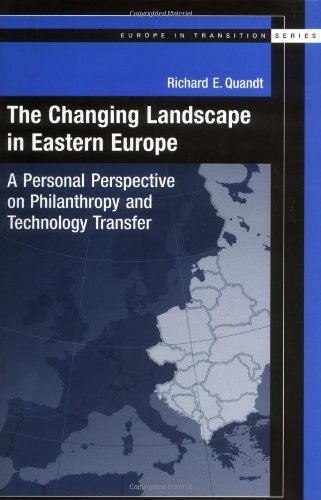
This book shows how philanthropy can be a primary force in the transfer of technology in transitional societies. It demonstrates the necessity of retraining of people and how this endeavor is as important as the technology itself. It is essentially about Hungary, Poland, Czech Republic, Slovakia, Latvia, Estonia, with somewhat smaller emphases on Russia, Romania and South Africa. It chronicles, explains, and analyzes western assistance efforts in Eastern Europe between 1989 and 2000 in the context of the political and economic events of the period, with particular emphasis on the activities of The Andrew W. Mellon Foundation. Factors that made transfers more or less successful and the role of social institutions and human factors will be highlighted. Significant illustrations include the creation of a small enterprise sectors, MBA programs, economic programs, and new markets and financial institutions. The material provides the reader with a clear understanding of how institutions for economic education emerged in Central and Eastern Europe, what role of US foundations and academic institutions played, and what the interplay with local personalities involved.
http://www.amazon.com/gp/product/0195146697/?tag=2022091-20
http://www.amazon.com/gp/product/B012YWTLZQ/?tag=2022091-20
http://www.amazon.com/gp/product/0720431778/?tag=2022091-20

http://www.amazon.com/gp/product/B0000CKF3N/?tag=2022091-20
Quandt, Richard Emeric was born on June 1, 1930 in Budapest, Hungary. Son of Richard F. and Elisabeth (Toth) Quandt. came to the United States, 1949, naturalized, 1954.
Bachelor, Princeton University, New Jersey, 1952. Master of Arts, Harvard University, 1955. Doctor of Philosophy, Harvard University, 1957.
Doctor Economics (honorary), Budapest University of Economics Sciences, 1991. Doctor Economics (honorary), Kossuth Lajos University, Hungary, 1994. Doctor Economics (honorary), Gödöllö Agricultural University, 1995.
Doctor Economics (honorary), Comenius University, Slovakia, 1996. DrLaws (honorary), Queens University of Canberra, 1996.
Member of faculty, Princeton University, 1956-1995;
professor economics, Princeton University, 1964-1995;
professor emeritus, senior research economist, Princeton University, since 1995;
Hughes-Rogers professor economics, Princeton University, 1976-1995;
professor emeritus, since 1995;
department chairman, Princeton University, 1968-1971, 85-88;
director, Finance Research Center, 1982-1995;
research professor, Ford Foundation, 1967-1968;
professor emeritus, senior research economist, Princeton University, since 1995. Consultant Alderson Associations, 1959-1961. Senior consultant Mathematica, Inc., 1961-1967.
Consultant International Air Transport Association, 1974-1975, New York Stock Exch., 1976-1977, New York State Department Education, 1978. Adviser American-Hungarian Foundation, 1977-1978. Editorial advisor Holt, Rinehart & Winston, 1968-1972.
Finance adviser Institute for Research in History, 1986. Senior advisor Andrew W. Mellon Foundation, since 1989. Member of advisory county Budapest U. Economics Sciences, 1992-1993.
Visiting professor Birkbeck College, 1981, U. Leicester, 1989-1992. Member Census Advisory Committee, 1983-1986. Member of advisory committee College Financial and Accounting, Budapest, 1993-1994.
(This book shows how philanthropy can be a primary force i...)
(The systematic study of disequilibrium phenomena is still...)
Author (with J. M. Henderson): Microeconomic Theory: A Mathematical Approach, 1958, 3d edition, 1980. Author: (with W. L. Thorp) The New Inflation, 1959. Author: (with B. G. Malkiel) Strategies and Rational Decisions in the Securities Option Market, 1969.Editor: The Demand for Travel: Theory and Measurement, 1970. Author: The Econometrics of Disequilibrium, 1988, The Changing Landscape in Eastern Europe: A Personal Perspective on Philanthropy and Technology Transfer, 2002. Author: (with P. Asch) Ractrack Betting: The Professor's Guide to Strategies, 1986.Author: (with Hari Singh Gour Rosen) The Conflict Between Equilibrium and Disequilibrium Theories, 1988. Editor (with S.H. Goldfeld): Studies in Nonlinear Estimation, 1976. Editor: (with S. M. Goldfeld) Nonlinear Methods in Econometrics, 1972.Editor: (with M. Peston) Prices, Competition and Equilibrium, 1986. Editor: (with R. Ekman) Technology and Scholarly Communication, 1999. Editor: (with A. Lass) Library Automation in Transitional Societies, 2000, Union Catalogs at the Crossroads, 2004.Associate editor: Econometrica, 1976-1980, Journal American Statistical Association, 1974-1980, Bell Journal Economics, Journal Comparative Economics, 1988-1991, Empirica, 1988-1993. Member editorial board Applied Economics, Economic Planning, Review Economic and Statistics, 1980-1991. Executive editor: Oxford University Press, since 2001.Translator: If Dogs Could Talk (V. Csányi), 2005. Contributor articles to professional journals.
Trustee Corvina Foundation, 1992—2008. Fellow: American Academy Arts and Sciences, Econometric Society (member council 1985-1988), American Statistical Association. Member: American Philosophical Society, American Economic Association, Hungarian Libraries Association (honorary).
Married Jean H. Briggs, August 6, 1955. 1 child Stephen.
