Background
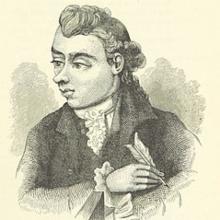
Robert Fergusson was born in Edinburgh, United Kingdom on September 5, 1750, of undistinguished parentage. He was a member of a large family. His parents, William and Elizabeth (née Forbes), were originally from Aberdeenshire, but had moved to the city two years previously. He was the third of three surviving children by them.
Education
Robert Fergusson was educated at the grammar school of Dundee and at St. Andrews University.
Career
The promise of his university years was thwarted by poverty and ill health. Unable to get help from wealthy friends and relatives, he was forced to give up his studies for the ministry, and worked most of his few remaining years as a clerk in the commissary clerk's office.
Despite his humble birth, Fergusson was accepted on high levels of Edinburgh society by those who were struck by the force with which he exploited his mastery of Scottish speech. Though his earliest poetry was in the conventional 18th-century pastoral tradition, he soon proceeded to use a true Scottish material; in this he continued the work of Allan Ramsay and antedated that of Robert Burns. Fergusson's persistent poverty and ill health led to mental depression and finally insanity.
His epitaph was finally written 15 years later by Burns. Fergusson's success and failure as a poet are aspects of the general problem that faced Scottish literature in its close relation to English literature. The question was whether the Scottish poet should imitate English conventions and diction, such as those of the courtly allegory in the 15th century or the artificial pastoral in the 18th, or write with his eye and ear on the real scenes and language of his own region. Fergusson made the latter choice with results that are sometimes effective and sometimes quaint. The Daft Days and The Farmer's Ingle, the latter a prototype of Burns's The Cotter's Saturday Night, possess great freshness and vigor, while the Elegy on the Death of Scots Music is, as with some of Burns's failures, an awkward blending of English Neoclassical diction and native Scottish turns of speech.