

Background
Ferrell, Robert Hugh was born on May 8, 1921 in Cleveland. Son of Ernest Henry and Edna Lulu (Rentsch) Ferrell.

(Will be shipped from US. Used books may not include compa...)
Will be shipped from US. Used books may not include companion materials, may have some shelf wear, may contain highlighting/notes, may not include CDs or access codes. 100% money back guarantee.
http://www.amazon.com/gp/product/B0027Q0LXG/?tag=2022091-20

http://www.amazon.com/gp/product/B0140D34U0/?tag=2022091-20

(During World War I, the Thirty-fifth Division was made up...)
During World War I, the Thirty-fifth Division was made up of National Guard units from Missouri and Kansas. Composed of thousands of men from the two states, the Missouri-Kansas Division entered the great battle of the Meuse-Argonne with no battle experience and only a small amount of training, a few weeks of garrisoning in a quiet sector in Alsace. The division fell apart in five days, and the qu...
http://www.amazon.com/gp/product/B00FBBVSS6/?tag=2022091-20

http://www.amazon.com/gp/product/B002JYEPOM/?tag=2022091-20

http://www.amazon.com/gp/product/B00IFFKI4A/?tag=2022091-20

( During World War I, the Thirty-fifth Division was made ...)
During World War I, the Thirty-fifth Division was made up of National Guard units from Missouri and Kansas. Composed of thousands of men from the two states, the Missouri-Kansas Division entered the great battle of the Meuse-Argonne with no battle experience and only a small amount of training, a few weeks of garrisoning in a quiet sector in Alsace. The division fell apart in five days, and the question Robert Ferrell attempts to answer is why. The Thirty-fifth Division was based at Camp Doniphan on the Fort Sill reservation in Oklahoma and was trained essentially for stationary, or trench, warfare. In March 1918, the German army launched a series of offensives that nearly turned the tide on the Western Front. The tactics were those of open warfare, quick penetrations by massive forces, backed by heavy artillery and machine guns. The American Expeditionary Forces (AEF) commanded by Gen. John J. Pershing were unprepared for this change in tactics. When the Thirty-fifth Division was placed in the opening attack in the Meuse-Argonne on September 26, 1918, it quickly fell. In addition to the Thirty-fifth Division’s lack of experience, its problems were compounded by the necessary confusions of turning National Guard units into a modern assemblage of men and machines. Although the U.S. Army utilized observers during the initial years of World War I, their dispatches had piled up in the War College offices in Washington and, unfortunately, were never studied. The Thirty-fifth Division was also under the command of an incompetent major general and an incompetent artillery brigadier. The result was a debacle in five days, with the division line pushed backward and held only by the 110th Engineer Regiment of twelve hundred men, bolstered by what retreating men could be shoved into the line, some of them at gunpoint. Although three divisions got into trouble at the outset of the Meuse-Argonne, the Thirty-fifth’s failure was the worst. After the collapse, the Red Cross representative of the division, Henry J. Allen, became governor of Kansas and instigated investigations by both houses of Congress. Secretary of War Newton D. Baker testified in an effort to limit the political damage. But the hullabaloo gradually died down, and the whole sad episode passed into the darker corridors of history. By focusing on a single event in history, Collapse at Meuse-Argonne offers a unique glimpse into one of the most critical battles of World War I. Historians, as well as the general reader, will find this new perspective on what really happened to the Thirty-fifth Division fascinating.
http://www.amazon.com/gp/product/0826215327/?tag=2022091-20

http://www.amazon.com/gp/product/B009X00DO6/?tag=2022091-20

http://www.amazon.com/gp/product/B010WFGPWE/?tag=2022091-20

http://www.amazon.com/gp/product/B011MDXW4Y/?tag=2022091-20

( The idea of revising what is known of the past constitu...)
The idea of revising what is known of the past constitutes an essential procedure in historical scholarship, but revisionists are often hasty and argumentative in their judgments. Such, argues Robert H. Ferrell, has been the case with assessments of the presidency of Harry S. Truman, who was targeted by historians and political scientists in the 1960s and ’70s for numerous failings in both domestic and foreign policy, including launching the cold war—perceptions that persist to the present day. Widely acknowledged as today’s foremost Truman scholar, Ferrell turns the tables on the revisionists in this collection of classic essays. He goes below the surface appearances of history to examine how situations actually developed and how Truman performed sensibly—even courageously—in the face of unforeseen crises. While some revisionists see Truman as consumed by a blind hatred of the Soviet Union and adopting an unrestrainedly militant stance, Ferrell convincingly shows that Truman wished to get along with the Soviets and was often bewildered by their actions. He interprets policies such as the Truman Doctrine, the Marshall Plan, and support for NATO as prudent responses to perceived threats and credits the Truman administration for the ways in which it dealt with unprecedented problems. What emerges most vividly from Ferrell’s essays is a sense of how weak a hand the United States held from 1945 to1950, with its conventional forces depleted by the return of veterans to civil pursuits after the war and with its capacity for delivery of nuclear weapons in a sorry state. He shows that Truman regarded the atomic bomb as a weapon of last resort, not an instrument of policy, and that he took America into a war in Korea for the good of the United States and its allies. Although Truman has been vindicated on many of these issues, there still remains a lingering controversy over the use of atomic weapons in Japan—a decision that Ferrell argues is understandable in light of what Truman faced at the start of his presidency. Ferrell argues that the revisionists who attacked Truman understood neither the times nor the man—one of the most clearheaded, farsighted presidents ever to occupy the Oval Office. Harry S. Truman and the Cold War Revisionists shows us that Truman’s was indeed a remarkable presidency, as it cautions historians against too quickly appraising the very recent past.
http://www.amazon.com/gp/product/0826220606/?tag=2022091-20

(This is a reproduction of a book published before 1923. T...)
This is a reproduction of a book published before 1923. This book may have occasional imperfections such as missing or blurred pages, poor pictures, errant marks, etc. that were either part of the original artifact, or were introduced by the scanning process. We believe this work is culturally important, and despite the imperfections, have elected to bring it back into print as part of our continuing commitment to the preservation of printed works worldwide. We appreciate your understanding of the imperfections in the preservation process, and hope you enjoy this valuable book.
http://www.amazon.com/gp/product/0208006532/?tag=2022091-20
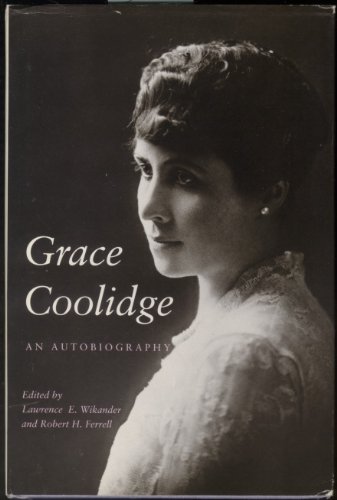
(Grace Coolidge: An Autobiography Hardcover - August, 1993...)
Grace Coolidge: An Autobiography Hardcover - August, 1993. An autobiography of the Former First Lady of the United States
http://www.amazon.com/gp/product/1881019012/?tag=2022091-20

(Perhaps no American president has seemed less suited to h...)
Perhaps no American president has seemed less suited to his office or his times than Calvin Coolidge. The taciturn New Englander became a vice presidential candidate by chance, then with the death of Warren G. Harding was thrust into the White House to preside dourly over the Roaring Twenties. Robert Ferrell, one of America's most distinguished historians, offers the first book-length account of the Coolidge presidency in thirty years, drawing on the recently opened papers of White House physician Joel T. Boone to provide a more personal appraisal of the thirtieth president than has previously been possible. Ferrell shows Coolidge to have been a hard-working, sensitive individual who was a canny politician and a clever judge of people. He reveals how after being dubbed the "odd little man from Vermont" by the press, Coolidge cultivated that image in order to win the 1924 election. Alas, Coolidge's long-suffering wife often had to serve as a safety valve for his temper. Ferrell's analysis of the Coolidge years shows how the President represented the essence of 1920s Republicanism. A believer in laissez-faire economics and the separation of powers, he was committed to small government, and he and his predecessors reduced the national debt by a third. More a manager than a leader, he coped successfully with the Teapot Dome scandal and crises in Mexico, Nicaragua, and China, but ignored an overheating economy. Ferrell makes a persuasive case for not blaming Coolidge for the failures of his party's foreign policy; he does maintain that the President should have warned Wall Street about the dangers of overspeculating but lacked sufficient knowledge of economics to do so. Drawing on the most recent literature on the Coolidge era, Ferrell has constructed a meticulous and highly readable account of the President's domestic and foreign policy. His book illuminates this pre-Depression administration for historians and reveals to general readers a President who was stern in temperament and dedicated to public service.
http://www.amazon.com/gp/product/0700608923/?tag=2022091-20

http://www.amazon.com/gp/product/B0028KQ7SY/?tag=2022091-20

http://www.amazon.com/gp/product/B0000CJZ1O/?tag=2022091-20

http://www.amazon.com/gp/product/B010EVPW84/?tag=2022091-20

http://www.amazon.com/gp/product/B010EVXRLS/?tag=2022091-20

(President Truman)
President Truman
http://www.amazon.com/gp/product/0670361968/?tag=2022091-20

(Beautiful leather collector's edition from the Presidents...)
Beautiful leather collector's edition from the Presidents Series.
http://www.amazon.com/gp/product/B001BOHW8M/?tag=2022091-20

http://www.amazon.com/gp/product/B001JA7JG8/?tag=2022091-20

http://www.amazon.com/gp/product/B010EVUQ4Y/?tag=2022091-20

( Available for the first time in paperback, The Strange ...)
Available for the first time in paperback, The Strange Deaths of President Harding challenges readers to reexamine Warren G. Harding's rightful place in American history. For nearly half a century, the twenty-ninth president of the United States has consistently finished last in polls ranking the presidents. After Harding's untimely death in 1923, a variety of attacks and unsubstantiated claims left the public with a tainted impression of him. In this meticulously researched scrutiny of the mystery surrounding Harding's death, Robert H. Ferrell, distinguished presidential historian, examines the claims against this unpopular president and uses new material to counter those accusations. At the time of Harding's death there was talk of his similarity, personally if not politically, to Abraham Lincoln. Secretary of State Charles Evans Hughes described Harding as one of nature's noblemen, truehearted and generous. But soon after Harding's death, his reputation began to spiral downward. Rumors circulated of the president's death by poison, either by his own hand or by that of his wife; allegations of an illegitimate daughter were made; and question were raised concerning the extent of Harding's knowledge of the Teapot Dome scandal and of irregularities in the Veterans' Bureau, as well as his tolerance of a corrupt attorney general who was an Ohio political fixer. Journalists and historians of the time added to his tarnished reputation by using sources that were easily available but not factually accurate. In The Strange Deaths of President Harding, Ferrell lays out the facts behind these allegations for the reader to ponder. Making the most of the recently opened papers of assistant White House physician Dr. Joel T. Boone, Ferrell shows that for years Harding suffered from high blood pressure, was under a great deal of stress, and overexerted himself; it was a heart attack that caused his death, not poison. There was no proof of an illegitimate child. And Harding did not know much about the scandals intensifying in the White House at the time of his death. In fact, these events were not as scandalous as they have since been made to seem. In this meticulously researched and eminently readable scrutiny of the mystery surrounding Harding's death, as well as the deathblows dealt his reputation by journalists, Ferrell asks for a reexamination of Harding's place in American history.
http://www.amazon.com/gp/product/0826212026/?tag=2022091-20

(Book by Ferrell, Robert H.)
Book by Ferrell, Robert H.
http://www.amazon.com/gp/product/0673393372/?tag=2022091-20

http://www.amazon.com/gp/product/B011MDZ6RA/?tag=2022091-20

http://www.amazon.com/gp/product/0393093093/?tag=2022091-20

(When Grace Anna Goodhue wed Calvin Coolidge in 1905, she ...)
When Grace Anna Goodhue wed Calvin Coolidge in 1905, she thought then that marriage "has seldom united two people of more vastly different temperaments and tastes." Warm and vivacious to her husband's dour and taciturn, Grace was to be a contrast to Calvin for years to come. But as Robert Ferrell shows, their marriage ensured her husband's rise to high office. Ferrell focuses on Grace Coolidge's years in the White House, 1923-1929. Although the president did his best to rein her in—even forbidding her to speak on public issues—Grace quickly became one of the most popular and stylish of first ladies. Among the best-dressed women of her time (famously in red), she became the nation's fashion leader. She also opened the White House to the public, sponsored musicales within its walls, and worked on behalf of the deaf and disabled—all despite a less than supportive spouse. Ferrell recounts how she accomplished all of this, finding strength through the years in her Burlington background, her family, and her faith. In this lively book Ferrell provides a perceptive and often moving account of Grace Coolidge. From his insightful portrait of her Vermont roots to a frank assessment of the Coolidges and their sons, he offers a fresh perspective on a much-admired woman who was perhaps her husband's greatest political asset. Ferrell also takes readers inside Grace's strained marriage to the famously taciturn president who kept his wife in the dark about his plans, both political and personal. He offers a much more subtle look at the Coolidges and their relationship in the public eye than we've had, shedding new light on how she managed to deal with his irascible temper-and how the marriage ultimately triumphed over difficulties that Calvin could not have handled alone. Alternately charming and analytic, Ferrell's narrative will leave readers with the real sense of Grace Coolidge as a human being and a contributor to the historical legacy of presidential wives. For she did more than simply enliven a quiet White House—she set the tone for a nation and for first ladies to come.
http://www.amazon.com/gp/product/0700615636/?tag=2022091-20

( As Franklin D. Roosevelt's health deteriorated in the m...)
As Franklin D. Roosevelt's health deteriorated in the months leading up to the Democratic National Convention of 1944, Democratic leaders confronted a dire situation. Given the inevitability of the president's death during a fourth term, the choice of a running mate for FDR was of profound importance. The Democrats needed a man they could trust. They needed Harry S. Truman. Robert Ferrell tells an engrossing tale of ruthless ambition, secret meetings, and party politics. Roosevelt emerges as a manipulative leader whose desire to retain power led to a blatant disregard for the loyalty of his subordinates and the aspirations of his vice presidential hopefuls. Startling in its conclusions, impeccable in its research, Choosing Truman is an engrossing, behind-the-scenes look at the making of the nation's thirty-third president.
http://www.amazon.com/gp/product/0826213081/?tag=2022091-20

( No portion of the political career of Harry S. Truman w...)
No portion of the political career of Harry S. Truman was more fraught with drama than his relationship with Thomas J. Pendergast. In one of their earliest meetings, the two men were momentarily at odds after Truman, who was then presiding judge of Jackson County, gave a $400,000 road contract to a construction company in South Dakota, and Pendergast, the boss of Kansas City, wasn't very happy about it. He had someone else in mind for the contract. Their association thus had its disagreements, but their common interest in politics was enough to establish a long-lasting relationship. In 1934, after considering fourteen other men, Pendergast sponsored Truman for the Senate. Although Truman had often cooperated with Pendergast on patronage issues, he had never involved himself in the illegalities that would eventually destroy the Pendergast machine. In fact, Truman had no idea how deeply the Boss had engaged in corruption in his personal affairs, as well as in managing the government of Kansas City. When the Boss was sent to Leavenworth for tax evasion in 1939, Truman was astonished. Despite Truman's honesty, his relationship with Pendergast almost caused his defeat during the Missouri senatorial primary in August 1940. The main challenger for Truman's Senate seat was the ambitious governor of Missouri, Lloyd C. Stark, who after destroying Truman's sponsor, the Pendergast machine, denounced Truman as "the Pendergast senator." Behind the governor was President Franklin D. Roosevelt, whom Stark turned against Truman. Roosevelt wanted Missouri's electoral votes in his forthcoming bid for a third term, and he believed that Stark could give them to him. Because of the stigma of Truman's Pendergast connection, the 1940 Democratic primary was the tightest election in his entire political career. He won by fewer than eight thousand votes. In Truman and Pendergast, Robert H. Ferrell masterfully presents Truman's struggle to keep his Senate seat without the aid of Pendergast and despite Stark's enlistment of Roosevelt against him. Ferrell shows that Truman won the election in his typical fashion—going directly to the people, speaking honestly and like one of them.
http://www.amazon.com/gp/product/0826212255/?tag=2022091-20

( Ever since the presidency of Richard M. Nixon, scholars...)
Ever since the presidency of Richard M. Nixon, scholars have been in a quandary over how much they really know about our country’s presidents. Nixon, as is now understood, was unstable in personality. The signs appeared well before the discovery of the infamous Watergate tapes, an appalling example of what the presidency could come to. Many Americans have difficulty penetrating the public persona of their leaders. But to know the private side of such figures—the cores of their being—is important, because this side often governs what they do publicly. In Presidential Leadership, Robert H. Ferrell examines four sometimes maligned, sometimes misunderstood presidents: Woodrow Wilson, Warren G. Harding, Calvin Coolidge, and Harry S. Truman. Along with these portraits, Ferrell incorporates comments on Hoover and Franklin Delano Roosevelt as well as key figures in each president’s administration. Also included in this volume is historian John A. Garraty’s interview with Ferrell on American foreign policy from 1919 to 1945. As is his style, Ferrell draws from many sources previously untapped. In the case of Wilson, Ferrell relies on the diary of Colonel Edward M. House, who served under Wilson during his presidency. Ferrell uses White House physician Joel T. Boone’s diary to provide an insider’s look at Harding, Coolidge, and Hoover. In dealing with these presidents, Ferrell debunks long-held myths and approaches the presidencies with fresh insights into what drove them to make the decisions they made. Throughout the book, Ferrell emphasizes the personal styles of each president. He not only shows how they made their own determinations but also evaluates those whom they appointed to important positions. Scholars of American history will welcome this insightful look at the men who saw the United States through the first half of the twentieth century.
http://www.amazon.com/gp/product/0826216234/?tag=2022091-20

(Book by Ferrell, Robert H.)
Book by Ferrell, Robert H.
http://www.amazon.com/gp/product/0962333344/?tag=2022091-20

( The Autobiography of Harry S. Truman is a compilatio...)
The Autobiography of Harry S. Truman is a compilation of autobiographical writings composed by Truman between 1934 and 1972. Taken directly from his own manuscript material, the volume presents the thoughts and feelings of the man himself. The book touches on details in Truman’s life from his days as a boy until graduation from Independence High School in 1901 to the vice presidency of the United States and beyond. There is also a memorandum written by Truman about the Pendergast machine in Kansas City telling how it was possible to work with the machine and not be soiled by it. The Autobiography concludes with some of the retired president’s thoughts about politics and the purposes of public life.
http://www.amazon.com/gp/product/087081091X/?tag=2022091-20

http://www.amazon.com/gp/product/B0140D33J2/?tag=2022091-20

http://www.amazon.com/gp/product/0208007490/?tag=2022091-20

http://www.amazon.com/gp/product/B011MDJMXE/?tag=2022091-20

http://www.amazon.com/gp/product/B011MDYMO8/?tag=2022091-20

http://www.amazon.com/gp/product/B011MEXATU/?tag=2022091-20

( Gathered for the first time, Truman's private papers--d...)
Gathered for the first time, Truman's private papers--diaries, letters, and memoranda--cover the period from his occupancy of the White House in 1945 to shortly before his death in 1972. Students and scholars will find valuable material on major events of the Truman years, from the Potsdam Conference to the Korean War.
http://www.amazon.com/gp/product/0060112816/?tag=2022091-20

( In Ill-Advised: Presidential Health and Public Trust, n...)
In Ill-Advised: Presidential Health and Public Trust, now available in paperback, noted historian Robert H. Ferrell presents powerful evidence of frightening medical scandals in the White House. Malpractice, missing public records, and politically motivated cover-ups have hidden sometimes severe presidential illnesses from the American people. Ferrell traces these often shocking incidents--from Grover Cleveland's secret surgery for cancer to the questionable reporting on the health of both Ronald Reagan and George Bush.
http://www.amazon.com/gp/product/0826208649/?tag=2022091-20

http://www.amazon.com/gp/product/B00IFFK7YQ/?tag=2022091-20

http://www.amazon.com/gp/product/B010EVZU0O/?tag=2022091-20

( During American participation in World War I, many even...)
During American participation in World War I, many events caught the public’s attention, but none so much as the plight of the Lost Battalion. Comprising some five hundred men of the Seventy-seventh Division, the so-called battalion was entrapped on the side of a ravine in the Argonne Forest by German forces from October 2 to 7, 1918. The men’s courage under siege in the midst of rifle, machine-gun, mortar, and artillery fire (coming both day and night), with nothing to eat after the morning of the first day save grass and roots, and with water dangerous to obtain, has gone down in American history as comparable in heroism to the defense of the Alamo and the stand at the Little Big Horn of the troops of General George A. Custer. Now, in Five Days in October, historian Robert H. Ferrell presents new material—previously unavailable—about what really happened during those days in the forest. Despite the description of them as a lost battalion, the men were neither lost nor a battalion. The name was coined by a New York newspaper editor who, upon learning that a sizable body of troops had been surrounded, thought up the notion of a Lost Battalion—it possessed a ring sure to catch the attention of readers. The trapped men actually belonged to companies from two battalions of the Seventy-seventh, and their exact placement was well known, reported by runners at the outset of the action and by six carrier pigeons released by their commander, Major Charles W. Whittlesey, during the five days his men were there. The causes of the entrapment were several, including command failures and tactical errors. The men had been sent ahead of the main division line without attention to flanks, and because of that failure, they were surrounded. Thus began a siege that took the lives of many men, leading to the collapse of the colonel of the 308th Infantry Regiment and, many believe, to the suicide of Major Whittlesey three years later. This book grew out of Ferrell’s discovery of new material in the U.S. Army Military History Institute at the Army War College from the papers of General Hugh A. Drum and in the National Archives in College Park, Maryland. The Drum papers contain the court-martial record of the lieutenant of a machine-gun unit attached to the battalions, who advised Major Whittlesey to surrender, while the Seventy-seventh Division files contain full accounts of the taut relations between the Lost Battalion’s brigade commander and the Seventy-seventh’s division commander. By including this material, Ferrell gives a new accounting of this intriguing affair. Five Days in October will be welcomed by all those interested in a fuller understanding of the story of the Lost Battalion.
http://www.amazon.com/gp/product/0826215947/?tag=2022091-20

( Few U.S. presidents have captured the imagination of t...)
Few U.S. presidents have captured the imagination of the American people as has Harry S. Truman, “the man from Missouri.” In this major new biography, Robert H. Ferrell, widely regarded as an authority on the thirty-third president, challenges the popular characterization of Truman as a man who rarely sought the offices he received, revealing instead a man who—with modesty, commitment to service, and basic honesty—moved with method and system toward the presidency. Truman was ambitious in the best sense of the word. His powerful commitment to service was accompanied by a remarkable shrewdness and an exceptional ability to judge people. He regarded himself as a consummate politician, a designation of which he was proud. While in Washington, he never succumbed to the “Potomac fever” that swelled the heads of so many officials in that city. A scrupulously honest man, Truman exhibited only one lapse when, at the beginning of 1941, he padded his Senate payroll by adding his wife and later his sister. From his early years on the family farm through his pivotal decision to use the atomic bomb in World War II, Truman’s life was filled with fascinating events. Ferrell’s exhaustive research offers new perspectives on many key episodes in Truman’s career, including his first Senate term and the circumstances surrounding the Truman Doctrine and the Marshall Plan. In addition, Ferrell taps many little-known sources to relate the intriguing story of the machinations by which Truman gained the vice presidential nomination in 1944, a position which put him a heartbeat away from the presidency. No other historian has ever demonstrated such command over the vast amounts of material that Robert Ferrell brings to bear on the unforgettable story of Truman’s life. Based upon years of research in the Truman Library and the study of many never-before-used primary sources, Harry S. Truman is destined to become the authoritative account of the nation’s favorite president.
http://www.amazon.com/gp/product/0826210503/?tag=2022091-20

http://www.amazon.com/gp/product/0826260500/?tag=2022091-20

http://www.amazon.com/gp/product/B00IH197I0/?tag=2022091-20
Ferrell, Robert Hugh was born on May 8, 1921 in Cleveland. Son of Ernest Henry and Edna Lulu (Rentsch) Ferrell.
Bachelor of Science in Education, Bowling Green State University, 1946. Bachelor, Bowling Green State University, 1947. Doctor of Laws (honorary), Bowling Green State University, 1971.
Master of Arts, Yale University, 1948. Doctor of Philosophy, Yale University, 1951.
Intelligence analyst, United States Air Force, 1951-1952; lecturer in history, Michigan State University, 1952-1953; assistant professor of history, Indiana U., 1953-1958; associate professor, Indiana U., 1958-1961; professor, Indiana U., 1961-1974; Distinguished professor, Indiana U., 1974-1988; emeritus, Indiana U., since 1988. Visiting professor Yale University, 1955-1956, American U. at Cairo, 1958-1959, U. Connecticut, 1964-1965, Catholic U. Louvain, Belgium, 1969-1970, Naval War College, 1974-1975, United States Military Academy, 1987-1988.
He received a B.S. in Education from Bowling Green State University in 1946 and a PhD from Yale University in 1951, where he worked under the direction of Samuel Flagg Bemis and his dissertation won the John Addison Porter Prize. He went on to win the 1952 Beer Prize for his first book, Peace In Their Time, a study of the making of the Kellogg-Briand Pact.
( Gathered for the first time, Truman's private papers--d...)
( The idea of revising what is known of the past constitu...)
(When Grace Anna Goodhue wed Calvin Coolidge in 1905, she ...)
( During American participation in World War I, many even...)
( Available for the first time in paperback, The Strange ...)
(During World War I, the Thirty-fifth Division was made up...)
( During World War I, the Thirty-fifth Division was made ...)
( In Ill-Advised: Presidential Health and Public Trust, n...)
(Perhaps no American president has seemed less suited to h...)
(Beautiful leather collector's edition from the Presidents...)
(This is a 360 page hardback book with dust jacket titled ...)
(Grace Coolidge: An Autobiography Hardcover - August, 1993...)
(This is a reproduction of a book published before 1923. T...)
( No portion of the political career of Harry S. Truman w...)
( In this authoritative account, Robert H. Ferrell shows ...)
( Ever since the presidency of Richard M. Nixon, scholars...)
( The Autobiography of Harry S. Truman is a compilatio...)
(Book by Ferrell, Robert H.)
(Book by Ferrell, Robert H.)
(Book by Ferrell, Robert H.)
(Will be shipped from US. Used books may not include compa...)
(President Truman)
( As Franklin D. Roosevelt's health deteriorated in the m...)
(by Robert H. Ferrell · Harper & Row · Hardback · 346 page...)
(Warren G. Harding, 29th president of the United States, h...)
( Few U.S. presidents have captured the imagination of t...)
Served with United States Army Air Force, 1942-1945. Member Society Historians, American Foreign Relations Organization American Historians, American History Association.
Married Lila Esther Sprout, September 8, 1956 (deceased January 2002). 1 daughter, Carolyn Irene.
