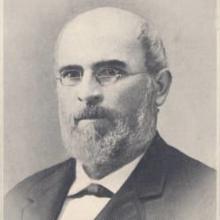
Speech of R. R. Bridgers, Esq., Of Edgecombe, on the Convention Question: Delivered in Committee of the Whole in the House of Commons of North-Carolina, January 14th, 1861
Robert Rufus Bridgers was an American congressman, manufacturer, and railroad president. He represented the state in the First Confederate Congress and the Second Confederate Congress from 1862 to 1865. He was also an ardent proponent of the standardization of time, serving as president of the Southern Railways Time Convention.
Background
Robert Rufus Bridgers was born on November 28, 1819, and was a son of John Bridgers and Elizabeth Kettlewells Routh. Robert belonged to a family, long resident in southside Virginia, which came to Edgecombe County, North Carolina, about 1761 and took up land on Town Creek.
Education
Failing to apply himself during early education under Elder Mark Bennett at Town Creek Academy, Robert was put to work on the farm at age thirteen. Two years later, having acquired an appreciation for education, he attended Stony Hill Academy in Nash County. He was graduated from the University of North Carolina in 1841 with distinction, delivering his commencement speech on the science of law.
After graduation from university, Robert Bridgers was immediately licensed to practice law and three years later was sent to the state House of Representatives. Then he settled down at Tarboro. At Tarboro, he had organized and developed a bank of North Carolina, of which he had become president in 1851. In 1852 he was purchasing large land-holdings out of which, with subsequent purchases, he made "Strabane," a plantation noted for high productivity. Simultaneously he was promoting a Tarboro branch of the Wilmington and Weldon Railroad with such success that the line was finished in 1860 and he became a president of Wilmington and Weldon in 1865.
Bridgers worked at the law very hard and in later life is said to have been offered the attorney-generalship. Though not "fervent for secession," he advocated a state convention in frank anticipation that secession would be necessary. In the Confederate Congress (1862-1865) he was regular in attendance, always a member of the committee on military affairs, and apparently disposed to support President Davis as far as his people's views would permit. His chief interest, however, had already begun to be business.
During the war, he revamped plants for the mining and manufacture of iron in Lincoln and adjacent counties (the "High Shoals property") which supplied the Carolinas with nails and plows and is said to have been the second-largest of its kind in the Confederacy.
Bridgers urged alike upon his railroad and the Confederate government policy of large production of cotton and its exportation to meet coming financial obligations abroad. Later the Confederate government is said to have wanted him as secretary of the treasury; in the fall of 1865 the Wilmington & Weldon company - which had resumed business in August with four locomotives and nine cars - elected him president.
For the next twenty-three years, Robert labored unremittingly on what was to be the Atlantic Coast Line Railroad. Each year he was unanimously re-elected president of the Wilmington and Weldon. For thirteen years he was also its general superintendent. For it, he built four branch lines, totaling nearly two hundred miles in length.
All of these lines were financed by a Baltimore firm to whom he had appealed in 1867 and for whom, as a condition of assistance, Robert had bought a controlling interest in Wilmington and Weldon, including the state's stock, during the Holden administration.
That he escaped the odium and suspicion which attended the transactions of this firm was perhaps due to his personal character as well as to the wisdom of his policies. Men noted that he had not taken advantage of the bankruptcy law when the failure of others overwhelmed him with debt at the time of the war. He knew intimately the lands which his roads served and their people individually.
Bridgers picked territory for branch roads with remarkable shrewdness and aided businesses all along his lines.
Achievements
Robert Rufus Bridgers is noted for managing his success not only in a field of politics, serving as a Representative from North Carolina in the Confederate Congress for three years, but also in business ventures as well. His first significant achievement was established in Tarboro where he organized and developed a bank and also became its president in 1851. One year later he purchased large land-holdings out of which he set up a highly productive plantation. However, his business interests spanned not only the world of finances and agriculture but also very promising at the time of railroad development. Simultaneously with other business projects he was promoting a Tarboro branch of the Wilmington & Weldon Railroad with such success that the line was finished in 1860 and he became a director of the Wilmington & Weldon. He also became president of the Columbia & Augusta, which continued his road from Wilmington. Robert Bridgers made his contribution to the field of education as well. He was greatly appreciated by his frequent donations to The University of North Carolina. Bridgers also served as a university trustee from Edgecombe County from 1858 to 1868 and from New Hanover County from 1879 to 1888. His other achievements include serving as a member of the Confederate Congress from 1862 to 1865, serving on the Military Affairs and Special Finances committees. He also operated the High Shoals iron furnaces, considered the second most important in the South for the production of nails and rolled material.
Margaret and Robert Bridgers were Episcopalians, and both were substantial contributors to Calvary Church in Tarboro and St. James Church in Wilmington.
Politics
Bridgers was a strong supporter of President Davis in the first Congress but turned against him in the second. He advocated financial policies based on sound business principles and urged that the Confederacy raise cotton and exchange it for gold on the world market. He served on the Currency, Military Affairs, and Conference Committees.
Personality
Robert Bridgers fostered enthusiasm among his men through his policy of promotion to vacancies; in turn, he rigidly insisted that they treat his patrons courteously. And since he declined better positions elsewhere, men deemed him "public-spirited."
Bridgers was also an ardent proponent of the standardization of time, serving as president of the Southern Railways Time Convention.
Interests
Bridgers also was extremely interested in agriculture and acquired extensive landholdings in Edgecombe and Halifax counties and in Florida.
Connections
On 11 December 1849, Bridgers married Margaret Elizabeth Johnston, daughter of Emily Norfleet and Henry Johnston of Tarboro. Their children were Emily, Robert R., Preston L., Mark, Luther, George J., Mary, and Frank W.