

Background
Gillespie, Ronald James was born on August 21, 1924 in London. Son of James Andrew and Miriam (Kirk) Gillespie. arrived in Canada, 1958.
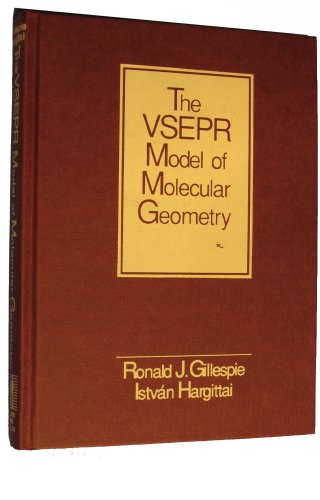
(Designed for use as a supplement for students in undergra...)
Designed for use as a supplement for students in undergraduate courses in inorganic chemistry, this text will also serve as a valuable reference for instructors of general and inorganic chemistry at the undergraduate and graduate levels. This book aims to provide a comprehensive account of the VSEPR model and its applications. The text features up-to-date treatment of the VSEPR model, and includes a comprehensive discussion of the geometry of molecules of elements from all parts of the periodic table including the transition metals. It also discusses the quantum mechanical basis for the VSEPR model.
http://www.amazon.com/gp/product/0205123694/?tag=2022091-20
( Valence Shell Electron Pair Repulsion (VSEPR) theory is...)
Valence Shell Electron Pair Repulsion (VSEPR) theory is a simple technique for predicting the geometry of atomic centers in small molecules and molecular ions. This authoritative reference was written by Istvan Hartiggai and the developer of VSEPR theory, Ronald J. Gillespie. In addition to its value as a text for courses in molecular geometry and chemistry, it constitutes a classic reference for professionals. Starting with coverage of the broader aspects of VSEPR, this volume narrows its focus to a succinct survey of the methods of structural determination. Additional topics include the applications of the VSEPR model and its theoretical basis. Helpful data on molecular geometries, bond lengths, and bond angles appear in tables and other graphics.
http://www.amazon.com/gp/product/048648615X/?tag=2022091-20
http://www.amazon.com/gp/product/B013PSWM22/?tag=2022091-20
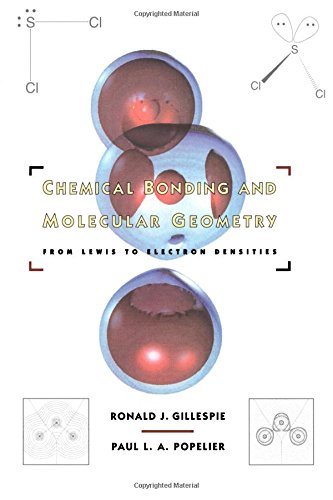
(Ideal for undergraduate and first-year graduate courses i...)
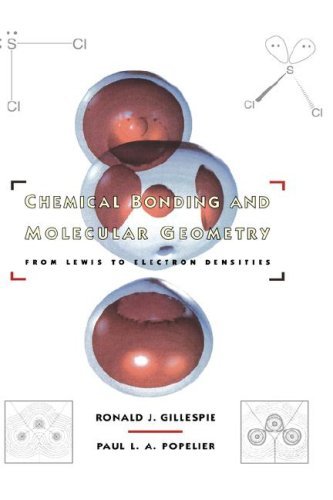
Ideal for undergraduate and first-year graduate courses in chemical bonding, Chemical Bonding and Molecular Geometry: From Lewis to Electron Densities can also be used in inorganic chemistry courses. Authored by Ronald Gillespie, a world-class chemist and expert on chemical bonding, and Paul Popelier of the University of Manchester Institute of Science and Technology, this text provides students with a comprehensive and detailed introduction to the principal models and theories of chemical bonding and geometry. It also serves as a useful resource and an up-to-date introduction to modern developments in the field for instructors teaching chemical bonding at any level. Features: * Shows students how the concept of the chemical bond has developed from its earliest days, through Lewis's brilliant concept of the electron pair bond and up to the present day * Presents a novel, non-traditional approach that emphasizes the importance of the Pauli principle as a basis for understanding bonding * Begins with the fundamental classical concepts and proceeds through orbital models to recent ideas based on the analysis of electron densities, which help to clarify and emphasize many of the limitations of earlier models * Provides a thorough and up-to-date treatment of the well-known valence-shell electron pair (VSEPR) model (which was first formulated and developed by author Ronald Gillespie) and the more recent ligand close-packing (LCP) model * Presents a unique pictorial and nonmathematical discussion of the analysis of electron density distributions using the atoms in molecules (AIM) theory * Emphasizes the relationships between these various models, giving examples of their uses, limitations, and comparative advantages and disadvantages
http://www.amazon.com/gp/product/019510496X/?tag=2022091-20
researcher writer chemistry educator
Gillespie, Ronald James was born on August 21, 1924 in London. Son of James Andrew and Miriam (Kirk) Gillespie. arrived in Canada, 1958.
Bachelor of Science, London U., 1945; Doctor of Philosophy, London U., 1949; Doctor of Science, London U., 1957; Doctor of Laws (honorary), Concordia U., Montreal, Canada, 1988; Doctor of Laws (honorary), Dalhousie U., Halifax, Canada, 1988; D Honoris causa, U. des Sciences et Techniques du Languedoc, 1991; Doctor of Science (honorary), McMaster U., 1993.
Assistant lecturer department chemistry, U. College, U. London, 1948-1950;
lecturer, U. College, U. London, 1950-1958;
associate professor department chemistry, McMaster U., Hamilton, Ontario, Canada, 1958-1960;
professor, McMaster U., Hamilton, Ontario, Canada, 1960-1987;
professor emeritus, McMaster U., Hamilton, Ontario, Canada, since 1987;
department chairman, McMaster U., Hamilton, Ontario, Canada, 1962-1965. Visiting professor U. Manchester (England), 1965-1966, U. des Sciences et Techniques du Languedoc, Montpellier, France, 1972-1973, U. Geneva, 1976, U. Göttingen, Federal Republic Germany, 1978, Australian National U., Canberra, 1979, U. Auckland, New Zealand, 1980, Panjab U., Chandigarh, India, 1983. Nyholm lecturer Chemical Society, London, 1978.
Gillespie lecturer U. College, London, 1990. Muetterties visiting scholar University of California, Berkeley, 1990.
(Designed for use as a supplement for students in undergra...)
(Ideal for undergraduate and first-year graduate courses i...)
( Valence Shell Electron Pair Repulsion (VSEPR) theory is...)
Fellow Royal Society London, Royal Society Canada (Henry Marshall Tory medal 1983), Royal Society Chemistry (Harrison Memorial medal 1953), Royal Institute Chemistry, Chemical Institute Canada (Noranda award 1966, Union Carbide award 1976, medal 1977). Member American Chemical Society (N.E. Region award 1971, Tour Speaker of Year award 1971, Distinguished Svc. award 1973, fluorine chemistry award 1981).
Married Madge Garner, July 5, 1950. Children: Ann, Lynn.
