Background
Nothing is known about his childhood and early life.

Nothing is known about his childhood and early life.
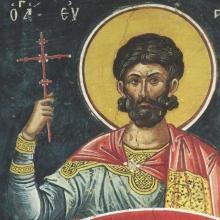
According to tradition, Eustace was born with the Roman name of Placidus and served as a general in the Roman army under the emperors Trajan and Hadrian. While hunting one day, he beheld a stag with a crucifix between its horns and heard a voice saying that he would suffer much for Christ's sake. He and his family became Christians. His faith was tested: his wealth was stolen; his servants died of a plague; when the family took a sea-voyage, the ship's captain kidnapped Eustace's wife; and as Eustace crossed a river with his two sons Agapius and Theopistus, the children were taken away by a wolf and a lion. Despite all of the calamanties, he didn't lose his faith. Then, he reunited with his family and restored to his former prestige. They were subsequently put to be roasted to death inside a bronze statue of a bull or an ox for refusing to sacrifice to the Roman gods in the AD 118. The Catholic Church rejects this story, reffering to it as "completely false".
Eustace is the patron saint of hunters and firefighters, and also of anyone facing adversity, and of the city of Madrid, Spain. His feast day is celebrated in the Western Church on September 20 and in the Eastern Church on November 2. The island of Sint Eustatius in the Caribbean Netherlands is named after him. The film Imagination and the novels "The Herb of Grace" (1948) by Elizabeth Goudge, and Riddley Walker (1980) by Russell Hoban incorporate the legend into their plot. Jägermeister, a German alcoholic digestif, features the saint's cross-and-stag symbol. In southern part of India, village Mittatharkulam, Tiruneveli district, Tamil Nadu, there is a church dedicated to him. Another church dedicated to him is in the campus of Newbridge College in Newbridge, County Kildare, Ireland. A nearby village is named Ballymore Eustace. A twelfth centure town church in Tocco da Casauria, Ptovince of Pescara, Abruzzo, Italy, was dedicated to Saint Eustace. It was partially destroyed by an earthquake in 1706 and rebuilt.
He was married to Theopista, they had two sons, Agapius and Theopistus.