

Background
Glasstone, Samuel was born on May 3, 1897 in London. Came to the United States 1939, naturalized 1944.

(1)
1
http://www.amazon.com/gp/product/0442027168/?tag=2022091-20

http://www.amazon.com/gp/product/B0000CMP3S/?tag=2022091-20

http://www.amazon.com/gp/product/B0027O50C0/?tag=2022091-20
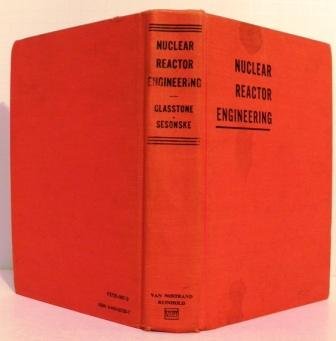
(This classic reference combines broad, yet in-depth cover...)
This classic reference combines broad, yet in-depth coverage of nuclear engineering principles with practical descriptions of their application in the design and operation of nuclear power plants. Published in a two-volume format to accommodate readers' specific interests, the first volume concentrates on the fundamentals of nuclear engineering, while the second explores applications and more advanced topics. In the second volume, Alexander Sesonske draws on his extensive experience in nuclear engineering to investigate state-of-the-art approaches to reactor systems, including computer analysis, assisting the reader in exploiting the potential of information technology in nuclear engineering. We explore energy transport and fuel management and their roles in cost-effective plant design and operation. Sesonske discusses the environmental, health, and safety concerns that are crucial to the continued success and expansion of nuclear power, illustrating risk analysis methods that facilitate reliable assessment and control of hazards. The book also details current and potential innovations in plant design, examining challenges likely to be faced by the nuclear power industry in meeting future energy demands. investigating topics such as reactor systems, cost-effective fuel management, environmental issues, and the design of future plants.
http://www.amazon.com/gp/product/0442027257/?tag=2022091-20

(Beginning with the earliest theories of the atom and its ...)
Beginning with the earliest theories of the atom and its structure, this book describes the growth of thought and knowledge in such fields as the theory of radioactivity, the concept of isotopes, the design of particle accelerators, and the use of nuclear reactors for research and for power. Clearly written, carefully organized, this edition provides the essential facts needed for constant reference in every plant, laboratory, school, or library today.
http://www.amazon.com/gp/product/0882758985/?tag=2022091-20

http://www.amazon.com/gp/product/B0046MJM52/?tag=2022091-20

http://www.amazon.com/gp/product/B001CZFDZO/?tag=2022091-20

(History Book)
History Book
http://www.amazon.com/gp/product/0882753266/?tag=2022091-20
http://www.amazon.com/gp/product/1489957537/?tag=2022091-20

http://www.amazon.com/gp/product/B002BFTBBG/?tag=2022091-20

(Dr. Samuel Glasstone, the senior author of the previous e...)
Dr. Samuel Glasstone, the senior author of the previous editions of this book, was anxious to live until his ninetieth birthday, but passed away in 1986, a few months short of this milestone. I am grateful for the many years of stimulation received during our association, and in preparing this edition have attempted to maintain his approach. Previous editions of this book were intended to serve as a text for students and a reference for practicing engineers. Emphasis was given to the broad perspective, particularly for topics important to reactor design and oper ation, with basic coverage provided in such supporting areas as neutronics, thermal-hydraulics, and materials. This, the Fourth Edition, was prepared with these same general objectives in mind. However, during the past three decades, the nuclear industry and university educational programs have matured considerably, presenting some challenges in meeting the objec tives of this book. Nuclear power reactors have become much more complex, with an ac companying growth in supporting technology. University programs now offer separate courses covering such basic topics as reactor physics, thermal hydraulics, and materials. Finally, the general availability of inexpensive xv xvi Preface powerful micro-and minicomputers has transformed design and analysis procedures so that sophisticated methods are now commonly used instead of earlier, more approximate approaches.
http://www.amazon.com/gp/product/0442200579/?tag=2022091-20

(Economic and regulatory pressures have yielded considerab...)
Economic and regulatory pressures have yielded considerable progress in the science and technology of nuclear reactor design. This practical reference in the field has been thoroughly revised and updated to include the latest engineering and operational developments and the likely course of future trends. All the basics of nuclear power technology are covered and this comprehensive volume also discusses important new design issues.
http://www.amazon.com/gp/product/0442009321/?tag=2022091-20

http://www.amazon.com/gp/product/B0000CKUFU/?tag=2022091-20

http://www.amazon.com/gp/product/B000S92LGY/?tag=2022091-20
(Dr. Samuel Glasstone, the senior author of the previous e...)
Dr. Samuel Glasstone, the senior author of the previous editions of this book, was anxious to live until his ninetieth birthday, but passed away in 1986, a few months short of this milestone. I am grateful for the many years of stimulation received during our association, and in preparing this edition have attempted to maintain his approach. Previous editions of this book were intended to serve as a text for students and a reference for practicing engineers. Emphasis was given to the broad perspective, particularly for topics important to reactor design and oper ation, with basic coverage provided in such supporting areas as neutronics, thermal-hydraulics, and materials. This, the Fourth Edition, was prepared with these same general objectives in mind. However, during the past three decades, the nuclear industry and university educational programs have matured considerably, presenting some challenges in meeting the objec tives of this book. Nuclear power reactors have become much more complex, with an ac companying growth in supporting technology. University programs now offer separate courses covering such basic topics as reactor physics, thermal hydraulics, and materials. Finally, the general availability of inexpensive xiii xiv Preface powerful micro- and minicomputers has transformed design and analysis procedures so that sophisticated methods are now commonly used instead of earlier, more approximate approaches.
http://www.amazon.com/gp/product/1461575273/?tag=2022091-20
(Dr. Samuel Glasstone, the senior author of the previous e...)
Dr. Samuel Glasstone, the senior author of the previous editions of this book, was anxious to live until his ninetieth birthday, but passed away in 1986, a few months short of this milestone. I am grateful for the many years of stimulation received during our association, and in preparing this edition have attempted to maintain his approach. Previous editions of this book were intended to serve as a text for students and a reference for practicing engineers. Emphasis was given to the broad perspective, particularly for topics important to reactor design and oper ation, with basic coverage provided in such supporting areas as neutronics, thermal-hydraulics, and materials. This, the Fourth Edition, was prepared with these same general objectives in mind. However, during the past three decades, the nuclear industry and university educational programs have matured considerably, presenting some challenges in meeting the objec tives of this book. Nuclear power reactors have become much more complex, with an ac companying growth in supporting technology. University programs now offer separate courses covering such basic topics as reactor physics, thermal hydraulics, and materials. Finally, the general availability of inexpensive xv xvi Preface powerful micro-and minicomputers has transformed design and analysis procedures so that sophisticated methods are now commonly used instead of earlier, more approximate approaches.
http://www.amazon.com/gp/product/1461358663/?tag=2022091-20

(Book by Glasstone, Samuel, Lovberg, Ralph Harvey)
Book by Glasstone, Samuel, Lovberg, Ralph Harvey
http://www.amazon.com/gp/product/125832055X/?tag=2022091-20

http://www.amazon.com/gp/product/1258328577/?tag=2022091-20
(This classic reference combines broad, yet in-depth cover...)
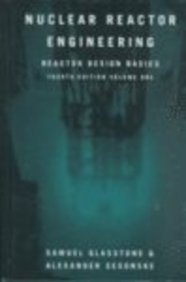
This classic reference combines broad, yet in-depth coverage of nuclear engineering principles with practical descriptions of their application in the design and operation of nuclear power plants. Published in a two-volume format to accommodate readers' specific interests, the first volume concentrates on the fundamentals of nuclear engineering, while the second explores applications and more advanced topics. Volume One introduces diverse aspects of nuclear engineering as a basis for applications and more advanced topics. Drawing on his extensive experience, Alexander Sesonske reviews the scientific underpinnings of nuclear power, including nuclear fission, radioactivity, and neutron diffusion theory, providing a solid foundation for more advanced understanding of nuclear power. This book demonstrates successful approaches to plant design and control, considering fuel depletion, reactor kinetics, and the effects of radiation on plant materials, enabling the reader to view each function in the broader context of the plant as a whole. Sesonske details vital aspects of radiation protection and shielding to allow integration of health and safety concerns into the design and control of the nuclear facility.
http://www.amazon.com/gp/product/0412985217/?tag=2022091-20

(1)
1
http://www.amazon.com/gp/product/B0000CK2AF/?tag=2022091-20

(The field of nuclear reactor engineering encompassing the...)
The field of nuclear reactor engineering encompassing the design, construction, and operation of reactors for the release of energy in a continuous and controlled manner by the fission of certain atomic nuclei. The main purpose of this book is to describe the fundamental scientific principles upon which reactor engineering is based. Actually, the principles are not very complicated and are, on the whole, well understood, but in their translation into practice there are encountered various problems of a somewhat novel character due to the peculiar nature of the fission process and its associated radiations. Reactor engineering is largely concerned with the solution of these problems, involving a cooperative effort in which chemical, electrical, electronic, mechanical, and other engineers must work with chemists, mathematicians, metallurgists, physicists, and even biologists. It is in order to facilitate such cooperation that this book covers a wide range of topics. The book treats the subject of nuclear reactor engineering in breadth rather than in depth. Nearly every chapter is to be regarded as an introduction to a particular aspect of reactor design.
http://www.amazon.com/gp/product/B0007DOXYY/?tag=2022091-20
Glasstone, Samuel was born on May 3, 1897 in London. Came to the United States 1939, naturalized 1944.
Bachelor of Science, University London, 1916. Master of Science, University London, 1920. Doctor of Philosophy, University London, 1922.
Doctor of Science, University London, 1926.
Lecturer in physical chemistry, U. London, 1919-1921; lecturer in physical chemistry, University College of S.W. (England), 1921-1928; lecturer in physical chemistry, U. Sheffield (England), 1929-1939; research associate, Princeton (New Jersey) U., 1939-1941; science editor, Princeton University Press, 1941-1942; professor of chemistry, U. Oklahoma, 1942-1943; professor of chemistry, Boston College, 1947-1948; consultant, Atomic Energy Commission, 1948-1992. Consultant Armed Forces Special Weapons Project, 1950-1951, Los Alamos (New Mexico)Science Laboratory, 1952-1992.
(Beginning with the earliest theories of the atom and its ...)
(The field of nuclear reactor engineering encompassing the...)
(This classic reference combines broad, yet in-depth cover...)
(This classic reference combines broad, yet in-depth cover...)
(Many of the earliest books, particularly those dating bac...)
(Many of the earliest books, particularly those dating bac...)
(Many of the earliest books, particularly those dating bac...)
(Economic and regulatory pressures have yielded considerab...)
(Book by Glasstone, Samuel, Lovberg, Ralph Harvey)
(Large-sized hardcover issued with dustjacket. Illustrated...)
(History Book)
(Dr. Samuel Glasstone, the senior author of the previous e...)
(Dr. Samuel Glasstone, the senior author of the previous e...)
(Dr. Samuel Glasstone, the senior author of the previous e...)
(Dr. Samuel Glasstone, the senior author of the previous e...)
(1)
(1)
Member Chemical Society London, Sigma Xi. M C.
Married Violette F. Collingwood, July, 1929.
