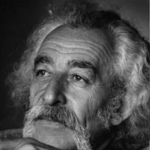
Background
Arakelyan was born in Jauk, Russian Empire (now Armenia), on December 17, 1884.


Moscow, Russian Federation
The Surikov Art Institute in Moscow.
Moscow, Russian Federation
The Surikov Art Institute in Moscow.
Sedrak Arakelyan's memorial plate.


Arakelyan was born in Jauk, Russian Empire (now Armenia), on December 17, 1884.
Sedrak Arakelian studied art attending the Caucasian Society for the Promotion of Fine Arts in Tiflis under the guidance of Egish Tadevosyan, an Armenian painter and member of the Peredvizhniki and Mir Iskusstva movements. He graduated from the Moscow School of Painting, Sculpture, and Architecture (now The Surikov Art Institute in Moscow) in 1916, where he had studied under S. V. Ivanov, K. A. Korovin, and A. E. Arkhipov.
Initially, Arakelyan worked for the Hasker magazine and the Maccall newspaper during 1905-1908. Arakelyan's works were exhibited for the first time by the Association of Traveling Art Exhibitions. Then the association organized many other exhibits with his paintings.
In 1920 Sedrak Arakelyan returned to Armenia and plunged into the cultural life of the country. Here he was engaged in oeuvre as well as social activities. He founded the Society of Fine Arts Workers, which became the first association of artists in Soviet Armenia. Five years later this society joined the Armenian branch of the Association of Artists of Revolutionary Russia. Concurrently with his public work, Arakelyan also was an educator. He taught at the Yerevan Art and Industrial Technical School.
The painter's art was greatly influenced by Yeghishe Tadevosyan, a Russian realistic painter. Arakelyan's artworks were characterized by the colorful reflection of native nature and rural life. The themes of his paintings were diverse, but mostly he preferred to create landscapes.

Sedrak Arakelyan was an outstanding and highly respected artist. Arakelyan became an Honored Artist of the Armenian Soviet Socialist Republic in 1935.
Arakelyan participated in numerous exhibitions not only in Armenia but also in exhibitions in Venice (1924), New York (1929), Stockholm (1930) and Paris (1934).
In 2015 Armenia's National Gallery hosted an exhibit of the artist's artworks, which included paintings and graphic works from different creative periods, as well as etudes and sketches. Today his works can be found in major galleries and museums, including the Art Gallery of Armenia (Yerevan), the Tretyakov Gallery and others.
Landscape
Sevan in the morning
Sevan
Spring (Spring Garden)
Seated old woman
View from the Sevan island
Autumn. Yerevan
Village Yard
Drying Wheat
Baking Bread
Near the Mill
Spring in Yerevan
Near the Spring
Lake Sevan
Carvansara. Ijevanat in Old Yerevan
Night scene
Rural yard
In the village
Sevan Fishermen
Source (sketch)
Culture in the mountains (option)
Kali in the village
The pilgrims' boat in Sevan
Painter G. Sharbabchian on the shore of Lake Sevan
Excavator work on the wagon
The portrait of Hripsime Sargsyan
Odessas
Sevan
Woman's portrait
Martuni Villagers on Lake Sevan
Yerevan yard
Sedrak Arakelyan fathered Arakel Arakelyan, who was also an Armenian painter.