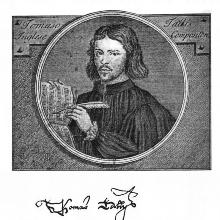
Background
He was born circa 1505.


(''To go from the medieval world of Ave, Dei patris to the...)
''To go from the medieval world of Ave, Dei patris to the stark directness of If ye love me, to the soaring phrases of Gaude gloriosa, to the compact intensity of the Lamentations and O sacrum convivium, to the incredible sonorities of Spem in alium is to travel as far as one man can ever have taken his listeners.'' - Peter Phillips
http://www.amazon.com/gp/product/B00026W65E/?tag=2022091-20

(Chants anglicans / The Tallis Scholars dir. Peter Phillips)
Chants anglicans / The Tallis Scholars dir. Peter Phillips
http://www.amazon.com/gp/product/B00005ATCV/?tag=2022091-20
He was born circa 1505.
Little is known either about Tallis's childhood and his musical reputation at that age.
Little is known about Tallis's early life, but there seems to be agreement that he was born in the early 16th century, toward the close of the reign of Henry VII. The name "Tallis" is derived from the French word "taillis, " which means a "thicket. "
From his Benedictine cloister (his first known musical appointment) he moved first to St. Mary-at-Hill in Billingsgate about 1537 and then to the Augustinian Abbey of the Holy Cross at Waltham, where he served until its dissolution in 1540.
Under the adverse circumstances which ensued, Tallis next joined the musical establishment at Canterbury, leaving 2 years later to become a gentleman of the Chapel Royal.
He stayed in that position for the rest of his life.
For nearly a half century he composed, played, sang, and taught music at the English court.
The few extant secular pieces actually do not compose a separate class, since most of these are somehow related to sacred compositions.
He was appointed by King Henry VIII to the Chapel Royal, where he served as organist under four sovereigns.
In 1575, Elizabeth I granted Tallis and his pupil and partner, William Byrd, a special license for the exclusive printing of music books and paper.
Tallis' music falls into three categories: Latin choral works, English choral works, and instrumental pieces.
Nearly half of Tallis' motets were published with works by William Byrd in their joint volume Cantiones Sacrae (1575).
The English choral works consist of two services, separate settings of Te Deum and Benedictus, the choral responses, the litany, 17 anthems, 10 settings of the proper Psalms for Evensong at Christmastide, and nine harmonized tunes for Archbishop Matthew Parker's metrical psalter of 1567.
Three of the anthems, including the well-known "If ye love me, " date from the last years of the reign of Henry VIII; the Dorian Service and Benedictus date from the brief reign of Edward VI; and the Te Deum and litany date from the early years of Elizabeth I's reign, as do the Christmastide Psalms, which follow the calendar of the second Prayer Book (1552).
The metrical psalter is also the source of the tune used by the modern English composer Ralph Vaughan Williams in his well-known Fantasia on a Theme by Thomas Tallis for string orchestra.
Eight pieces for the virginal are known from other sources. In his own lifetime, "Master Tallys" was esteemed as the dean of his profession.
At his passing, William Byrd wrote in a madrigal, "Tallis is dead, & Music dies. "
Four secular songs by Tallis are known, one of which shares the music of a Latin motet. Tallis' instrumental music contains some of the finest examples of early English organ music.
Tallis is regarded as one of the finest of 16th-century composers.
He is considered the father of English cathedral music.
(''To go from the medieval world of Ave, Dei patris to the...)
(Chants anglicans / The Tallis Scholars dir. Peter Phillips)